

Old notices
These pages collect together notices posted on the IUCr web site in past years. They are retained for archival interest, but there is no guarantee (or likelihood) that many of the web links found in these notices will still be active.
Remembering Dorothy Mary Crowfoot Hodgkin
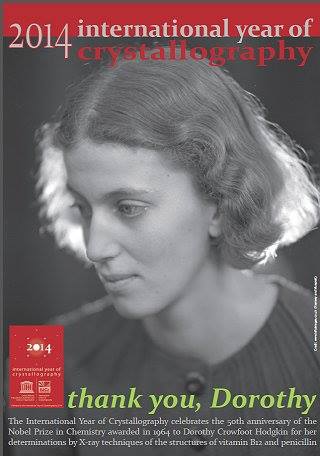 Dorothy Mary Crowfoot Hodgkin was born in Cairo on 12 May 1910 and educated at the Sir John Leman School, Beccles, and Somerville College, Oxford, UK where she read chemistry 1928-1932. Here Dorothy spent the majority of her career where she combined teaching chemistry at Somerville (one of her students included the future Prime Minister Margaret Thatcher) with research at the highest level. She became University lecturer and demonstrator in 1946, University Reader in X-ray crystallography in 1956 and from 1960 to official retirement in 1977 Wolfson Research Professor of the Royal Society. In 1937 she married Thomas Lionel Hodgkin with whom she had three children.
Alongside a successful research career where she was awarded the Nobel Prize in Chemistry in 1964 for her determinations by X-ray techniques of the structures of important biochemical substances, Dorothy held the position of President of the International Union of Crystallography, 1972-1975.
The International Union of Crystallography (IUCr) was fundamental at this time for the advancement of crystallography in all its aspects. The Union continues to champion research in the crystallographic arena providing a platform for communities to collaborate, share information and improve the understanding of structure properties in materials. The IUCr is coordinating the International Year of Crystallography 2014 (IYCr2014) and amongst many of its activities and objectives in spreading the importance of crystallography globally, IYCr2014 also pays tribute to many of the leading scientists in the field such as William and Lawrence Bragg, Max von Laue, Paul Peter Ewald and of course Dorothy Mary Crowfoot Hodgkin.
Dorothy is most well known for her work on penicillin, where early in the Second World War, working alongside Howard Florey at the University of Oxford, Dorothy and her team in three years successfully determined the chemical structure of penicillin using X-ray techniques, showing conclusively that the formula included beta-lactam and thiazolidine rings. She later went on to elucidate the structure of cephalosporin C, an antibiotic closely related to penicillin.
After 1948 she began work on the X-ray analysis of the anti-pernicious anaemia factor vitamin B12; after nearly 10 years work, Dorothy and her team were successful in finding the structure. Following this work, Dorothy and her colleagues turned their attention back to further elucidation of the structure of insulin – she had taken the first X-ray images of insulin crystals in 1935 and was able to present the 3D structure of rhombohedral 2Zn insulin in 1969. Research on insulin refinements continued into the 1980s.
Dorothy's IUCr published papers can be found here.
Additional information on Dorothy's life and numerous achievements can be found here.