




Meeting report
Training on Symmetry and Group Theory
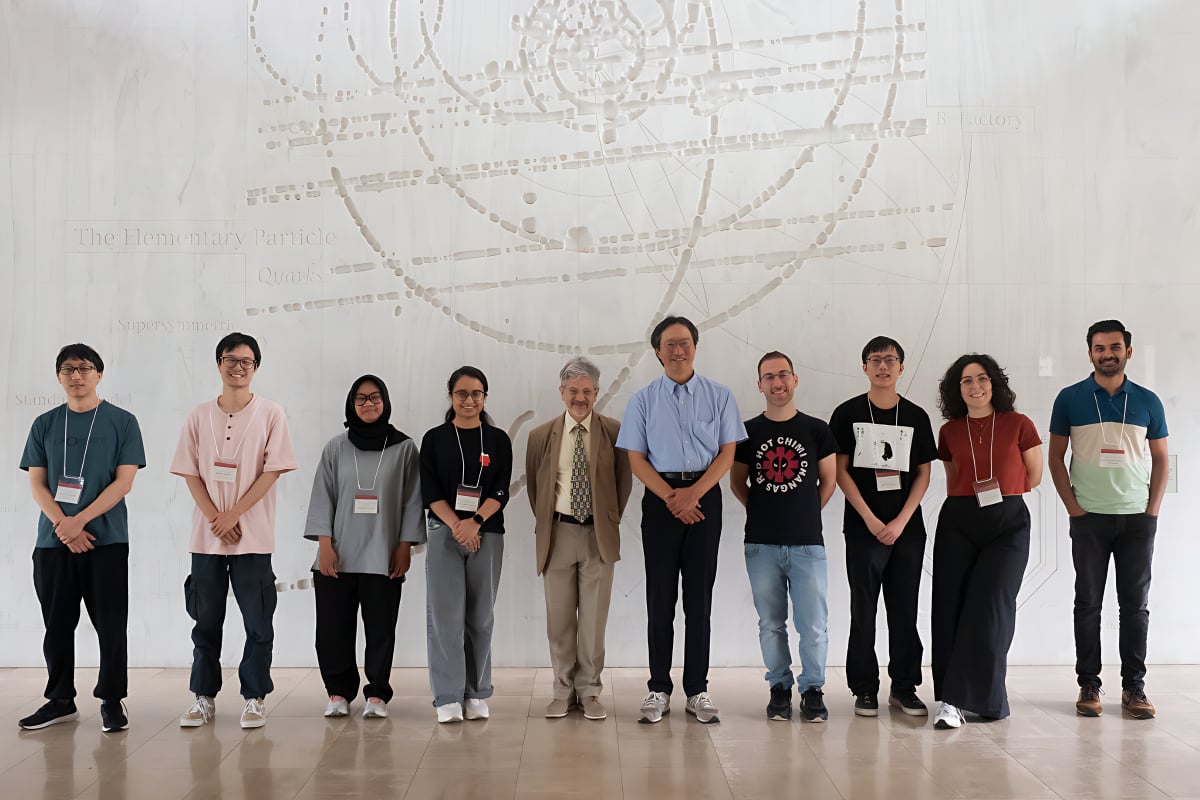
I recently attended the 13th basic training course in symmetry and group theory. I am a synthetic inorganic chemist by training, and single-crystal X-ray crystallography is one of our final analytical techniques in our experiments. Though I have basic training in traditional crystallography, chemists often teach crystallography without mathematics. It was hard for me to understand mathematical concepts qualitatively. I was looking for a course on mathematical crystallography. At this point, I learned about IUCr – MathCryst and subsequently attended Prof. Massimo Nespolo’s lecture in Tsukuba, Japan.
Prof. Massimo’s lecture was a basic course in symmetry and group theory in crystallography. Before attending his course, I was introduced to the textbook ‘Ulrich Müller's - Symmetry Relationships between Crystal Structures’’. It was difficult for me to follow the book because of its abstract mathematics. The basic course in Japan further enlightened me about group theory and its applications as presented in the textbook. The pictorial representation of the concepts of group theory presented in the lecture was much more useful for understanding the underlying mathematics.
The introduction of group theory, followed by the derivation of point groups and space groups in two dimensions, was presented at the beginning of the lecture. This information helped me in understanding how space groups and point groups in crystallography are derived from scratch. Later, seven crystal systems and fourteen types of Bravais lattice were presented, starting from their respective two-dimensional lattice symmetry. The symmetry directions in each crystal system are of paramount importance for space-group assignments. I realized that the space group symbols indeed indicate the directions that belong to their respective crystal systems. In short, the lectures about ‘fundamental crystal patterns and crystal structures’ throw light on the basic concept of symmetry in crystallography.
A brief practical workshop was conducted during the lecture. The handouts describing lattice points were given, and we were asked to find a suitable unit cell and different possible unit cells in a two-dimensional lattice. Each student's questions about the exercise were addressed promptly. This exercise gave us a deeper understanding of how diffraction patterns are indexed experimentally.
Under the topic ‘Introduction to crystallographic calculations’, vector algebra and matrix concepts were introduced. The exercise on changing the basis and coordinates is important in realizing the idea behind choosing the different crystal systems while reducing the data. Simple mathematical concepts, like how to find a distance between two points and the angle between two vectors, explain to us the computations behind finding bond lengths and angles in a crystal structure.
Matrix representation of all symmetry operations in crystallography was presented with appropriate examples. Conversion of symmetry operations into matrix form and identifying symmetry operations from the corresponding matrix is much easier than the traditional way of computing symmetry operations in three-dimensional Euclidean geometry.
In the ‘space-group setting’ lecture, how symmetry operations in matrix form are represented for different space groups, and what happens if we choose different space group settings, were discussed. Wyckoff’s positions, crystallographic orbits, and other details presented in the International Tables of Crystallography were explained in the lecture.
As a case in point, reflection conditions and the deduction of the space group from reflection data, based on a symmetry point of view, were priceless. Traditional crystallographers still use Friedel’s law to interpret space-group details. But Prof. Massimo disagreed with Friedel’s concept, and he explained it with an example. The presenter also stressed the importance of using various crystallographic terms at appropriate places. ‘And the availability of misleading textbooks in the field one should be really aware of,’ Prof Massimo adds.
In brief, the lecture helped me to understand the fundamental concepts of crystallography in detail. For chemists, this lecture will be very useful in clearing their long-standing doubts in the field. For those who are dealing with crystallography daily, this lecture is immaculate.
Copyright © - Prior permission is not required to reproduce short quotations, tables and figures from this article, provided the original authors and source are cited.
The permanent URL for this article is https://www.iucr.org/news/newsletter/volume-34/number-3/training-on-symmetry-and-group-theory