



Editorial
June 2026
At last, summer is upon us. Over here in Europe, we were recently “treated” to an incredible heat wave (canicule in French), breaking all records for the month of May. But now we return to the usual UK weather: cold, windy, and drizzly. So far, June is not looking much better, but there are ominous warnings for a very hot July. Ho, hum!
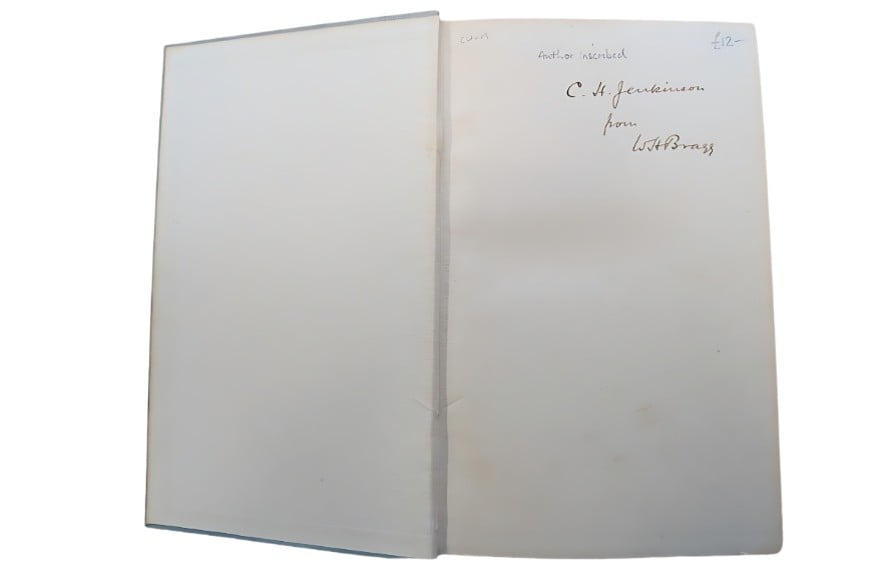 As some of you may be aware, I am always interested in the history of our subject. Recently, a colleague found in a second-hand bookshop in Oxford the book entitled The Universe of Light (1933) by Sir William Henry Bragg (WHB). WHB evidently gave this book to C.H. Jenkinson, who was WHB’s personal workshop technician, responsible for building the first ionisation spectrometer circa 1912, the forerunner of the modern X-ray diffractometer. The book was originally priced at four shillings and sixpence (about 23 UK new pence at the time).
One of my sad duties for the Newsletter is to report obituaries. In this issue, three colleagues of mine, Wolfram Saenger, Sax Mason and Svend Erik Rasmussen. I recall first meeting Wolfram many years ago at a summer school in Poland. He was an engaging (then young) man, very interesting to talk to. He had a fascinating party trick in which he demonstrated that he could write simultaneously with both hands, each the mirror image of the other. I think this is called Bimanual mirror writing, and is relatively rare and sometimes researched by neurologists.
Sax Mason was a scientist whom those of us who have ever carried out research at the Institut Laue-Langevin (ILL) came across. I recall meeting him the first time I measured powder patterns at the ILL, as Sax was always there to guide us. I am sorry to hear of his loss.
I recall that at IUCr Congresses I always met with Svend Rasmussen, who was then General Secretary of the IUCr (the General Secretary of the International Union of Crystallography (IUCr) was the Union’s chief administrative and operational officer, responsible for keeping the organisation running smoothly between General Assemblies). He was always a delight to talk to: friendly, quiet, and we shared many similar views. His passing is one of personal deep sadness as I came to know him as a personal friend. One thing I learnt from the obituary is that in the 1950s, he spent time in the Chemistry Department at Queens College, Dundee, Scotland. I too was there, but much later (1962-1965) to study for my undergraduate degree in Chemistry. At that time, Queens College was one of the Colleges of the University of St Andrews, but later it became independent as the University of Dundee.
Turning to more pleasant matters, since the beginning of the 20th century, crystallographers have always been pioneers in the collection and publishing of data. For a long time, crystallography was just about the only discipline that produced large datasets, especially diffraction intensity data. When computers became available, many of the algorithms we use today as routine were developed with crystallographic data in mind. For instance, the earliest systematic use of computer based least squares refinement occurred in X ray crystallography, starting around the 1940s, when researchers began using electronic computers to refine atomic positions and thermal parameters from diffraction data. This predates its widespread use in physics, geodesy, astronomy, and statistics by several years. It may be said that the crystallographer’s love affair with data began as far back as 1913, when W.H. and W.L. Bragg published their measurements and interpretations as a matter of routine. So, in this issue you can read an article discussing the importance of data.
One of the most important things that any crystallographer needs to learn about is the mathematics of symmetry. Yes, I know that these days you can solve structures with an automatic diffractometer without the need to know much about symmetry, but to me, that is not real science. I guess, at my age, I am old-fashioned (grumpy old man syndrome?). Anyway, one of the mainstays of our use of crystallographic symmetry is found in the series of books known as the International Tables of Crystallography. In particular, any crystallographer worth his/her salt should know about the so-called 230 space group types, and this is what the Tables give us. The first full published compilation was in 1935 and was written in German. Since then, the Tables have undergone some evolution, first in 1952, when they were recompiled by Norman Henry and Kathleen Lonsdale. Then later on, the Tables were revisited by members of the International Commission on Tables, and much new material was added, especially with tighter definitions of terms used in our subject. The result has been an amazing compilation of definitions and explanations of crystallographic terminology, though sometimes hard to read, it is nonetheless thorough. Oh, I remember many times attending meetings and sometimes seeing heated discussions among colleagues voicing their own ideas, often at odds with the majority opinion. One of the contentious matters then was the vexed question of whether there were 6 or 7 crystal systems, a problem arising from the presence of 3- and 6-fold symmetries (6-fold symmetry also contains 3-fold symmetry). In the end, the Commission settled on 7 in order to be consistent with most earlier usage. Anyway, what has resulted is what I sometimes say is the greatest book ever written! But then I am prejudiced, of course. Now, one of the odd leftovers is the question of the order in which the space group types are listed and numbered. This has been revisited in a recent publication written by Mois Aroyo and Carol Brock, which you can read about here.
We also have the second article by Zbigniew Dauter and Mariusz Jaskólski, dealing with the packing of spheres in cubic space groups. Packing of spheres is one of those subjects that we crystallographers are familiar with, since, to a reasonable approximation, we can usually treat atoms in a crystal structure as akin to spheres.
Another article that you may find interesting is on the development of Cryo-EM in Portugal by Célia V. Romão and Pedro M. Matias. Cryo EM is electron microscopy performed on flash frozen samples, allowing researchers to see proteins, viruses, and other macromolecules in a state very close to their natural environment, and was the subject of the Nobel Prize in Chemistry in 2017, awarded to Jacques Dubochet, Joachim Frank and Richard Henderson. The equipment for this is expensive, and it is a great achievement of the Portuguese researchers to be able to obtain the funding for such an important research tool. Strictly, this is not crystallography.
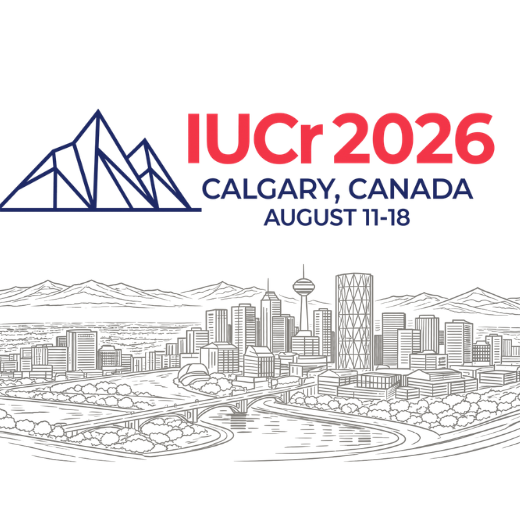
Finally, let me add that in August of this year, crystallographers will be gathering together to attend the IUCr Congress of Crystallography, to be held in Calgary, Canada. So if you have not yet signed up for this, do not lose the opportunity to be able to meet with fellow crystallographers and learn about the latest in our amazing science!
Copyright © - Prior permission is not required to reproduce short quotations, tables and figures from this article, provided the original authors and source are cited.
The permanent URL for this article is https://www.iucr.org/news/newsletter/volume-34/number-3/june-2026