


Feature article
A More Rational Order for the 230 Space Groups
This project began in 2023 with two simple questions:
Why is space group C2221 (#20) before space group C222 (#21) in Vol. A of International Tables for Crystallography (2016)?
Why are the Pnm, n = 4 and 6 space groups ordered differently in that volume? (i.e., P41, P42, P43 vs. P61, P65, P62, P64, P63)
The resulting paper has now appeared in the Teaching Section of the Journal of Applied Crystallography (Aroyo & Brock, 2026). That paper outlines the history of the ordering of the space groups (with hyperlinks for some of the original books), lists the very great number of inconsistencies in the way the groups are currently ordered, and proposes an alternative order.
That longish paper is accompanied by an even longer Supplementary Commentary providing more complete explanations of some points, along with many things we found interesting but not central. These extra items include Sohncke’s drawing (Sohncke, 1879) of his space group #13, which is not a group (Fig. 1), and a comparison of the orderings of Schoenflies (1891) and Fedorov (1891).
The short answer to the questions above is that the order within the geometric crystal classes (commonly referred to as the point-group classes) is that of Schoenflies (1891). Perhaps he was satisfied with the very major accomplishment of having found, by himself and then later in collaboration with Fedorov, the complete set of crystallographic space groups, and then wanted to move on to other projects rather than developing rules for ordering the groups. There are fewer inconsistencies in Fedorov’s (1891) ordering, but it was not adopted, possibly because his notation is difficult and possibly because German was more widely understood than Russian. In 1919 Paul Niggli proposed a more logical order (Niggli, 1919), but noted that it was too late for a change. We agree, partly because any revised order would change the number of space group #14 (P21/c, etc.), which is deeply embedded in many crystallographers’ minds. Space-group numbers are, however, just attributes, and there could be two sets in the electronic versions of Vols. A (2016) and A1 (2011) of the series International Tables for Crystallography.
The order of the space groups depends on the order of the crystal systems, the order of the geometric crystal classes, and the rules (or lack thereof) for determining the order within those classes. Committees of the IUCr have argued for decades about the identities of the seven (or six) crystal systems and their order; the choices made seem final. The order of the geometric crystal classes (Fig. 2) has not changed since 1952 (International Tables for Crystallography, 1952) and has not been questioned recently. The problem then is with the ordering of the groups within the geometric crystal classes. It seems strange that there are so many inconsistencies in a tabulation published by a scientific community that cares so much about order.
The key rules for sorting within a geometric crystal class follow; for details see Aroyo & Brock, 2026.
-
Groups are sorted first by arithmetic crystal class, which is the point group followed by the centering type in the order P > C > A > F > I and P > R, where > means before.
While this order is generally followed in Vol. A, there are exceptions (Fig. 3), and the 432P, 432F, and 432I groups are interspersed. This rule necessarily changes the number of space group #14. -
Within each arithmetic crystal class the symmorphic group is first. [A symmorphic group has no screw axis or glide plane in its full Hermann-Mauguin (hereafter, HM) symbol.]
This rule reverses the order of C2221 and C222. -
The remaining groups in the arithmetic crystal class are sorted by the extent to which they differ from the symmorphic group, i.e., by the number of screw axes and glide planes that appear in the full HM symbol. Following Niggli’s (1919) lead, all groups having a screw axis in the full HM symbol follow all groups having none.
-
For sets of groups that differ only by the value m of a screw axis nm, members of a pair of enantiomorphic groups are adjacent. Groups that have rotation axes coincident with the screw axes precede groups that do not.
The orders of the Pnm groups are then P42, P41, P43 for n = 4 and P63, P62, P64, P61, P65 for n = 6. -
Groups having glide planes in the full HM symbol are sorted according to the existing priority order e > a > b > c > n.
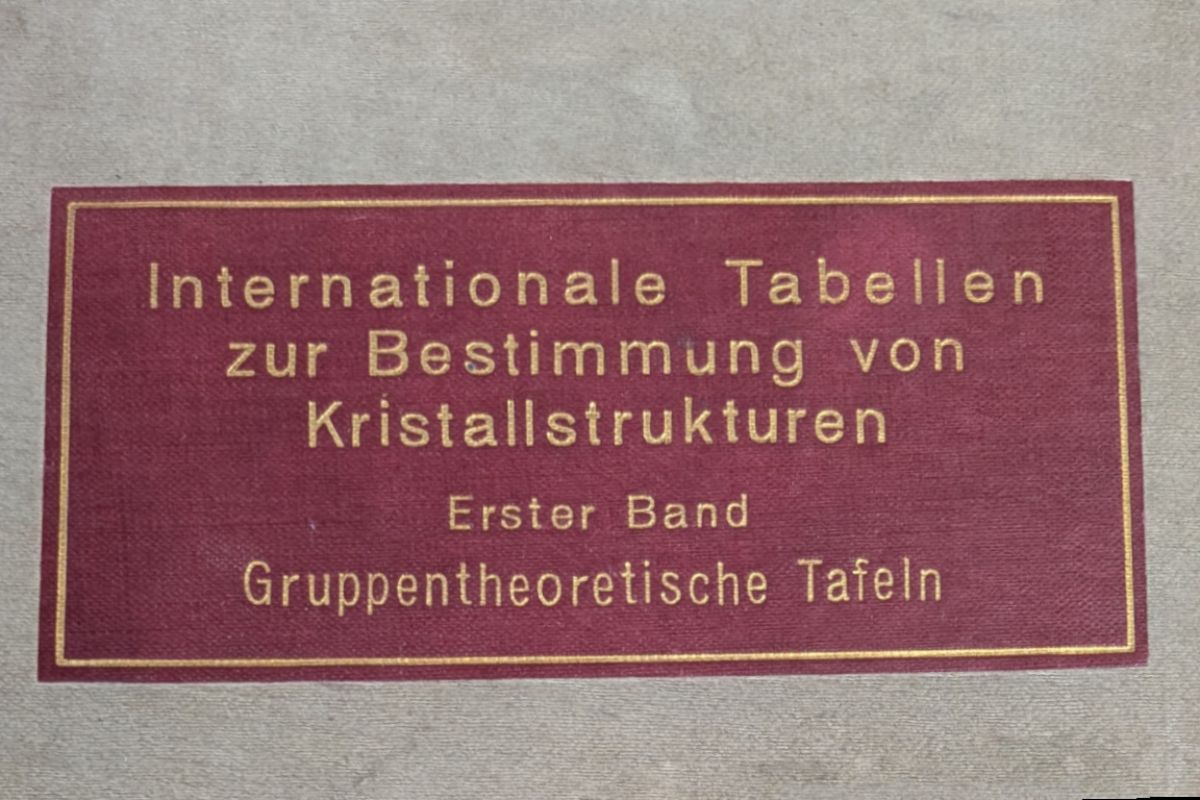
The choices of axes for the space groups were established in 1935 (Internationale Tabellen zur Bestimmung von Kristallstrukturen, 1935). Those choices have not changed since except for the addition of the c-unique setting of the monoclinic groups. The logic behind the choices of the standard settings of the orthorhombic groups is unclear. The group Pna21, for example, could have been chosen as any one of six possibilities (Pbn21, Pn21a, P21cn, etc.; see Table 1.5.4.4 of the 2016 edition of Vol. A). Choosing a different setting as standard for a group would alter the proposed space-group ordering and might have some advantages, but trying to change the standard setting of any space group now seems unwise if not foolhardy.
An advantage of the proposed ordering is that it makes the relationships of the space groups more obvious. Students may wonder how Schoenflies, Fedorov, and Sohncke developed their lists of space groups. The answer is that they started with low-symmetry groups and then worked out where to add a symmetry element so that the addition of the corresponding symmetry operation(s) gives a new mathematical group. Schoenflies outlined the steps in his 1891 book. The proposed new sequence of space groups makes that process more obvious by putting the sets of space-group generators in a more rational order. The generators are a set of symmetry operations that can be combined to generate all the other symmetry operations of the space group.
We hope that this proposal will stimulate discussion and will be useful in teaching, and that the alternative ordering can be added as an option to Vols. A and A1.
Mois Aroyo1 and Carol Brock21 Departamento de Fisica, Universidad del Pais Vasco Facultad de Ciencias, Apartado 644, Bilbao, Vizcaya, 48080, Spain
2 Department of Chemistry, University of Kentucky, 505 Rose St, Lexington, KY, 40506-0055, USA
References
Aroyo, M. I. & Brock, C. P. (2026). A more rational order for the 230 space groups. Journal of Applied Crystallography, 59, 932–942.
Hermann, C. (ed.) (1935). Internationale Tabellen zur Bestimmung von Kristallstrukturen. I. Band: Gruppentheoretische Tafeln. Berlin: Borntraeger.
Henry, N. F. M. & Lonsdale, K. (eds.) (1952). International Tables for X-ray Crystallography, Volume I: Symmetry Groups, 1st ed. Birmingham: Kynoch Press.
Aroyo, M. I. (ed.) (2016). International Tables for Crystallography, Volume A: Space-group Symmetry, 6th ed. Chichester: Wiley.
Wondratschek, H. & Müller, U. (eds.) (2011). International Tables for Crystallography, Volume A1: Symmetry Relations Between Space Groups, 2nd online ed.
Niggli, P. (1919). Geometrische Kristallographie des Diskontinuums. Leipzig: Borntraeger.
Schoenflies, A. (1891). Krystallsysteme und Krystallstruktur. Leipzig: Teubner.
Sohncke, L. (1879). Entwicklung einer Theorie der Kristallstruktur. Leipzig: Teubner.
Figures
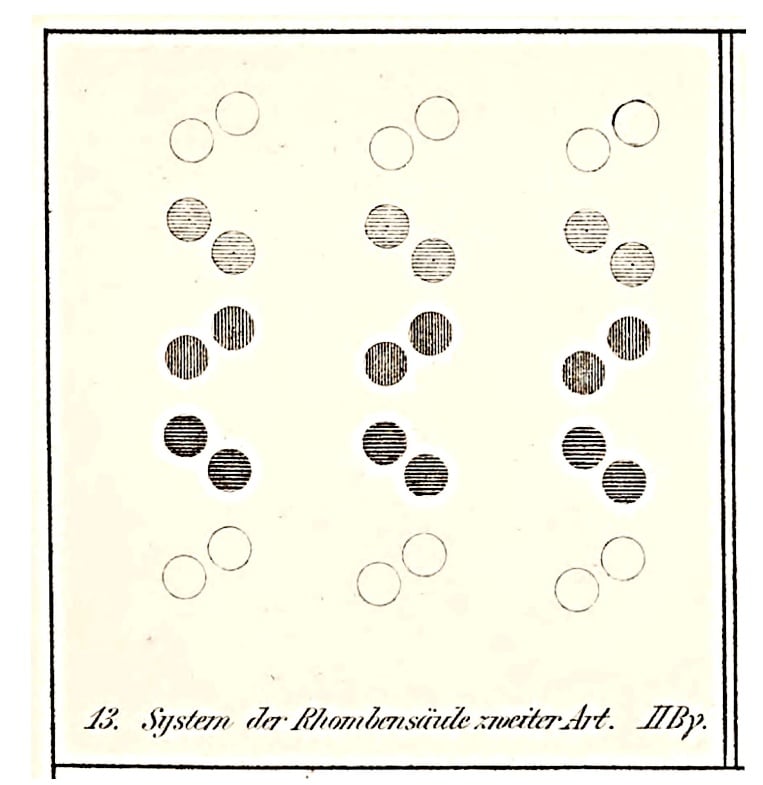
Fig. 1 Sohncke’s (1879) drawing of space group #13 of his 66 that include only chirality-preserving operations. (The correct number of such groups is 65.) Shading of the symmetry-related circles indicates height above the plane of the drawing. Sohncke’s group #13 is not a group because the obvious twofold rotations that relate adjacent circles in his drawing having the same shading do not relate the pairs having different shading that are immediately above and below where there seems to be a twofold axis. Those pairs are related instead by a 21 screw rotation.
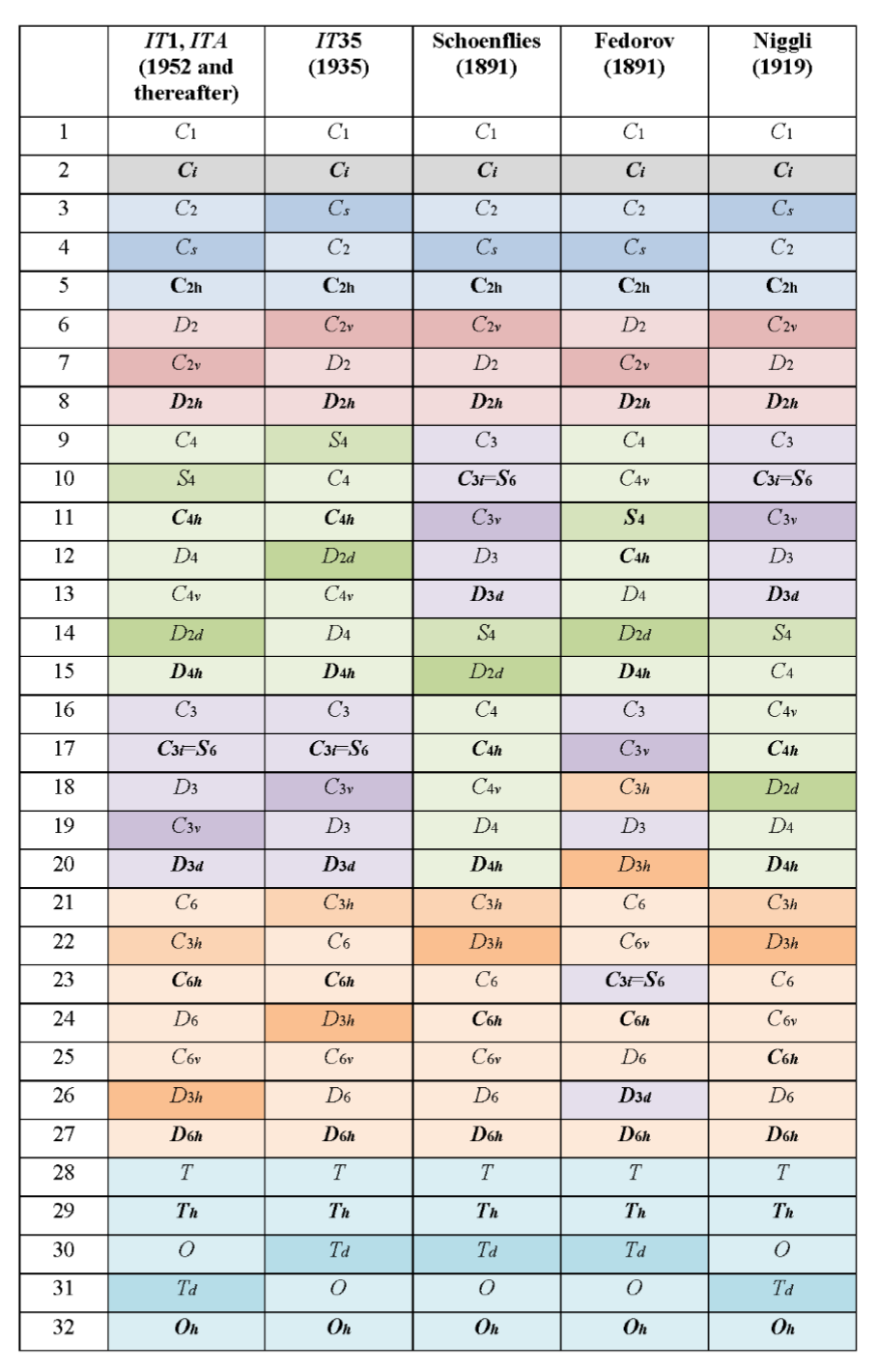
Fig. 2 The ordering of the geometric crystal classes (i.e., the point-group classes) in different compilations of the space groups. The background color of the cell indicates the crystal system; the symbols of the centrosymmetric groups are in boldface. For some groups the color shade is darker to highlight their different placement.
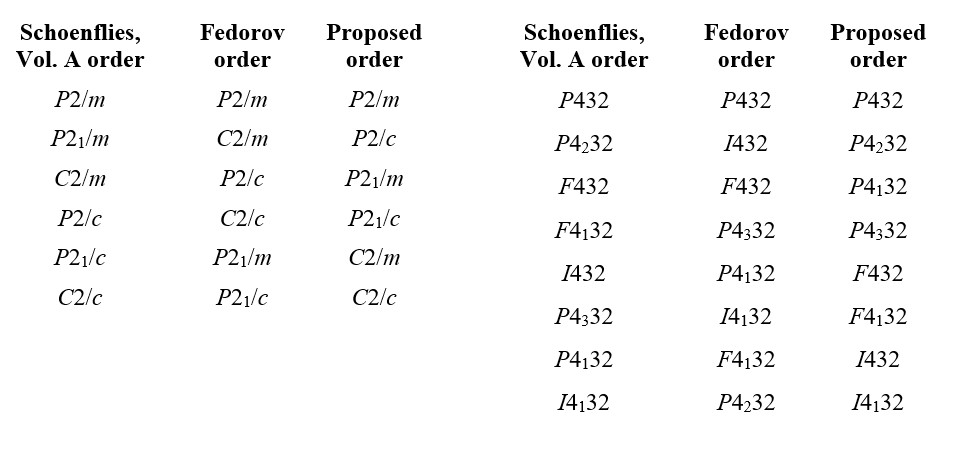
Fig. 3 The orders of the 2/m (#10-15) and 432 (#207-214) space groups in the listings of Schoenflies and Fedorov, and as proposed. The symbols shown are those used in Vol. A rather than those that appear in the original lists.
Copyright © - Prior permission is not required to reproduce short quotations, tables and figures from this article, provided the original authors and source are cited.