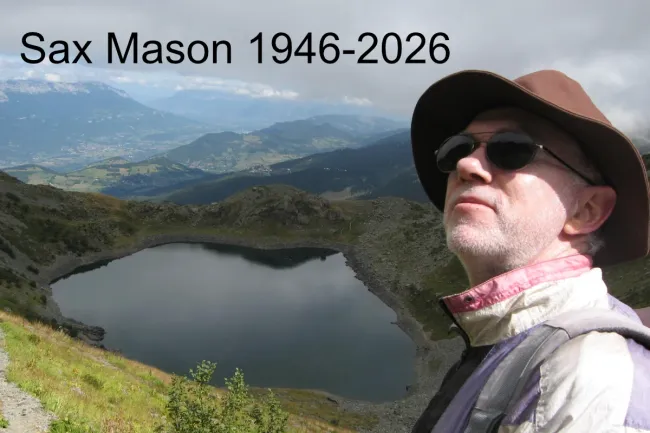
Alan Hewat (Grenoble) and Judith AK Howard (Durham)
Sax Mason, an Australian neutron crystallographer at the ILL Grenoble, died on Thursday, 16th April, from a heart attack, having accomplished his dream to use neutrons for the “Structure and dynamics of the active site of hen egg-white lysozyme from atomic resolution neutron crystallography” (Ramos et al., 2025).
After completing his doctorate at Melbourne University (Queen's College) with Bernard Hoskins, and working with the New Zealander Frank Moore at AINSE Sydney, he spent three years with Dorothy Hodgkin in Oxford. Frank himself had completed his D.Phil on the neutron structure of vitamin B12 under Dorothy, and Sax continued this work on neutron structures of insulin and lysozyme in Terry Willis' laboratory at Harwell. Such experiments in the early 70's were extremely difficult, given the low neutron intensity relative to X-rays and the absence of large-area detectors.
When the UK joined the Common Market in 1973, and the European high-flux reactor in Grenoble, Sax became, in June 1973, one of the first "British" scientists at ILL. The reactor flux was ten times greater, and ILL had begun developing 2D position-sensitive detectors (PSDs), both promising huge advantages for the structures of large molecules. ILL Director Rudolf Mössbauer and Harwell's Michael Lomer assigned Sax to D8, a conventional diffractometer with high intensity constructed by students Alain Filhol and Michel Thomas. ILL's nascent PSD technology was to be used to multiply data-collection efficiency for large molecules, transforming D8 to D19.
From 1976, John Archer and John Allibon supported D8-D19 and other single-crystal diffractometers, and then all other diffractometers, replacing the centralised instrument control system with individual DEC-type computers, as at ANSTO-AINSE in 1968. Later, D19 was the first Ethernet machine at the ILL, with a MicroVAX 3500 for data acquisition and a VAX 750 for data processing, before moving to SGI workstations and then to powerful PCs running UNIX. Sax's D19 thus led ILL instrument control. John Archer was the mechanical genius, installing larger detectors, focusing monochromators, and designing sample environments.
To achieve Sax's dream, Jean Jacobé, Dominique Feltin and A. Rambaud started with small 2D multiwire detectors, until Anton Oed from CERN invented much larger "Microstrip" detectors. Unfortunately, there were many practical problems with the fine-printed circuit electrodes oxidising from out-gassing in the 3He chamber. A similar detector was also needed for the D20 high flux powder diffractometer being built by Pierre Convert and Thomas Hansen, and at one point, the Science Director Alan Leadbetter had to decide to continue or abandon both. Fortunately, he decided to persevere, and both D19 and D20 finally succeeded. It was a long struggle, finally solved by Bruno Guérard, the new head of the detector group.
While waiting for his PSD detector, Sax promoted D19 and neutron crystallography to a worldwide community - in particular, one of us (JAKH), who was also Dorothy Hodgkin's student, Trevor Forsyth (Keele, later Lund), Garry McIntyre (ILL, later ANSTO, Sydney), Alberto Albinati (Milan), Matthew Blakely (ILL) and many others. Sax was known for his "disponibilité", always willing to help others and often taking no credit for himself. One of the four most cited ILL papers is from D19, without Sax as an author (Nishiyama et al., 2002). Sax chaired the IUCr Commission on Neutron Diffraction from 1987 to 1996, with the 1993 Neutron Scattering Satellite Meeting (NSS-93) in Beidaihe, China.
Sax loved the mountains and entertained visiting scientists and locals by leading hiking and cross-country skiing adventures. The environment was an important part of ILL’s attraction, and Sax promoted that advantage.
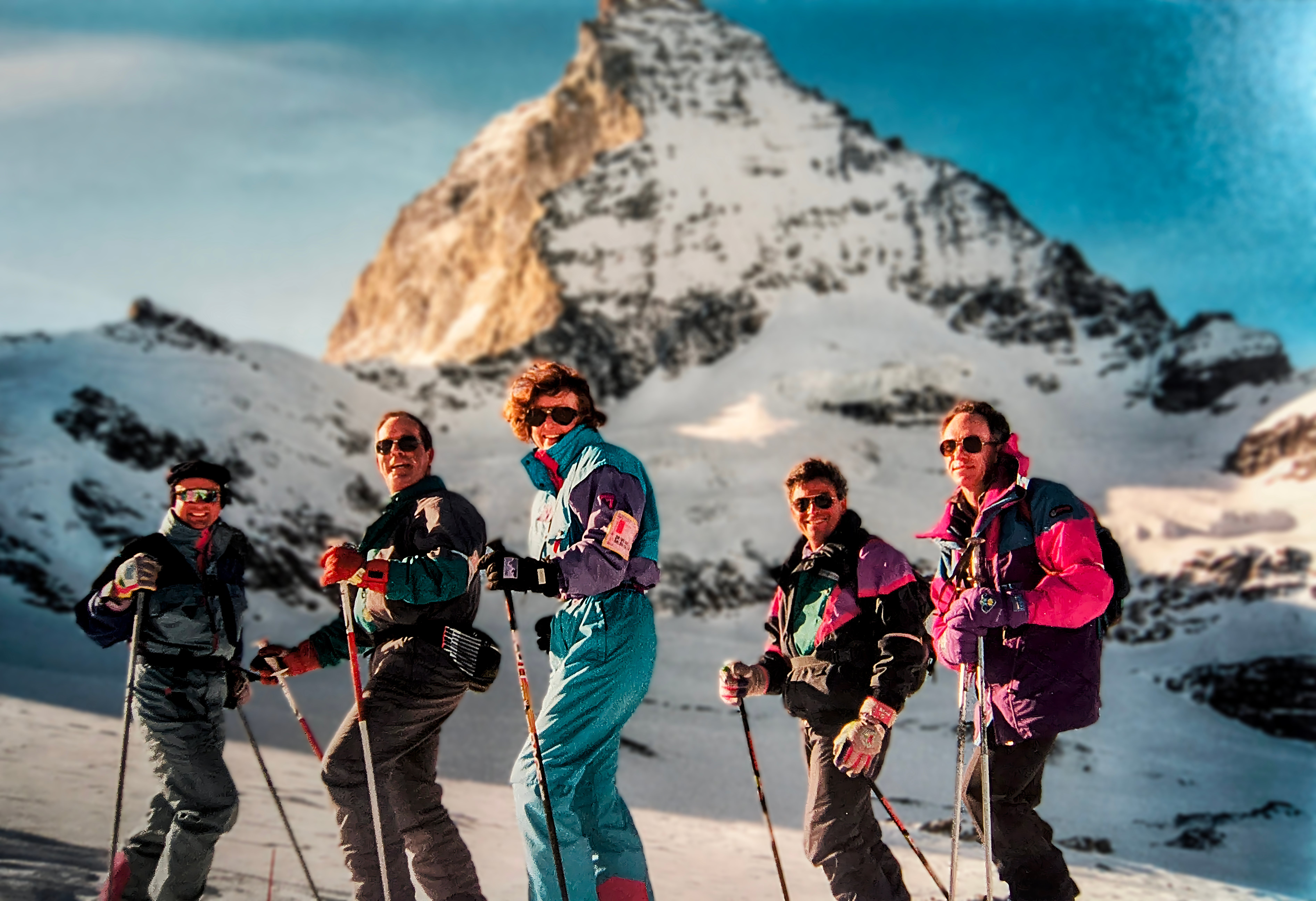
NN, José Dianoux, Liz Hewat, Raoul Mathieu and Sax Mason in front of the Matterhorn.
One of us (AH) knew Sax from when we shared rooms in Queen's College in the 1960's - he started University at the precocious age of 15 when everyone else was 18. We both spent three years in Oxford, married to Ros and Liz, respectively, before moving to ILL in 1973 to work in the same group. Our wives were also working while each raising three children; Ros became head of the user programme at ESRF, while Liz pioneered cryo-EM for virus structures (and HREM for HiTc superconductivity).
Sax came from a tiny town (Nyah West) in Victoria, and was named after Sax Rohmer, the English novelist, and spent his childhood summer vacations harvesting in the scorching Australian sun. As a result, 50+ years later, he developed aggressive skin cancer that eventually progressed to his brain. The fortitude and optimism that he displayed while waiting for D19, were repeated in his deadly struggle with cancer, over several years and multiple operations that cost him an eye and part of his brain. Amazingly, he was "cured" but at great physical cost. For most of that time, he continued actively in science, as witnessed by his last paper in 2025. He contributed greatly to the success of the ILL programme in neutron crystallography.
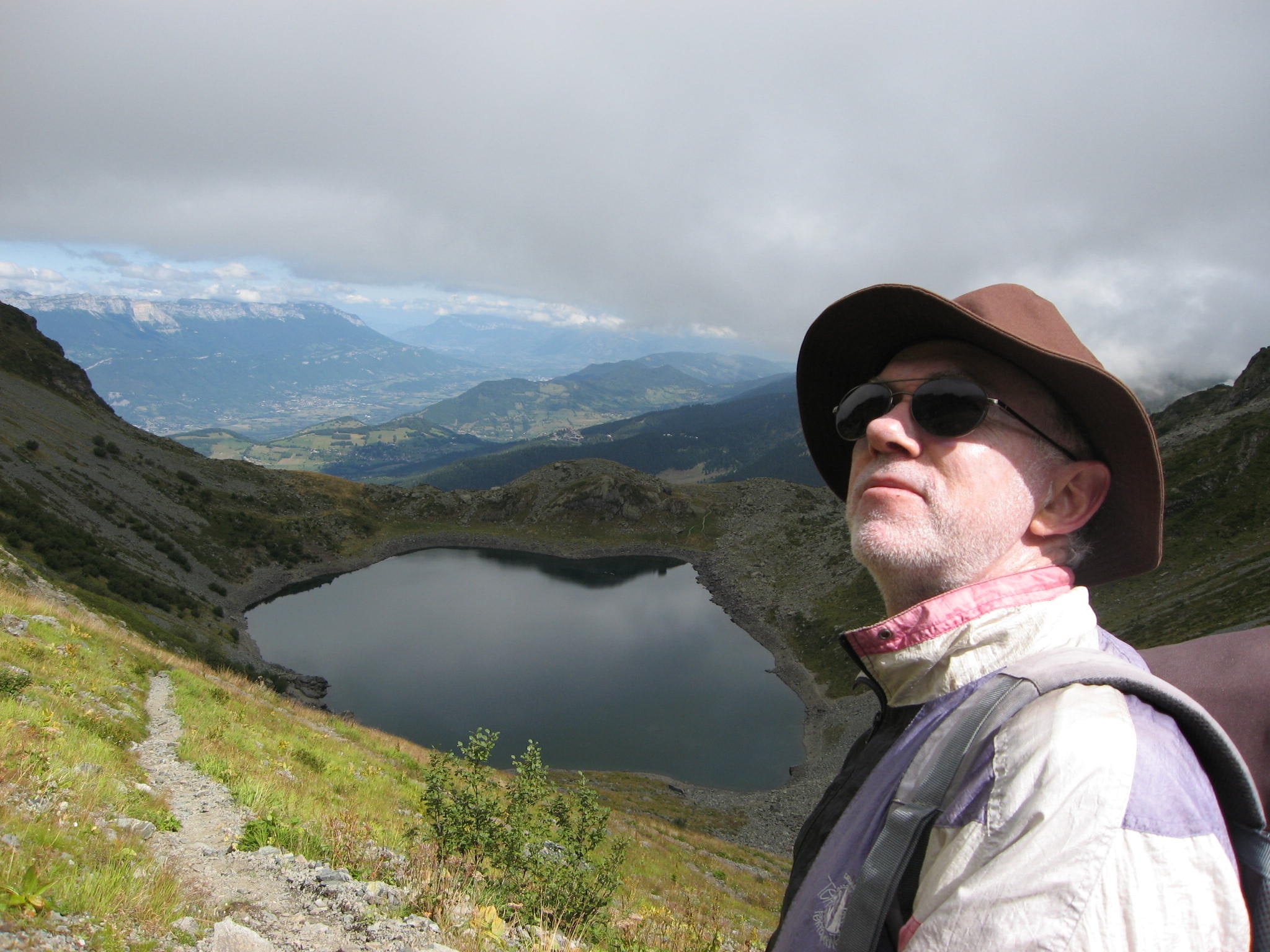
Sax dreaming of mountains unclimbed (Photo John Swale).
References
Nishiyama, Y., Langan, H. & Chanzy, H. (2002). J. Am. Chem. Soc. 124, 9074–9082.
13 May 2026
Copyright © - Prior permission is not required to reproduce short quotations, tables and figures from this article, provided the original authors and source are cited.
The permanent URL for this article is https://www.iucr.org/news/newsletter/volume-34/number-3/sax-mason-1946-2026