




Meeting report (IUCr supported)
Quantum Crystallography in Focus: Highlights from Sagamore XX-2024
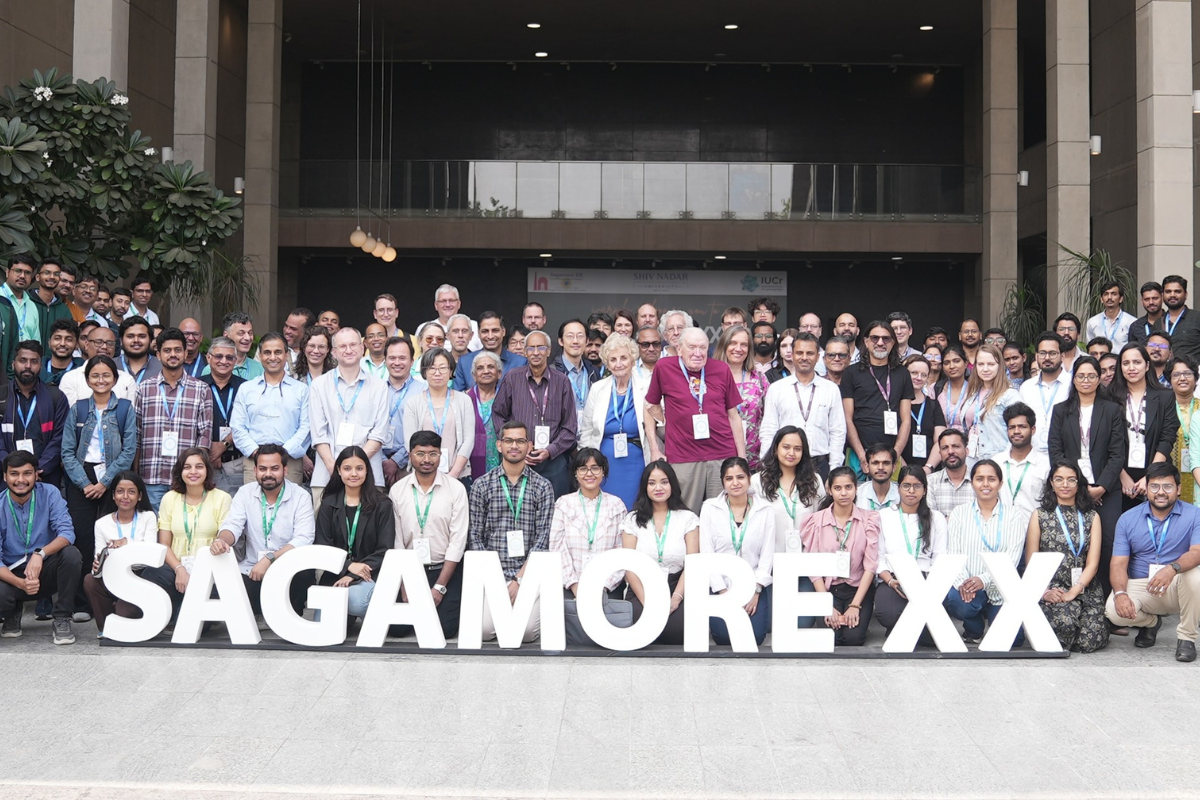
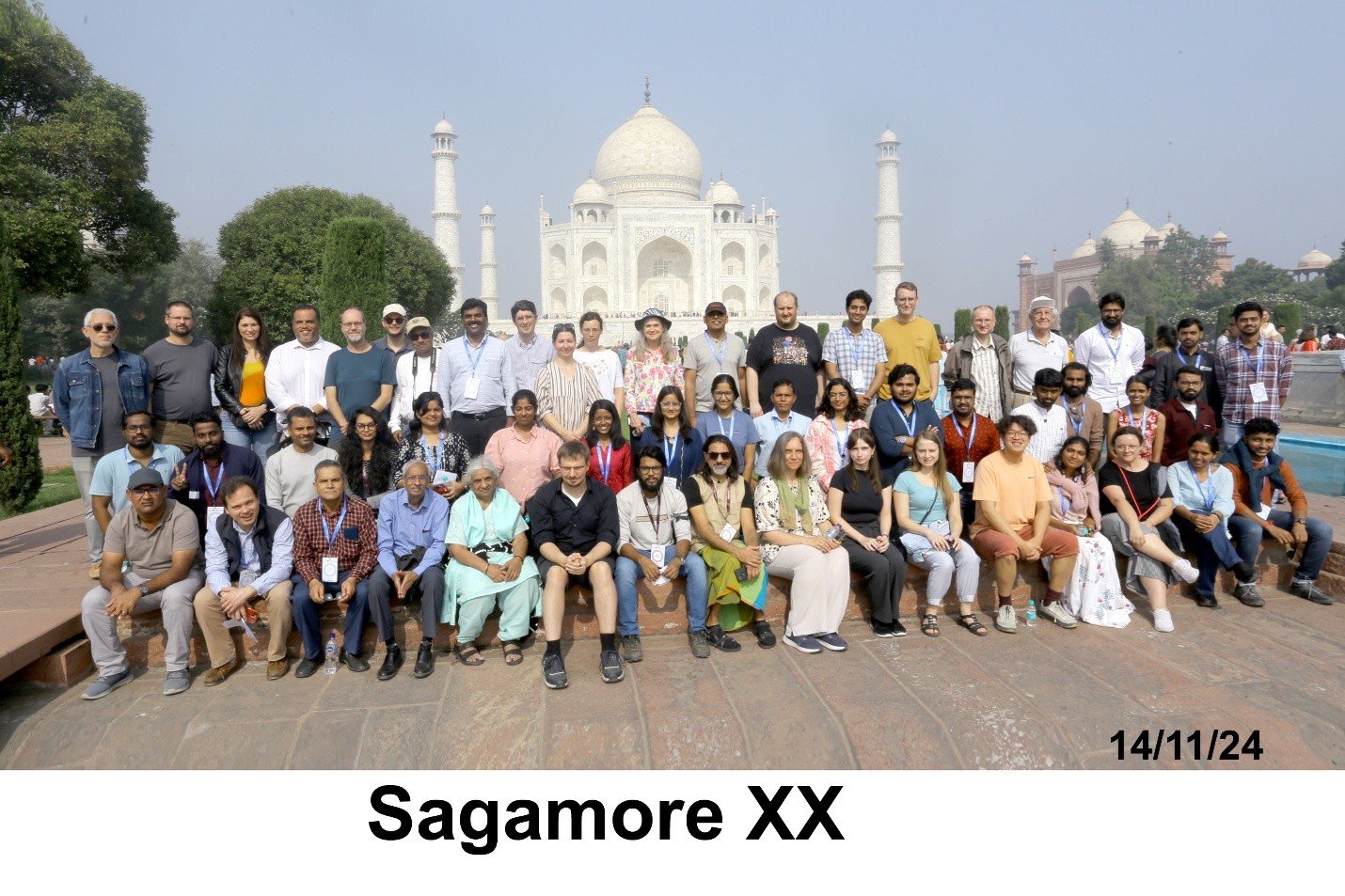
The Sagamore XX-2024 Conference on Quantum Crystallography, held from 10th to 15th November 2024, at the Shiv Nadar Institution of Eminence (deemed to be a University), Delhi-NCR, marked a significant milestone as the 20th iteration of this prestigious international event was convened for the first time in India. Since its inception in 1964, this meeting has brought together leading researchers in the field of quantum crystallography and related disciplines. The conference has traditionally focused on the study of charge, spin, and momentum densities, with recent emphasis on quantum crystallography, which combines quantum mechanics and crystallography to model crystal structures accurately. The utility of quantum crystallography to allied disciplines is realized in the topics covered, including ultrafast spectroscopy, NMR crystallography, photo-crystallography, X-ray and neutron diffraction, electron diffraction, polarized neutron diffraction, X-ray free electron lasers (XFELs), chemical bonding, interaction energy and lattice energy, charge density analysis, nuclear dynamics and force fields, prediction of crystal structures and properties, material properties and quantum crystallography, quantum crystallography tools, quantum refinement of protein structures, and enzyme mechanisms: quantum and complementary approaches. The inaugural welcome address was followed by a cultural program, Incredible India: A Celebration of Dance, highlighting the diverse cultural heritage of India. The five-day conference included five keynote and four plenary lectures, 41 invited lectures, along with 13 oral presentations from young researchers and a poster session with 40 participants. Meetings of the IUCr Commission on Quantum Crystallography, as well as a round table discussion on sustaining quantum crystallography, focused on the future of quantum crystallography with an emphasis on the inclusion of diverse complementary techniques and approaches. The conference also included a trip to the Taj Mahal and Agra Fort, which functioned as a refresher as well as an opportunity for the exchange of ideas. The conference featured a diverse range of presentations from leading experts across the globe.
Dr Junko Yano of the Lawrence Berkeley National Laboratory, USA, detailed her investigations on capturing the sequence of events during the light-driven water oxidation reaction in Photosystem II using XFELs. Dr Hosea Nelson of the California Institute of Technology, USA, highlighted innovative approaches that merge chemical innovation with cutting-edge structural biology techniques like X-ray crystallography and cryo-electron microscopy, emphasizing the potential of diffraction methods in guiding natural product discovery and structure determination, offering a glimpse into the future of this field. Dr Sarah L. Price of University College London, UK, emphasized the need for advancements in crystal structure prediction (CSP) in her lecture "Organic Crystal Structure Prediction: What is Needed for Confident Prediction of Polymorphs?". Dr Shridhar R. Gadre from Savitribai Phule Pune University presented on "A Topological Tale of Two Scalar Fields", exploring the topological properties of electron momentum density (EMD) and molecular electron density (MED).
Keynote lectures included a talk by Dr Xiaoping Wang from Oak Ridge National Laboratory, USA. He provided insights into the Topaz techniques and their applications in functional materials, such as crystal engineering for direct air capture of carbon dioxide. His research showed the impact of single-crystal neutron diffraction in understanding material properties under extreme conditions and designing materials with tailored characteristics. Dr Hans-beat Bürgi from the University of Bern, Switzerland, addressed the importance of acknowledging and mitigating errors in Bragg diffraction data interpretation. Dr Artem Oganov from the Skolkovo Institute of Science and Technology, Russia, revisited the fundamental concepts of electronegativity and chemical hardness in his lecture "Electronegativity, Chemical Hardness, and Compound Formation: New Twists on Old Ideas". Dr Simon Grabowsky from the University of Bern, Switzerland, demonstrated the power of quantum crystallography in unravelling the complexities of chemical bonding.
Notable lectures included a talk by Dr Paulina M. Dominiak from the University of Warsaw, Poland. She presented a unique perspective on the use of electron beams to study material properties, including electronic density distribution. Dr Philip Nakashima discussed his investigations on chemical bonding at the nanoscale. His talk revealed unique chemical bonding patterns at the nano-void surface, offering valuable insights into the complex relationship between nanoscale chemical bonding and material structure. Dr Huibo Cao shed light on crystallographic applications of polarized neutron diffraction. He explored how integrating this technique with others can further advance related fields that rely on crystallography. Dr Simon J. L. Billinge presented a thought-provoking talk titled "All density functional theory (DFT) is wrong: the average of the properties is not equal to the properties of the average". Inspired by George Box's quote, Dr Billinge highlighted the limitations of traditional DFT approaches and emphasized the importance of considering local structure and fluctuations in materials science. Dr Paul Hodgkinson discussed the role of NMR spectroscopy in understanding hydrogen positioning and dynamics in organic solids, highlighting NMR's unique benefits, such as resolving ambiguities in hydrogen positioning, complementing X-ray crystallography, and providing local structure insights. Dr Bo B. Iversen provided insights into the complex relationships governing thermoelectric performance and emphasized the chemical bonding origin that gives rise to disorder. Dr Kenji Tsuda showcased the application of convergent beam electron diffraction (CBED) in analyzing nanoscale local electrostatic potential in ferroelectrics and multiferroics, enabling the mapping of electrostatic potential with sub-nanometre resolution. Dr Partha Sarathi Mukherjee demonstrated the potential of metal-organic cages (MOCs) and coordination cages to revolutionize chemical reactions. Dr C. Malla Reddy presented his research on adaptive molecular crystals with exceptional mechanical flexibility and self-healing abilities, with applications in flexible electronics. Dr K. V. Jovan Jose presented a novel strategy for efficient crystal structure prediction. Dr Peter Spackman highlighted the significance of interaction energy calculations in predicting crystal growth from solution. Dr Lorraine Malaspina discussed the balance between speed and accuracy in quantum crystallography. Dr Enrique Espinosa explored the effects of electric fields on intermolecular interactions in his lecture titled "Polarization induced by electric fields on intermolecular interactions: atomic transfer in halogen-bonded complexes", and Dr Maura Malinka discussed the challenges and opportunities in predicting binding affinity in her talk titled "Understanding Binding Affinity Through Non-Covalent Interactions: Myth or Goal?", to mention a few.
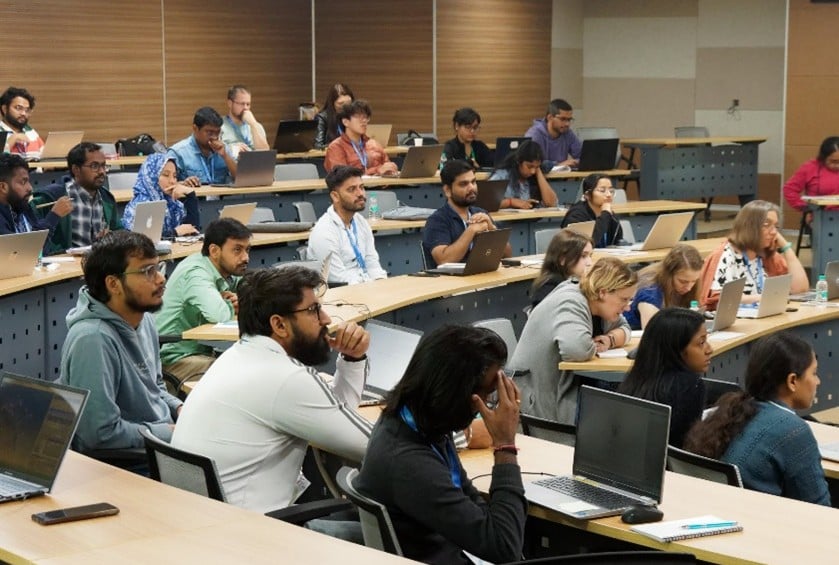
The oral presentations and poster sessions were interactive and gave an opportunity for young researchers to discuss their ideas with the pioneers in the field. Over a span of five days, during Sagamore XX, researchers from around the globe discussed a multitude of theoretical, experimental, and interdisciplinary aspects of quantum crystallography.
The programme schedule and other relevant details of the conference can be found at this link.
Copyright © - Prior permission is not required to reproduce short quotations, tables and figures from this article, provided the original authors and source are cited.
The permanent URL for this article is https://www.iucr.org/news/newsletter/volume-33/number-3/sagamore-xx-2024-conference-on-quantum-crystallography