





Advertising feature
Operando X-ray Diffraction: A Powerful Tool for Battery Analysis

X-ray diffraction (XRD) is a material characterization method that is fundamental in establishing structure-property relationships for crystalline materials. The benefit of the technology is that it is non-destructive: materials do not typically change or degrade when exposed to the X-ray beam. Moreover, the beam can penetrate deep into materials in order to investigate bulk properties rather than just the surface. Thus, XRD enables users to investigate processes such as thermal degradation, aging, or phase transitions through operando measurements.
With the ongoing boom in the field of battery and energy storage materials, XRD has proven to be an invaluable analytical technique. It can be employed for quality control during battery assembly, to investigate the purity and composition of raw materials, and for the qualitative and quantitative analysis of recycling products. Additionally – and maybe most importantly – XRD can be used to investigate batteries while they are being charged or discharged/used. Since the X-ray beam can penetrate the outer container of batteries, structural changes in battery active materials can be observed during the cycling of the batteries. This enables researchers to test the structural performance of new active materials, to identify potentially harmful side products appearing during cycling, and to observe the exact changes the active battery material undergoes throughout its lifetime.
During cycling, one of the most commonly observed changes in battery materials is the shift in the position of certain reflections (i.e. the scattering angle 2θ). The most common battery active materials are structurally similar to lithium cobalt oxide (LCO), and the intercalation and deintercalation of the lithium in the layered LCO structure causes an expansion and contraction of the structure. By observing this change in the reflection position, researchers can follow the progress of structural changes in the battery’s active material during cycling without having to disassemble the cell.
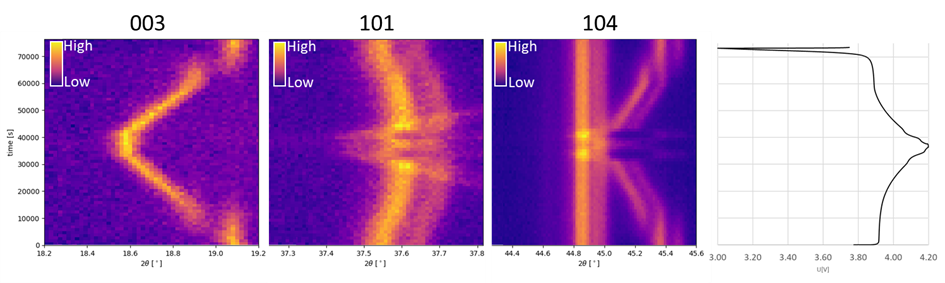
Figure 1. Heat maps of XRD scans for 003, 101 and 104 reflections of LCO during battery cycling (left), and a charging/discharging curve (right).
Fig. 1 shows heat maps of three prominent reflections (003, 101 and 104) of LCO during battery cycling in addition to a charging/discharging curve. It is obvious that the reflections shift significantly during charging and discharging. The plot also shows regions in which the peaks appear to jump from one 2θ to another, or where peaks split only to recombine later. This behavior is indicative of phase transitions in the battery material, which are usually reversible and occur due to either structural polymorphism or order-disorder transitions that reorganize and evenly distribute the diminished Li throughout the active material during deintercalation. They are naturally of great interest for determining the performance and stability of battery materials.
The regions in which the transitions occur are influenced significantly by the temperature of the battery. Since the performance of energy materials at non-ambient temperatures is important in many fields, such as e-mobility or the storage of renewable energies, this observation may provide a path to develop new battery active materials that are more stable at high or low temperatures and can therefore improve the efficiency of new green technologies.
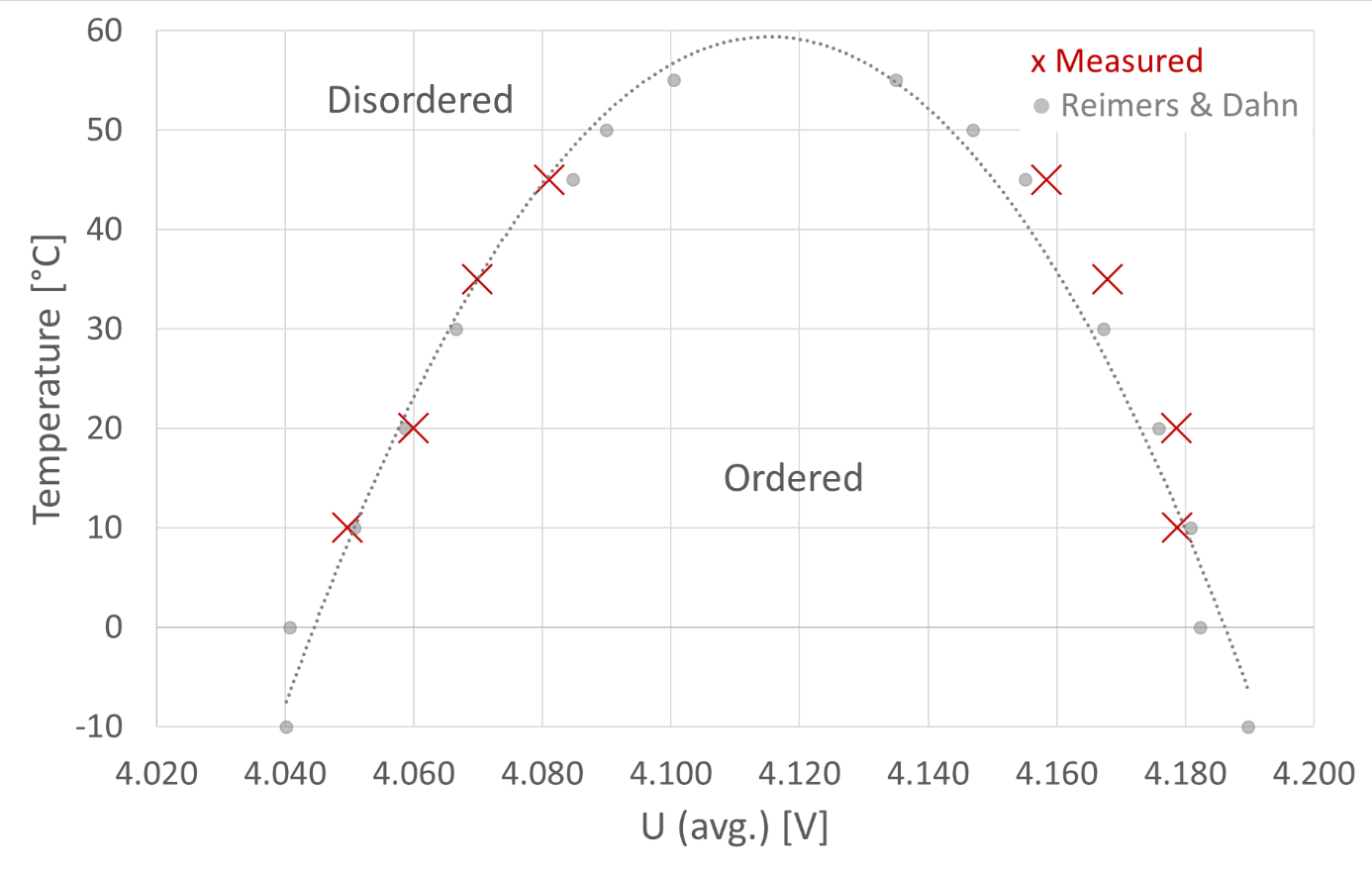
Figure 2. Temperature-Voltage phase diagram of LCO based on data from Reimers & Dahn (1992) [1].
In Fig. 2, the temperature of an LCO coin cell is plotted against the voltage at which the order-disorder phase transitions occur in the active material. The red crosses represent measurements performed by the author of this report, while the grey dots represent data by J. N. Reimers and J. R. Dahn previously published in 1992 [1]. The grey dashed line is the polynomial trend line of the data obtained by Reimers & Dahn [1]. The ordered phase appears only temporarily above approximately 4 V before the disordered state re-emerges above approximately 4.15 V. The voltage window in which the ordered phase appears is strongly influenced by the temperature. At very low temperatures of -10°C, the ordered phase is visible between 4.04 V and 4.19 V, while at 55°C the LCO is only ordered between approximately 4.1 V and 4.13 V.
The observation of the temperature-dependent phase transitions in an LCO coin cell during charging is only one example of the numerous possible applications of XRD for operando battery analysis. Its ability to provide non-intrusive insights into the structural properties of the active material of assembled batteries during their cycling makes it an invaluable tool for quality control as well as R&D in the field of battery manufacturing.
Read more here.
References
Copyright © - Prior permission is not required to reproduce short quotations, tables and figures from this article, provided the original authors and source are cited.
The permanent URL for this article is https://www.iucr.org/news/newsletter/volume-33/number-3/strengthening-regional-collaboration-sao-carlos-openlab-brings-together-latin-american-crystallographers