




Meeting report (IUCr supported)
Advances, AI integration and emerging techniques from 60th course: Electron crystallography
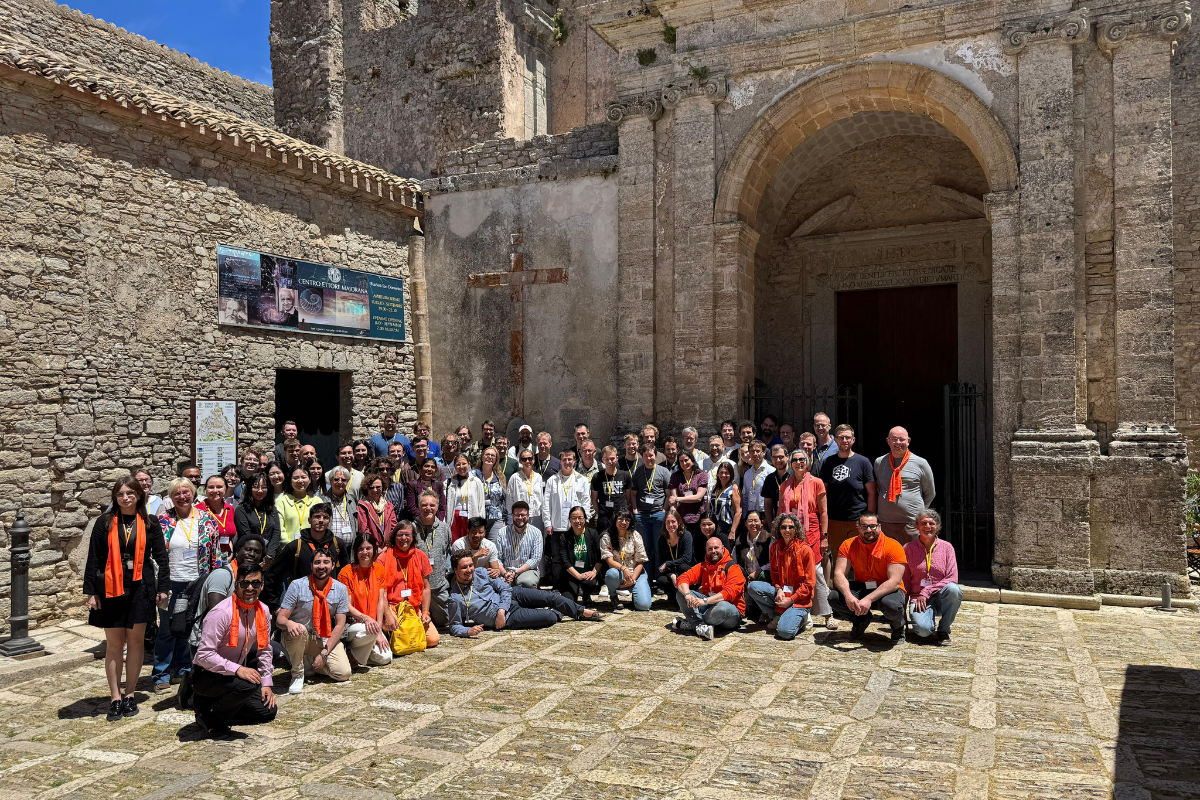
Group photo of the participants of the 60th course of ISCoC “Electron Crystallography”.
The 60th course of the International School of Crystallography was focussed on the use of electrons as a source radiation to study the crystal structure of solid materials. There was a particular emphasis on the use of electron crystallography for the study of organic, hybrid, pharmaceutical and biological materials. There were 45 participating students, encompassing PhD students, postdoctoral researchers, early career academics and facility scientists, and 23 speakers and tutors.
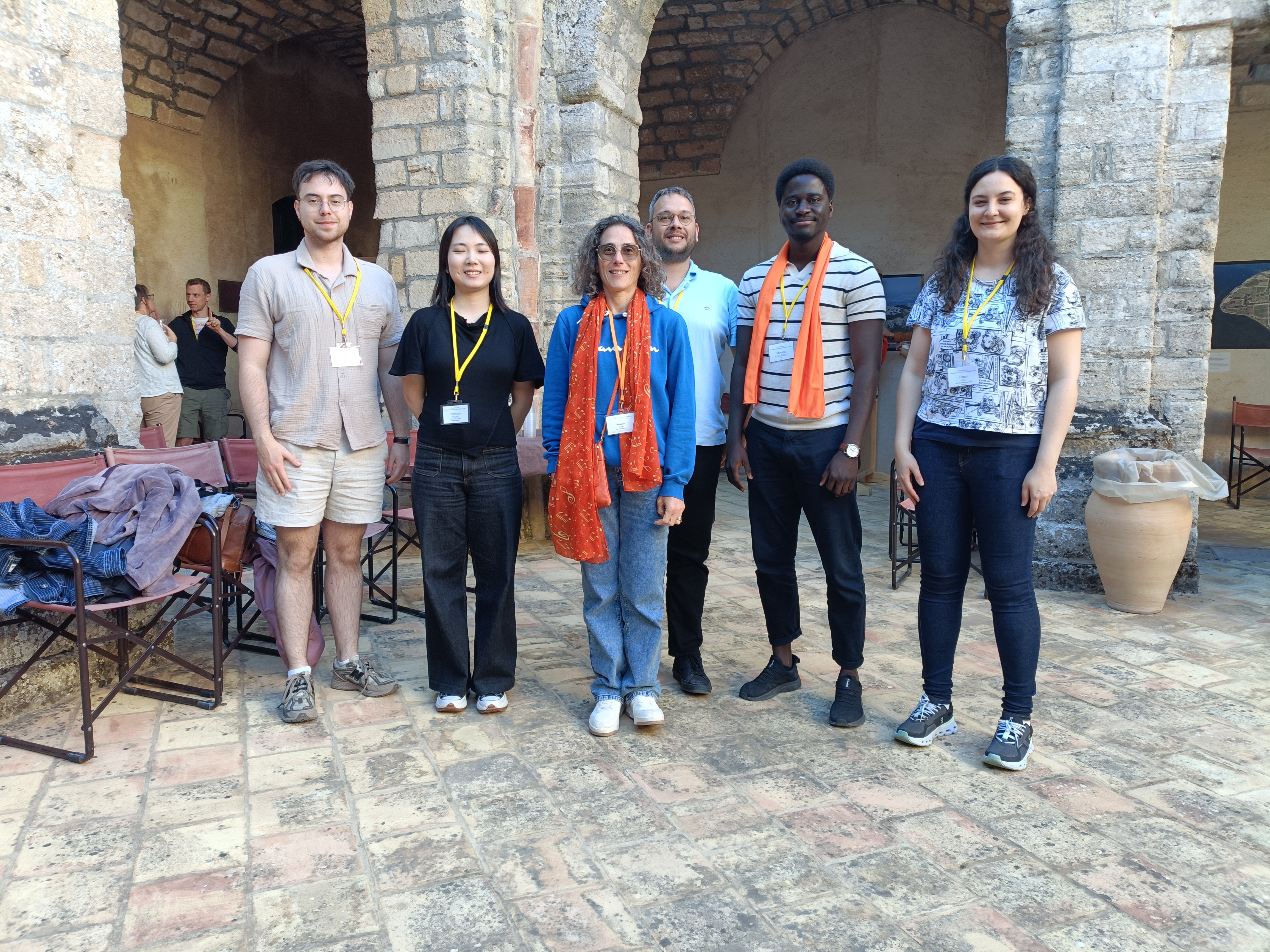
The students supported with the IUCr grant: from left to right, Yann Schmitt (University of Hannover, DE), Yanxuan Wang (University of Manchester, UK), Annalisa Guerri (University of Florence, IT), Ioannis Mylonas Margaritis (Stockholm University, SE), Moussa Faye Diouf (IIT, IT) and Günce Göc (University of Hamburg, DE).
Considering all the participants (68), the course was attended by 43 (63%) men and 25 (37%) women, from 22 different countries. In particular, among the speakers there were 70% male (16) and 30% female (7) lecturers, while among the students there were 60% male (27) and 40% female attendees (18).
The school was run in parallel with the 61st course on Quantum Crystallography, allowing a number of shared sessions; notably, most of day one, covering the essential physics of diffraction and crystallography, and on day four covering the prospects for future experimental and analytical methods within the field.
The course was built around daily sets of lectures (in the mornings) followed by practical demonstrations and exercises (in the afternoons). The first part of the course (day one) was designed to provide a core understanding of the fundamentals of diffraction and crystallography, this covered the geometry of reciprocal space, the structure factor, and the nature of elastic/inelastic and dynamical scattering. The second part of the programme (days two and three) followed a stepwise progression through the typical data processing workflow: from the experimental acquisition of diffraction data, through data processing, structure solution, refinement and validation. Incorporated into this were hybrid methods such as simulated annealing and molecular replacement. The third part of the programme (days five and six) covered more exotic experimental methods for electron crystallographers such as serial-electron diffraction, single particle reconstruction, and applications to nanoscale materials. For the first time also, AI and machine learning entered into the scene of electron crystallography, marking a first step into the future of the discipline, while the final day was dedicated to convergent beam techniques, introducing 4D-STEM and ptychographic imaging of biological materials. Most lectures had a dedicated workshop associated with them, providing expert demonstration of software application and other associated techniques (in particular, a number of Python-based approaches for data-handling were provided).
Participants were invited to present their recent work at dedicated poster sessions. These were run across two evenings at which dinner was provided, leading to a full evening of scientific discussions. Preview sessions over lunch on the same days also provided opportunities for extended discussion. Poster prizes were decided by a panel of lecturers and awarded at the closing ceremony. In keeping with a tradition at the school, students were given the opportunity to chair the lecture sessions on the later days of the school, encouraging them to consider questions for the lecturers as well as managing the timing and discussion in the room.
More informal engagement between lecturers and students occurred across the numerous meals, social activities and coffee breaks in the programme. With lecturers often continuing to answer questions on their lectures over lunch. These discussions often extended to the after-dinner desserts and digestivos provided in the social room below the Feynman theatre.
During the final ceremony, the awards for the best posters were assigned: the first place was assigned to Yann Schmitt (Institute of Inorganic Chemistry, Leibniz University Hannover, DE). The prize included a Springer eBook Voucher. The second poster prize went to Alexander Feige (Department of Chemistry and Mineralogy, Leipzig University, Leipzig, DE) and the third place was conferred to Diana Piankova (Department of Mechanical and Process Engineering, ETH Zürich, CH).
To assess the outcome of the Course, participants were asked to provide their contribution with a survey to evaluate and comment on the scientific quality of the Course and the general organization. From their answers, it was clear a similar meeting should be held at least in 3-4 years time. Overall, 77% of the voting participants scored the Course higher than 90/100.
Copyright © - Prior permission is not required to reproduce short quotations, tables and figures from this article, provided the original authors and source are cited.
The permanent URL for this article is https://www.iucr.org/news/newsletter/volume-33/number-4/60th-course-on-electron-cryst