




Obituary
Brian H. O'Connor (1940–2024)
![[es5059thumbnail]](https://www.iucr.org/__data/assets/image/0009/161289/thumbnail_oconnor.jpg "es5059thumbnail")
Figure 1. Brian O'Connor.
It is with deep regret that we record the passing of Professor Brian H. O'Connor (Fig. 1) on 1 July 2024. A distinguished figure in the domain of diffraction and crystallography, Professor O'Connor's pioneering contributions significantly advanced understanding in diffraction techniques, materials characterization and analysis.
Born in 1940, Professor O'Connor completed his undergraduate studies at the University of Western Australia (UWA), graduating with First Class Honours in Physics in 1961. Under the mentorship of the late Dr Ted Maslen, he undertook doctoral research culminating in the thesis Crystal studies of dimeric copper(II) complexes and hydrogen-bonded compounds. His early investigations (e.g. O'Connor & Maslen, 1965) explored aminobenzenesulphonic acids and emphasizing hydrogen-bonding interactions and substituent effects within aromatic systems.
His foundational work in structural chemistry (e.g. O'Connor & Maslen, 1966a,b, 1974) exemplifies his early application of single-crystal diffraction to resolve chemical structures. As the field matured, his focus increasingly centred on electron density analysis and the of structure solution methodologies.
Between 1965 and 1970, Professor O'Connor held research fellowships including a UK Atomic Energy Authority Fellowship at Harwell and a Queen Elizabeth II Research Fellowship at UWA. These formative years expanded his expertise into neutron diffraction and materials characterization, contributing notably to the elucidation of biologically relevant molecules such as vitamin B12 (Venkatesan et al., 1971).
In 1971, Professor O'Connor joined the Western Australian Institute of Technology (now Curtin University). Here, he dedicated over five decades to research, education and service, supervising more than 30 Australian and international postgraduate students and fostering collaborations nationally and internationally. His publication record exceeds 200 articles. His research interests encompassed quantitative phase analysis through powder diffraction, mineral and ceramic structure studies—including bauxites, superconductors and zirconia—and the development of diffraction instrumentation and analytical techniques. With extensive experience in X-ray diffraction, synchrotron radiation and neutron scattering, Professor O'Connor's work also addressed topics such as microstructure, texture and radiation safety, emphasizing the radiological aspects of mineral processing and setting benchmarks that continue to influence research practices worldwide.
His contributions to powder X-ray diffraction and particularly in the and application of the (Rietveld, 1969; Hewat et al., 2016; van Laar & Schenk, 2018), have profoundly influenced quantitative phase analysis [see in particular the foundational work of O'Connor & Raven (1988)]. Professor O'Connor's efforts on quantitative phase analysis, correction and texture analysis (e.g. O'Connor et al., 1990, 1991; Sitepu et al., 2004; Sitepu et al., 2005) have helped establish internationally recognized standards in diffraction data interpretation and advanced the understanding of texture–mechanics relationships and quantitative microstructural analysis in powder diffraction studies.
Beyond his scientific achievements, Professor O'Connor was a committed leader within the crystallographic community. He served as President of the Australian X-ray Analytical Association (AXAA), Vice-Chairman of the International Centre for Diffraction Data (ICDD) and Regional Co-chair for the Indian Ocean Rim, and President of the Australian Institute of Nuclear Science and Engineering (AINSE), alongside collaborative efforts with organizations such as the International Union of Crystallography and Australian Academy of Science. His advisory roles with the Australian Synchrotron and the Australian Nuclear Science and Technology Organisation and his editorial stewardship of Powder Diffraction journal underscored his dedication to advancing infrastructure and fostering international collaboration (Fig. 2).
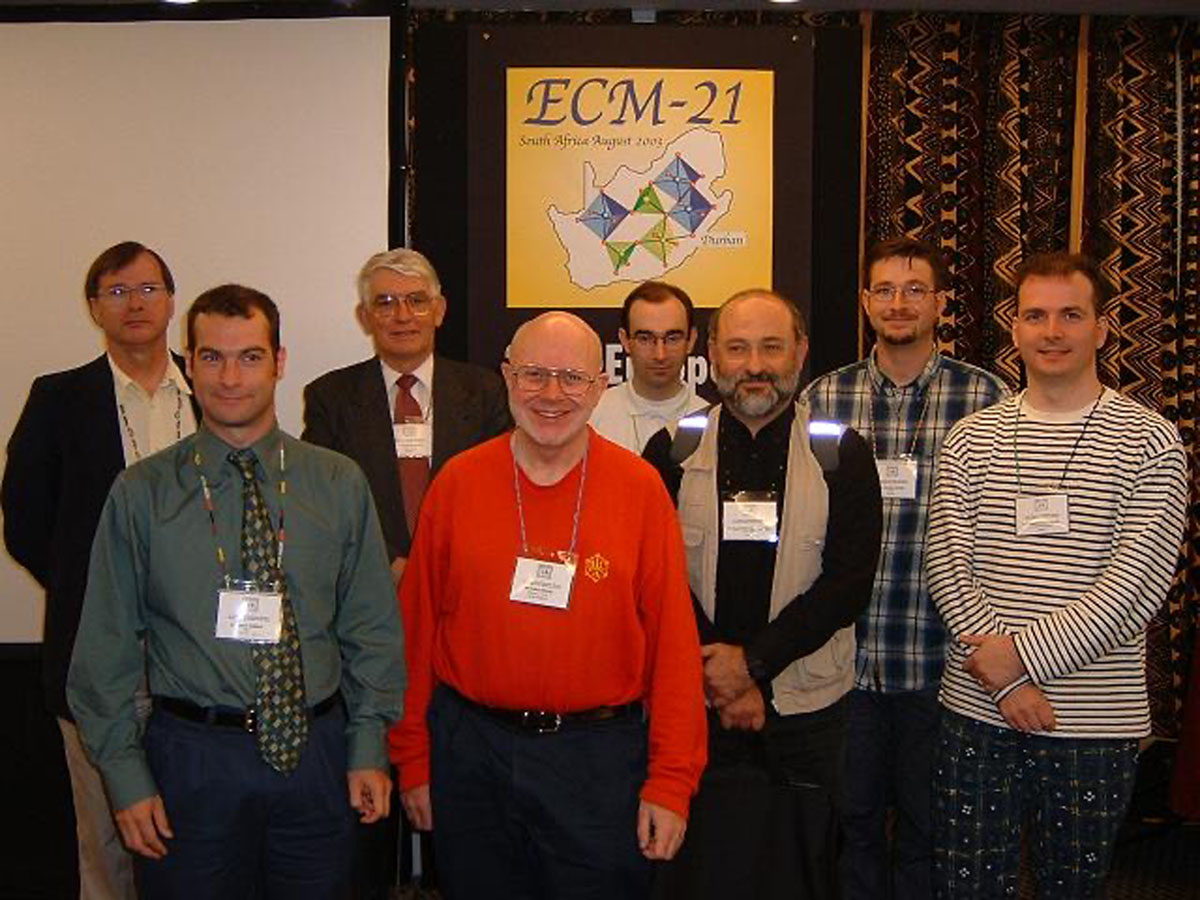
Figure 2. One-day Single Crystal and Powder Diffraction Software Workshop (ECM 21, Durban, South Africa, 2003), exemplifying Brian O'Connor's engagement with the global community. (Left to right) Armel Le Bail; Martin Attfield; Brian O'Connor; Robin Shirley; Lachlan Cranswick (session chair); Juan Rodriguez-Carvajal; Jon Wright; Vincent Favre-Nicolin.
His recognitions include Life Membership of AXAA (2001), the Australian Neutron Beam Users Group Career Achievement Award (2007), the Bob Cheary Award for Excellence in X-ray Diffraction (2011), an Honorary Fellowship of AINSE (2011) and the Distinguished Fellowship of the ICDD (2011).
In his own words, Professor O'Connor emphasized the vital role of mentorship:
Mentors keep mentees on track, whether they're having a winning day or a learning day. They help explore research gaps, push for excellence and foster professional growth. Selecting the right mentor—someone you respect, who challenges you and shares your values—can transform your scientific journey. The rewards are profound: enhanced well being, fulfilled potential and the joy of discovery.
He guided numerous scientists across laboratory, synchrotron and neutron facilities worldwide, instilling rigorous scientific principles and fostering a culture of integrity and curiosity. His influence endures through the achievements of his mentees, reflecting his lasting legacy.
We extend our deepest condolences to his family (his wife Jenny, his five children and his grandchildren), his colleagues and all who had the privilege of knowing him.
Footnotes
Husin Sitepu recently retired from Saudi Aramco after over 16 years.
References
Hewat, A., David, W. I. F. & van Eijck, L. (2016). J. Appl. Cryst. 49, 1394–1395.
O'Connor, B. H., Li, D. Y. & Sitepu, H. (1990). Adv. X-ray Anal. 34, 409–415.
O'Connor, B. H., Li, D. Y. & Sitepu, H. (1991). Adv. X-ray Anal. 35, 277–283.
O'Connor, B. H. & Maslen, E. N. (1965). Acta Cryst. 18, 363–366.
O'Connor, B. H. & Maslen, E. N. (1966a). Acta Cryst. 21, 828–830.
O'Connor, B. H. & Maslen, E. N. (1966b). Acta Cryst. 20, 824–835.
O'Connor, B. H. & Maslen, E. N. (1974). Acta Cryst. B30, 383–389.
O'Connor, B. H. & Raven, M. D. (1988). Powder Diffr. 3, 2–6.
Rietveld, H. M. (1969). J. Appl. Cryst. 2, 65–71.
Sitepu, H., O'Connor, B. H. & Li, D. (2005). J. Appl. Cryst. 38, 158–167.
Sitepu, H., O'Connor, B. H. & Li, D. Y. (2004). Physica B 350, E577–E580.
van Laar, B. & Schenk, H. (2018). Acta Cryst. A74, 88–92.
This article was originally published in J. Appl. Cryst. (2025). 58, 1511-1512.
Copyright © - Prior permission is not required to reproduce short quotations, tables and figures from this article, provided the original authors and source are cited.
The permanent URL for this article is https://www.iucr.org/news/newsletter/volume-33/number-4/brian-h.-oconnor-19402024