




Meeting report (IUCr supported)
Durham hosts the 20th BCA/CCG teaching school in X-ray structure analysis
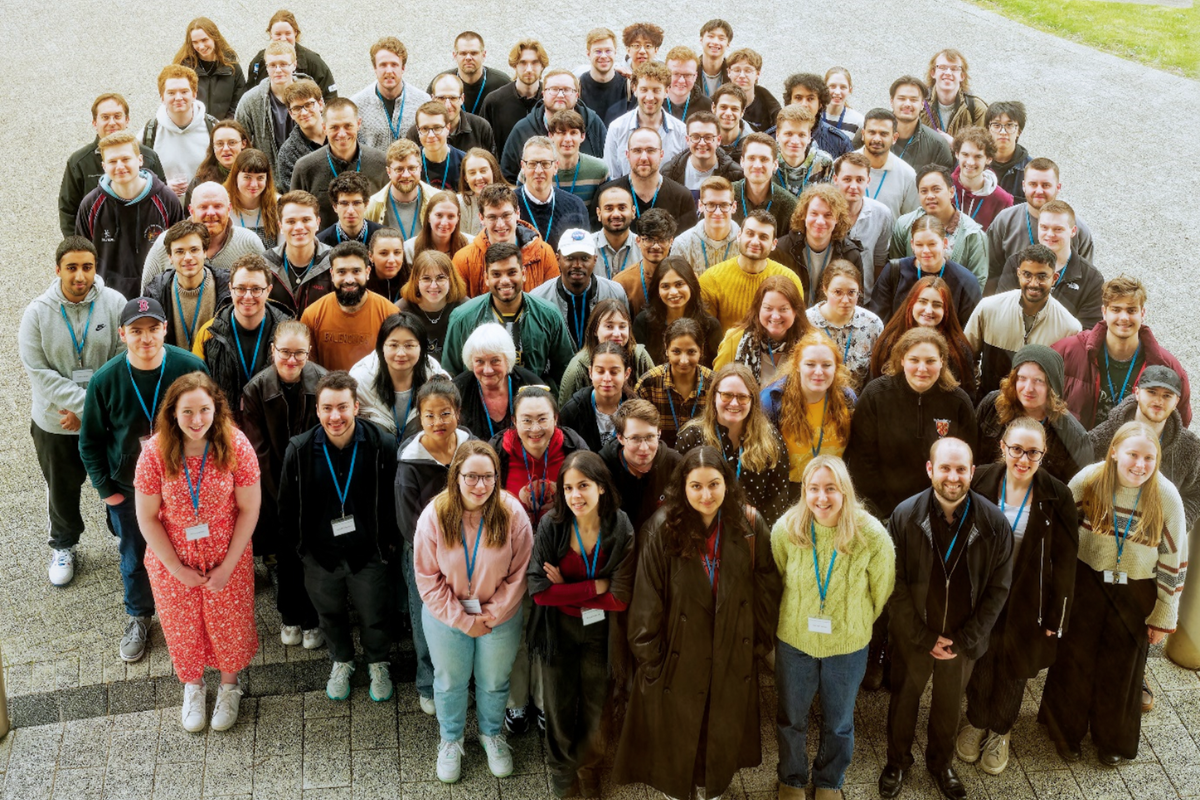
The 20th BCA/CCG Intensive Teaching School in X-ray Structure Analysis was held at the Mount Oswald Hub, Durham from 29th March - 6th April 2025. The school was once again heavily oversubscribed, due to the school’s national and international reputation for providing a good basis in crystallography; this year we welcomed almost 80 students from universities in the UK, Finland, Ireland, Italy, Japan, Poland, Singapore, Slovenia, Sweden, UAE and USA. The variety of nationalities, academic backgrounds and crystallographic experience created a fantastic environment for both learning and meeting new people, with many students and staff commenting on the positive and friendly atmosphere.
As a result of feedback from students and staff over the years, the format of the biennial course has evolved. It currently consists of a mixture of lectures and tutorials designed to help students improve their understanding of the lecture material. As the name suggests, the course is intensive with a full timetable across the 7 days providing the students with the opportunity to gain a good theoretical understanding of various aspects of crystallography from a single crystal perspective. Beginning with an introductory lecture shortly after arrival on Saturday evening, the lectures given by Professor Richard Cooper, Dr Andrew Bond, Dr Lukas Palatinus, Dr Mark Senn and Dr Helena Shepherd covered Maths, Symmetry, International Tables, Data collection, Fourier synthesis, Patterson methods, Direct methods, Charge flipping, Superspace, Parameterisation, Least squares, Refinement, Twinning and Derivation of results. An introduction to Databases was also given by Dr Natalie Johnson and the use of Synchrotron, Neutron and 3D Electron Diffraction facilities were highlighted by Dr Ben Coulson, Dr Amber Thompson and Dr Jeremiah Tidey, respectively.
Attendees were assigned to a tutor group, consisting of one tutor and up to eight students, and worked together throughout the week to tackle a series of problems related to the lecture material. This year we welcomed new tutors, Dr Ben Coulson, Dr Tom Fellows and Dr Georgia Orton, and welcomed back Dr Andrew Cairns, Dr Samantha Chong, Dr Natalie Johnson, Dr Carsten Lenczyk, Dr Matic Lozinsek, Dr Natalie Pridmore (as a floating tutor), Dr Amber Thompson and Dr Jeremiah Tidey. This year, the lectures and tutorials were held in the Mount Oswald Hub, which enabled easy switching between formal lectures and tutorial work, with minimal disruption. The accommodation and evening meals were provided in Collingwood College, which is around a ten-minute walk away, and lunch was in Van Mildert College, which is halfway between the two. This provided a chance for some fresh air and brief exercise during the day and, fortunately, the weather was pleasant all week.
As is traditional at the school, apart from the Math’s lecture on the first day, the evening activities are designed to be more relaxed and provide an opportunity for the students to mix with each other through a combination of educational and fun activities. On the Sunday evening, Richard Cooper ran a successful bar quiz, while Tuesday evening’s panel question session was a chance for the students to learn more about the lecturers and also ask more general crystallography questions, which included a discussion of if/how AI could be beneficial to the field.
This year’s student presentations, on the Friday evening, were organised by Dr Jeremiah Tidey and Dr Samantha Chong. Each of the tutor groups put together a five-minute presentation on a crystallographic topic, drawn from a hat earlier in the week, and performed it in a style that was also chosen at random. This year, this included crystal growth as a sports commentary, space groups described in TV adverts and structure solution explained in the style of a children’s TV show. As with previous years, the scientific quality, thematic accuracy and entertainment value of each presentation was assessed by our elite panel of judges, the lecturers, who were extremely impressed by all the entries.
The conference dinner, held in Collingwood College, on the Saturday evening, provided the chance to thank everyone who had contributed to the success of this year’s school including the local staff, organisers, lecturers, tutors and students. The positive attitude and hard work of the staff and students alike helped to create a very friendly school. After this year’s school, Professor Judith Howard is stepping down from her role as a local organiser, which she has been doing since the first school, 38 years ago. We would like to thank her for her role in starting the school and keeping it going all these years; her drive, enthusiasm and encouragement have enabled the course to run and helped maintain its high standards.
Following on from the school, an optional hands-on Olex2 workshop was held on the Sunday, run by Dr Horst Puschmann and Dr Oleg Dolomanov. This was well received by the over 50 registered participants, with a range of experience with the software, who had the opportunity to use Olex2 to apply concepts that they had learnt on the course to both test structures and their own data.
Finally, I would like to say thank you to all the sponsors of this year’s school: IUCr, ECA, CCG, BCA-IG, Bruker, Rigaku, CCDC, NCS, CrystEngComm, Journal of Materials Chemistry C and RSC Advances. Without the financial support from these organisations, we would not have been able to help as many students attend the school, or run it so successfully, and we are extremely grateful for their continued support.
Natalie Pridmore, Local OrganiserCopyright © - Prior permission is not required to reproduce short quotations, tables and figures from this article, provided the original authors and source are cited.
The permanent URL for this article is https://www.iucr.org/news/newsletter/volume-33/number-4/20th-bcaccg-intensive-teaching-school-in-x-ray-structure-analysis