




Obituary
James Dewey Watson (April 6, 1928 – November 6, 2025)
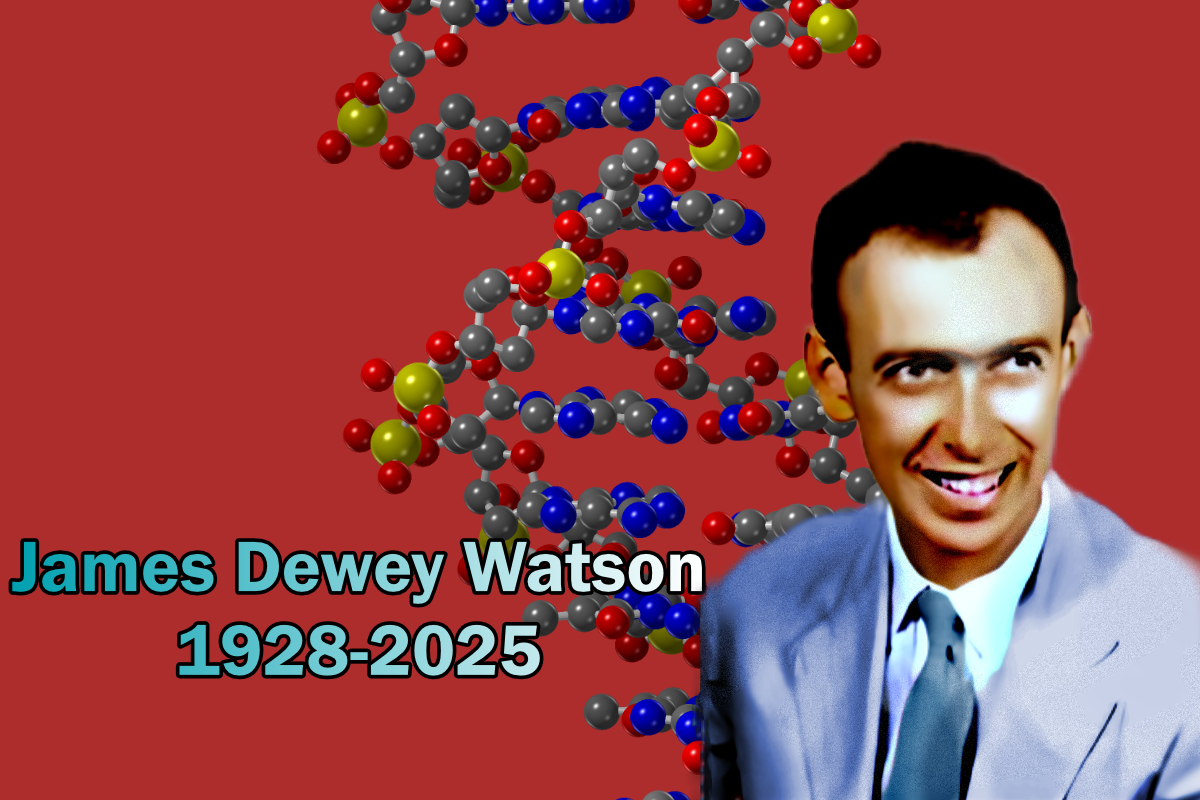
In 2003, the Laboratory of Molecular Biology in Cambridge hosted a celebration of the 50th anniversary of the discovery of the DNA double helix, co-discovered in the Cavendish Laboratory by Jim Watson and Francis Crick, who were awarded the Nobel Prize for Physiology and Medicine in 1962, shared with Maurice Wilkins of King's College London. I attended this event. At the morning coffee, I found myself standing within a few metres of Jim Watson. I wasn’t close enough to hear what the conversation was but for his loud voice dominating the group around him, which included various other luminaries. So, I saw at first hand the intellectual genius of the field of molecular biology, then aged 75. A measure of his precociousness was that he enrolled in a zoology degree at the University of Chicago at the age of 15 years (The Times Obituary, 2025). Jim Watson not only had a momentous positive impact with the discovery of the DNA double helix but also had a negative impact with his increasingly controversial views on issues such as eugenics. These views he would repeat, and as a result, eventually, in 2019, he was removed even from his honorary position at the Cold Spring Harbour Laboratory in the USA, where he had been director for many years from 1968.
Jim Watson wrote his personal account of the DNA double helix discovery, eventually entitled The Double Helix, published in 1968 (Watson, 1968). This book was initially called “Honest Jim” (Bragg, 2015). Lady Alice Bragg recalled:
“During this time, we shared in the drama of Jim Watson’s book The Double Helix, which was to prove a bestseller both in the States and in this country. It will be remembered that the author was one of the Cavendish Laboratory people to receive the Nobel Prize in 1962 when WLB was so ill. WLB was attached to this young American (known in our home as ‘the Bush Baby’ because of his protruding eyes) and encouraged him to write a popular account of his work on DNA. My feelings towards him were mixed. I admired him for being himself, but it did not seem to me to be a very nice self. I have known and had friends among many scientists, and they have a respect for each other, and a certain code of behaviour which Jim Watson did not appear to share. I saw the first draft of the book when it was shown to WLB (i.e. Sir William Lawrence Bragg). It was originally called Honest Jim. I was appalled; so many of those people that he had met in his host country, and especially in Cambridge, were held up for criticism and ridicule, and none more than his professor, WLB. We were in the States about that time and had been invited to see the people at Harvard University Press who were considering publishing Honest Jim. Pressure was put on them not to do so by interested parties, and I understand that it was finally decided that it was not suitable for a university press. Subsequently, it was published in England under the title The Double Helix and, with regard to personalities, in a somewhat milder form. Jim Watson asked WLB to write the introduction, and to my amazement, he accepted. I recall standing with the two of them in the hall of our flat, and Jim saying that he hoped that I realised that there was no one he admired more than my husband. I was very annoyed. ‘No one could possibly think that after all the horrid remarks you make about him in your wretched book’, I said angrily. The introduction was duly written and I was pleased at the many messages WLB received paying tribute to his magnanimity. He had written gently at the end: ‘Those who figure in this book must read it in a very forgiving spirit.’ I had not seen the last of the Bush Baby. After he had gone back to the States, he returned to England for a day or two, on one of which he hired a car and drove down to Suffolk where we happened to be, to show us his newly acquired fiancée. I found this endearing and we made them very welcome. WLB said to her with a twinkle, ‘I hope you know what you have taken on’.”
The original title of Honest Jim brought to my mind the controversial use he and Crick made of Rosalind Franklin’s X-ray diffraction photograph of a particular hydrated state of DNA, detailed by Franklin & Gosling (1953) in the IUCr journal Acta Crystallographica. Or, more precisely, “Photo 51 was taken by Raymond Gosling (a PhD student), working under Rosalind Franklin, on 2 May 1952” (Wikipedia contributors, 2025). Under the rules of today about using someone else’s raw data, even in the most liberal data policies giving early access to a data reuser, namely of the European central photon (and neutron) facilities, the measuring team have confidential use for as long as they would like up to a maximum of 3 years at which point the facility would release those raw data, unless an appeal is made to the facility director by the measuring team leader. So, the 'controversial use' accusation of 'Photo 51' to my mind is substantiated for the Watson & Crick (1953) paper. A further key aspect of Watson and Crick's state of knowledge, to my mind a major advantage, was the theory of helical X-ray diffraction described by Cochran et al. (1953), also in Acta Cryst. Nevertheless, the lingering odour of dishonesty frequently surfaces, even to this day, not only on Watson but also on Crick. In a review of the recent biography of Francis Crick in The Times, the reviewer (Blakely, 2025) picks up on a quote from Sir Lawrence Bragg:
“Crick developed a reputation for making breakthroughs with information that others had painstakingly gathered. As Lawrence Bragg — the Nobel laureate physicist who headed the Cavendish Laboratory during the DNA race — put it, he was ‘the sort of chap who was always doing someone else’s crossword’.”The Watson & Crick (1953) paper describing their model of the double helix of DNA was momentous because, as they themselves put it, “It has not escaped our notice that the specific pairing we have postulated immediately suggests a possible copying mechanism for the genetic material.” Just how momentous? I would say it was the most significant scientific discovery of the 20th century. That said, in my undergraduate studies of physics at the University of York in 1974 in the comprehensive course on biophysics given by Peter Main, it was Max Perutz’s structure of haemoglobin and his evocative description in New Scientist of “Haemoglobin as the molecular lung” that initiated my interest in doing a PhD in protein crystallography at the Laboratory of Molecular Biophysics at Oxford University.
The key takeaway is that Jim Watson was a remarkable character in many ways, not always palatable, but still commanding attention, as I witnessed in 2003 at the DNA 50th Anniversary conference in Cambridge.
John R. Helliwell, University of Manchester, UKReferences
Cochran, W., Crick, F. H. & Vand, V. (1952). Acta Cryst. 5, 581–586.
Franklin, R. E. & Gosling, R. G. (1953). Acta Cryst. 6, 673–677.
Watson, J. D. & Crick, F. H. (1953). Nature 171, 737–738.
Wikipedia contributors (2025). Photo 51, https://en.wikipedia.org/wiki/Photo_51.
Copyright © - Prior permission is not required to reproduce short quotations, tables and figures from this article, provided the original authors and source are cited.
The permanent URL for this article is https://www.iucr.org/news/newsletter/volume-33/number-6/james-dewey-watson-april-6,-1928-november-6,-2025