





Obituary
Aris Terzis (1941–2025)
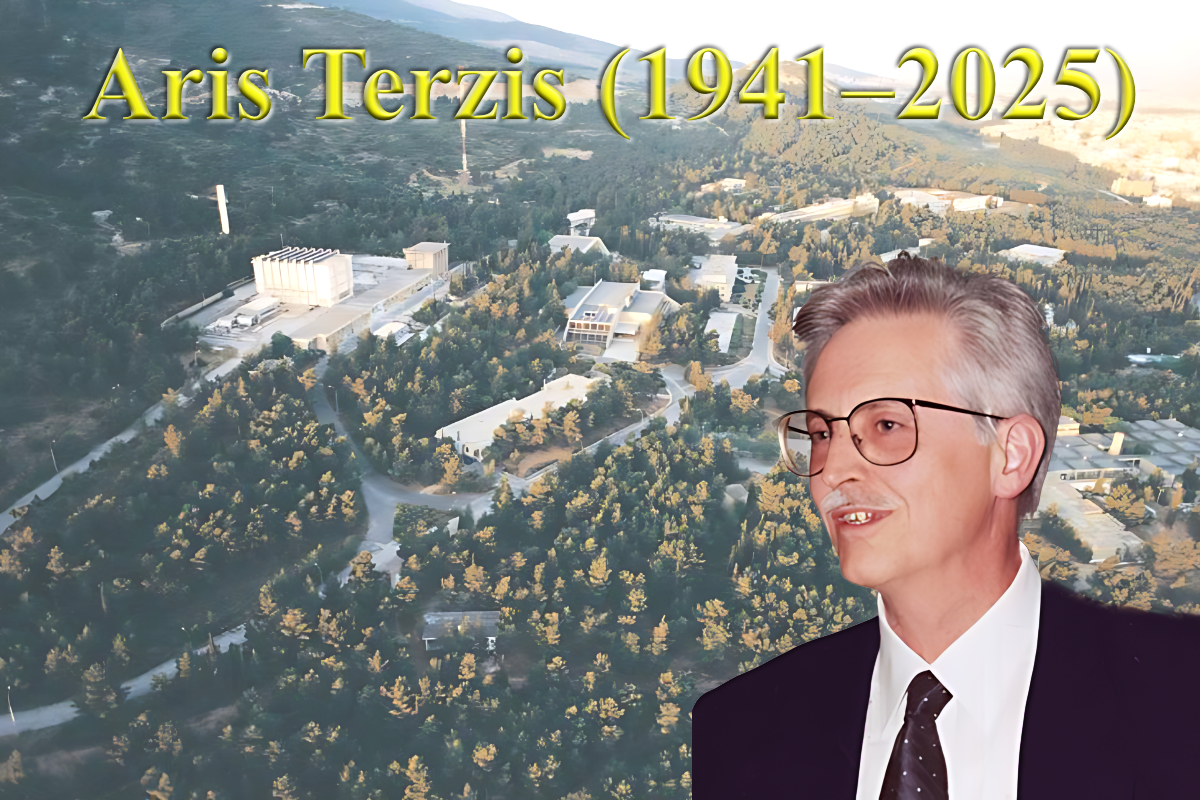
Dr Aris Terzis (1941–2025) was the Director of the Crystallography Laboratory at the former Institute of Materials Science (now Institute of Nanoscience and Nanotechnology) at the National Center of Scientific Research “Demokritos” (Athens, Greece), serving from 1979 until his retirement in 2008. Even after retiring, he remained actively engaged in daily research until 2020.
Dr Terzis earned his PhD in Chemistry from Princeton University (1970), working under the supervision of Thomas Spiro. He then joined the University of Montreal as a Researcher (1970–1974), and Dalhousie University, Canada, as an Assistant Professor (1974–1978). He was a visiting researcher at the National Hellenic Research Foundation (NHRF) in Athens during 1977, before joining the Crystallography Laboratory at “Demokritos” in 1978 as a visiting researcher. In 1979, he was appointed to a permanent position as Research Director.
Throughout his career, Dr Terzis held visiting professorships at the University of Southern California, Los Angeles (1986), and UCLA (1991). During his visit at UCLA he worked on porphyrin clathrates and co-authored a paper in the Journal of the American Chemical Society (Byrn et al., 1993) reporting the conservation of host structure in over 200 porphyrin-based lattice clathrates with guest molecules ranging from organic compounds to natural products such as pheromones. This work has promoted the clathrate compounds as an effective approach to form highly ordered inclusion complexes with targeted complicated molecules, and it is regularly cited to this day, having received more than 400 citations.
His second highly cited article was published in Journal of the American Chemical Society in 1966 on the hydrolytic polymerization of iron(III). This was the first report of the isolation of a discrete high polymer obtained by hydrolysis of a metal ion and still remains a special achievement; as such, this work is cited today with more than 280 citations (Spiro et al., 1966).
Special recognition should be given to his collaboration with Dr George Papavassiliou in the NHRF on the structural characterization of metal halide perovskites. Recently, in an opinion letter published in MRS Bulletin and written by David Cahen, Gary Hodes and Mercouri G. Kanatzidis with the title “George C. Papavassiliou, an unrecognized pioneer” (Cahen et al., 2025), his impressive work published in 1979 on size quantization effects is discussed, where the observed blueshifts in the absorption spectra of a one-dimensional organometallic semiconductor were correlated with particle size for the first time. During the 1990s, Papavassiliou explored a broad range of three-dimensional and two-dimensional metal halide perovskites, with a focus on their optical properties. He published together with Dr Terzis a series of papers (e.g. Papavassiliou et al., 1994) where these compounds were characterized as 'quantum-well' analogues, an insight that is now widely acknowledged by the scientific community, although rarely, if at all, attributed to him.
Equally noteworthy are his contributions to the crystallographic characterization of key coordination complexes for the development of the interdisciplinary field known as Molecular Magnetism. Among them: (i) a hexanuclear manganese(III) cluster, which was the first member of a large family of Single–Molecule Magnets (Milios et al., 2003); (ii) triangular manganese(III) complexes for which 'switching on' of the Single–Molecule Magnetism properties were discovered (Stamatatos et al., 2007); and (iii) dinuclear lanthanide(III) complexes for which intermolecular interactions between 4f metal ions could be detected and quantified (Panagiotopoulos et al., 1995) for the first time. The coordination chemistry related to Molecular Magnetism has become an important research activity in “Demokritos”, mainly developed by the successors of Dr Terzis (C. P. Raptopoulou and V. Psycharis).
Dr Terzis and his team also structurally characterized hundreds of metal complexes that exhibit remarkable biological properties, e.g. compounds that behave as non–steroidal anti-inflammatory drugs (Dimiza et al., 2011), and diagnostic (99mTc) or therapeutic (186Re or 188Re) radiopharmaceuticals (Papachristou et al., 2003), thus helping the development of medicinal inorganic chemistry in Greece.
Under his leadership, the Crystallography Laboratory became a national centre for collaboration, working closely with Inorganic Chemistry Departments across Greek universities. These efforts resulted in hundreds of crystal structures being solved and hundreds of PhD theses being supported. By 'opening' the X-ray Laboratory to the broader Greek Chemistry community, he significantly advanced research in this field, helping the community earn international recognition. A new generation of scientists were introduced into crystallography, using it as an everyday tool in their research. Many from this new generation of scientists are now Professors at Greek universities, with internationally recognized scientific work and achievements, while others are executive officers in chemical and pharmaceutical industries.
In recognition of his huge impact, Polyhedron published a special issue honouring his contribution to the development of inorganic chemistry in Greece (Christou et al., 2009). His productivity is documented in the CCDC database, where C. P. Raptopoulou ranks at position 244 (1113 deposited structures), Aris Terzis at position 408 (882 structures), and Vassilis Psycharis at position 852 (611 structures) in the international list of authors’ contributions in the database up to 1/1/2025. Dr Terzis co-authored 456 papers in international peer-reviewed journals, accumulating more than 14,000 citations, and reached an h-index of 63.
Dr Terzis was a particularly educated and cultured man, a true bookworm. Apart from his scientific interests, which covered not only chemistry but also biology, physics and linguistics, he had other interests related to social and political issues, such as injustice, hunger, poverty and war in underdeveloped countries. He had extensive publications on issues of social injustice and political ideas in print media, as well as commentaries on major global political, social, and economic issues in electronic media.
References
Cahen, D., Hodes, G. & Kanatzidis, M. G. (2025). MRS Bull. 50, 862–866.
Christou, G., Raptopoulou, C. P., Psycharis, V. & Perlepes, S. P. (2009). Polyhedron 28, 3169–3406.
Copyright © - Prior permission is not required to reproduce short quotations, tables and figures from this article, provided the original authors and source are cited.
The permanent URL for this article is https://www.iucr.org/news/newsletter/volume-33/number-6/aris-terzis-19412025