





Feature article
MOFs: function in beauty
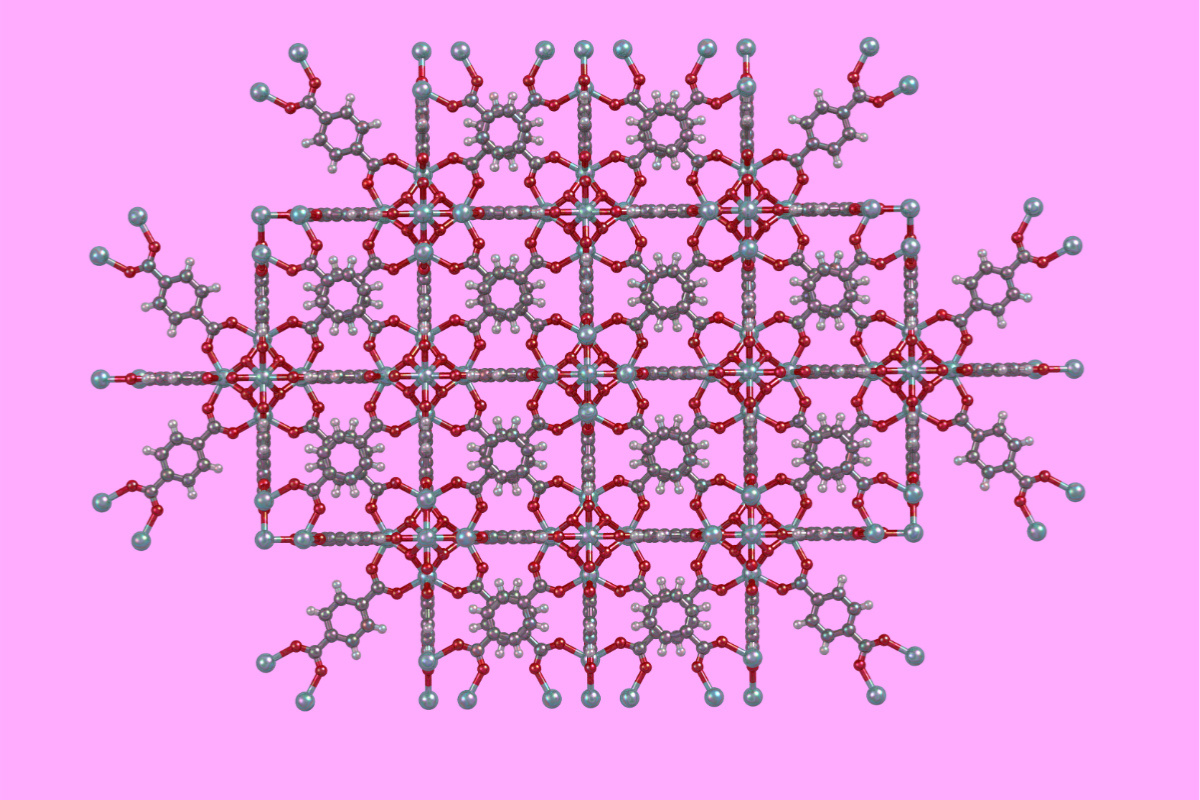
Humans have an innate sense for building structures to modify their natural environment: from simple shelters made of wood, stones or ice-blocks to royal palaces, the Great Wall, cathedrals, and skyscrapers, architecture has shaped our world. At the end of the 20th century, a new form of architecture was unveiled by the three 2025 Chemistry Nobel Prize laureates: using metal ions, molecules and bonds as bricks, steel, and concrete, Susumu Kitagawa at Kyoto University in Japan, Richard Robson at the University of Melbourne in Australia, and Omar Yaghi at the University of California, Berkeley in the US, opened the road to the imagination and creation of a new nano-world populated by wonderful architectures targeted by design.
Crystallographers have a special sense for beauty and patterns, and metal-organic frameworks (MOFs) are a supreme playground to play with motifs, symmetry, and topology, to build a mental representation of what we will never be able to actually see. One of the most pervasive contributions of crystallography to popular scientific imagery and to the modeling of the chemical world in the 20th century has been, in fact, the possibility to visualize molecules through 3D representation, which have immediately become the molecules themselves. Protein crystallography has populated science with ribbons and sheets of stunning beauty, and the first models of haemoglobin and myoglobin, forests of rods made of wood and iron wire, can be considered artwork for explaining nature. Now we have human-made MOFs, which can be rationally designed like a construction toy, and their pictorial representation often competes with the most beautiful patterns created by Islamic art or by the genius of M. C. Escher. The discovery of MOFs' beauty has triggered the flourishment of methods for topological description, the need for the investigation of real defects in the platonic perfect framework, the use of the patterned structure to act as a sponge to reveal the substructure of the pore contents, and a world of ideas to exploit the cavities for storage, delivery, as nano-flasks for catalysis, and to optimize the synthesis by understanding how all the components can assemble in such predictable exact constructions.
What is particularly rewarding for all us crystallographers in the motivation of the Nobel Prize committee, and in the narrative of the decades that brought R. Robson, S. Kitagawa and O. Yaghi to the highest scientific recognition, is that the first idea of assembling metals and ligands in a preorganized way came to Robson while using structural models to teach chemistry, and that the idea was developed by Kitagawa to seek structural stability again by seeing MOF crystals as robust buildings with pores, and that the isoreticularity concept developed by Yaghi still strongly visually resembles the bottom-up design of a castle.
The applications of MOFs are already thrilling chemists and material scientists; the most cited spanning drug delivery, CO2 capture, water storage from deserts, and sequestration of pollutants from the environment. Yet, a non-negligible effect of the MOF research explosion is that it has refuelled the quest for beauty and the excitement in designing and discovering patterns that is one of the most rewarding aspects of being crystallographers.
Alessia Bacchi, Dipartimento di Scienze Chimiche, della Vita, e della Sostenibilità Ambientale, University of Parma, Italy[email protected]
Copyright © - Prior permission is not required to reproduce short quotations, tables and figures from this article, provided the original authors and source are cited.
The permanent URL for this article is https://www.iucr.org/news/newsletter/volume-33/number-6/mofs-function-in-beauty