




Notice
CSD Communications: Expanding Access to Crystallographic Data

CSD Communications is a way to share small molecule crystal structures directly in the Cambridge Structural Database (CSD) without requiring an associated scientific publication.
Each entry includes author and crystallographer details, an ISSN, and a full CCDC citation with DOI and publication year, ensuring proper credit for data contributors. The goal is to expand public access to crystallographic data. Around 5000 structures are shared annually that might otherwise remain unpublished. Previously known as Private Communications, CSD Communications helps make valuable scientific data widely available.
It’s a community-driven effort, with datasets contributed by researchers from around the world. Check out how the CSD has grown over the years.
Explore structures published as CSD Communications in our online access structures service by searching Journal = CSD Communications.
And find out more about how to deposit your structures in the CSD.
CCDC Publications 2025
The CCDC team regularly publish the results of their research, often in collaboration with other academic and industrial scientists. The topics range from Crystallographic Data Quality and Spectroscopic Data Standards and Curation in the Physical Sciences to Computational Chemistry & Drug Discovery, and more.
You can explore the full list of our publications on our website.
New Training and Learning Resources Launched in 2025
New Videos
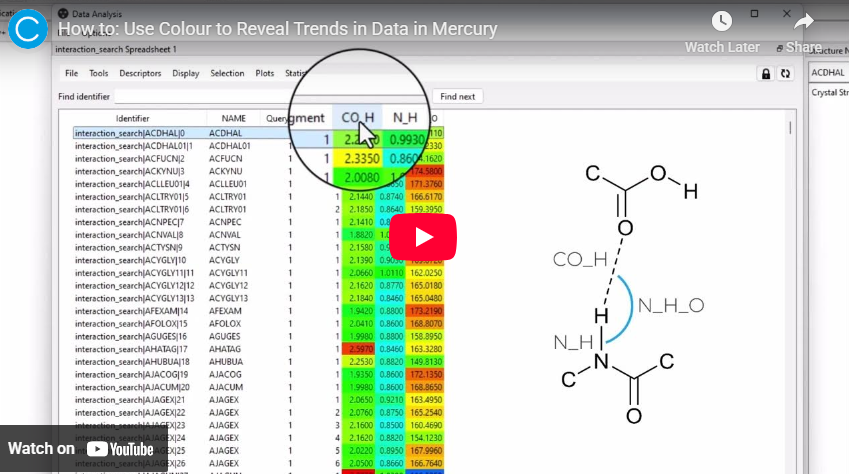
In this video, we demonstrate how to apply colour to spreadsheet columns and how to add colour as an indicator of a third variable in scatterplots. This will be of interest to researchers analysing 3D data from structure searches of the CSD, as well as educators and students seeking to understand or demonstrate fundamental chemistry concepts such as hydrogen bonding.
In this 5-minute video, you can learn about the different CSD subsets available, how to view and search them in ConQuest, and how to access them in Mercury. You can also find out about CSD classifiers as a complementary way to uncover entries belonging to different chemical classes.
Learn how to select and filter data in Mercury’s Data Analysis module, using results from ConQuest searches. You’ll learn how to apply numerical and text filters to explore and save datasets. These tools are useful for crystallographers, chemists, and materials scientists working with complex data, and can also support teaching core chemistry concepts.
With this tutorial, you'll learn how to search using WebCSD and download data, making it ideal for enhancing literature reviews and research. It’s a great starting point for students and researchers looking to explore the CSD, contextualise results, and see how the CSD can support scientific writing.
This video tutorial shows you how to create different query types and combine them in a single search in ConQuest. You can also see how to view search results and information, how to export results and how to save search sessions.
Explore, search, and view 3D structures in WebCSD. Watch this tutorial to learn how to draw substructure queries, set 3D constraints like distances and angles, and explore structural data using built-in tools.
Self-guided Workshops
In this workshop, you can explore methods to compare closely related coordination polymers using tools in Mercury and calculate the pore properties of a metal-organic framework (MOF).
You will learn how to visualise and control the display of coordination polymers, overlay structures in Mercury, run a Pore Analyser calculation, and calculate pore properties programmatically using the CSD Python API.
Explore molecular geometry with Mogul and the CSD Python API in our new self-guided workshop! In this workshop you can also learn about the handling of disorder in the CSD and how to assess the geometry of disordered structures. It’s a practical way to deepen your understanding of 3D disorder data in over 300,000 CSD entries.
CSD60 Frontier Panel Webinars - Watch On Demand
This year, we hosted four panel webinars to celebrate the 60th anniversary of the CCDC and the CSD. Each session brought together experts from our community to explore key themes: Data, Education, Drug Discovery, and MOFs. Together, they reflected on progress made in these areas and shared inspiring insights into the many opportunities still ahead for the scientific community.
All webinars are available to watch on demand.
Stay Connected
You probably already follow us on Facebook, LinkedIn, Instagram, and now BlueSky, but there’s more!
- Monthly Newsletter: Latest blogs, software updates, data news, events, and community highlights.
- Training & Outreach Newsletter (every 2 months): Updates on training events and educational resources.
Sign up to get these updates straight to your inbox.
Do you have ideas for blogs, case studies, webinars, or outreach activities? Email us at [email protected]. We’d love to hear from you!
For licence queries, contact [email protected] or our support team at [email protected].
Copyright © - Prior permission is not required to reproduce short quotations, tables and figures from this article, provided the original authors and source are cited.
The permanent URL for this article is https://www.iucr.org/news/newsletter/volume-33/number-6/csd-communications-expanding-access-to-crystallographic-data