




Meeting report (IUCr supported)
6th International School on Aperiodic Crystals 2025 in Dresden, Germany
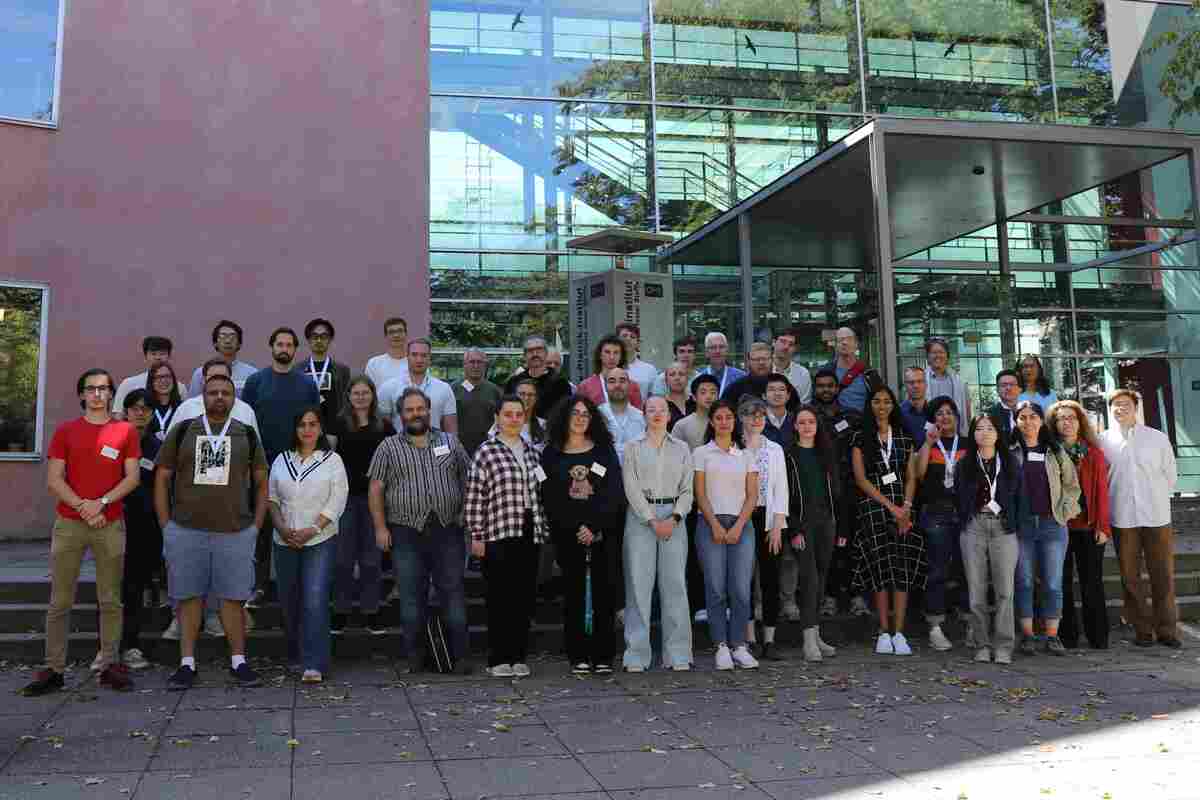
From September 1 to 5, 2025, the 6th International School on Aperiodic Crystals (ISAC-6) took place at the Max Planck Institute for Chemical Physics of Solids (MPI CPfS) in Dresden, Germany. This series of summer schools was launched in 2010 by the Aperiodic Crystals Commission of the International Union of Crystallography (IUCr) to promote knowledge among crystallographers of superspace or high-dimensional space methods for the description and understanding of modulated structures, polytypes, incommensurate misfit or composite crystals, and quasicrystals. This year’s event, a satellite meeting of the 35th European Crystallographic Meeting in Lviv and Poznań, was organized by Dr Eteri Svanidze (MPI CPfS, Dresden) and Professor Thomas Doert (TUD, Dresden University of Technology).
Forty participants gathered to learn about the fundamentals of aperiodic crystals, super-space symmetry, and quasicrystals. In addition, profound insights were provided into diffuse scattering, electronic and physical properties of aperiodic crystals, phasons, chemical bonding in intermetallic compounds, and aperiodic magnetic structures. In four extensive exercise sessions, the participants were able to apply and deepen their newly acquired knowledge with the active support of the lecturers.
The program featured a distinguished lineup of lecturers from multiple countries who contributed significantly to the success of the event through their didactically well-structured presentations and their great commitment to the exercises. Following introductory lectures by Professor Marc de Boissieu (Grenoble, France), Professor Sander van Smaalen (Bayreuth, Germany), and Dr Václav Petříček (Prague, Czech Republic), course participants were able to practice solving and refining a modulated crystal structure. On Tuesday, Professor Emilie Gaudry (Nancy, France) shed light on the electronic and physical properties of aperiodic crystals before Professor Tsunetomo Yamada (Tokyo, Japan) laid the foundations for quasicrystals. The relationship between diffuse scattering and disorder was discussed on Wednesday by Professor Ella M. Schmidt (Bremen, Germany), and Marc de Boissieu introduced the concept of collective excitations in aperiodic structures. On Thursday, Dr Eteri Svanidze and Professor Yuri Grin (Dresden, Germany) provided exciting insights into structures and chemical bonding in complex intermetallic compounds. After a second lecture on quasicrystals, the participants analyzed the diffraction pattern of an icosahedral quasicrystal under the guidance of Professor Yamada. The last day of the school was devoted to the topic of magnetic aperiodic structures in theory (Professor Anuradha Jagannathan, Paris, France) and practice (Dr Margarida Henriques, Prague, Czech Republic), and was also explored in depth in an exercise.
A poster session on Tuesday provided the opportunity to present participants' own research findings and discuss them with experts in the field. Three poster prizes were awarded to PhD students and early career scientists.
The programme was enriched by an excursion to Terra Mineralia in Freiberg, one of the largest mineral collections in the world.
ISAC-6 provided an excellent platform for early career researchers to gain a solid grounding in the theory and practice of structures and properties of aperiodic crystals. The combination of lectures, tutorials, and poster discussions fostered networking, exchange of ideas, and potentially future collaborations. The hands-on and practical components are especially meaningful in a field where many concepts and computational tools do not belong to standard curricula.
Thanks to generous financial support from the IUCr, the German Crystallographic Society (DGK), and the German Chemical Society (GDCh), the participation fee for young scientists was reduced and travel subsidies could be granted.
We would also like to express our gratitude for the financial support provided by the European Center for the Development of New Metal Alloys and Compounds (ECMetAC, Leuven, Belgium) and the Collaborative Research Center 1143 “Correlated Magnetism: From Frustration to Topology”, as well as the industrial sponsors Bruker-AXS (Karlsruhe, Germany), Dectris (Baden, Switzerland), Quantum Design Europe (Pfungstadt, Germany), Rigaku SE (Neu-Isenburg, Germany), and STOE & Cie. (Darmstadt, Germany).
Last but not least, we would like to thank the staff of MPI CPfS for providing the infrastructure and for their friendly, competent, and uncomplicated support in the run-up to and during the event!
Copyright © - Prior permission is not required to reproduce short quotations, tables and figures from this article, provided the original authors and source are cited.
The permanent URL for this article is https://www.iucr.org/news/newsletter/volume-33/number-6/6th-international-school-on-aperiodic-crystals-2025-in-dresden,-germany