





Commentary
Kinetic effects yield different results on the timescales of laboratory and synchrotron high-pressure experiments
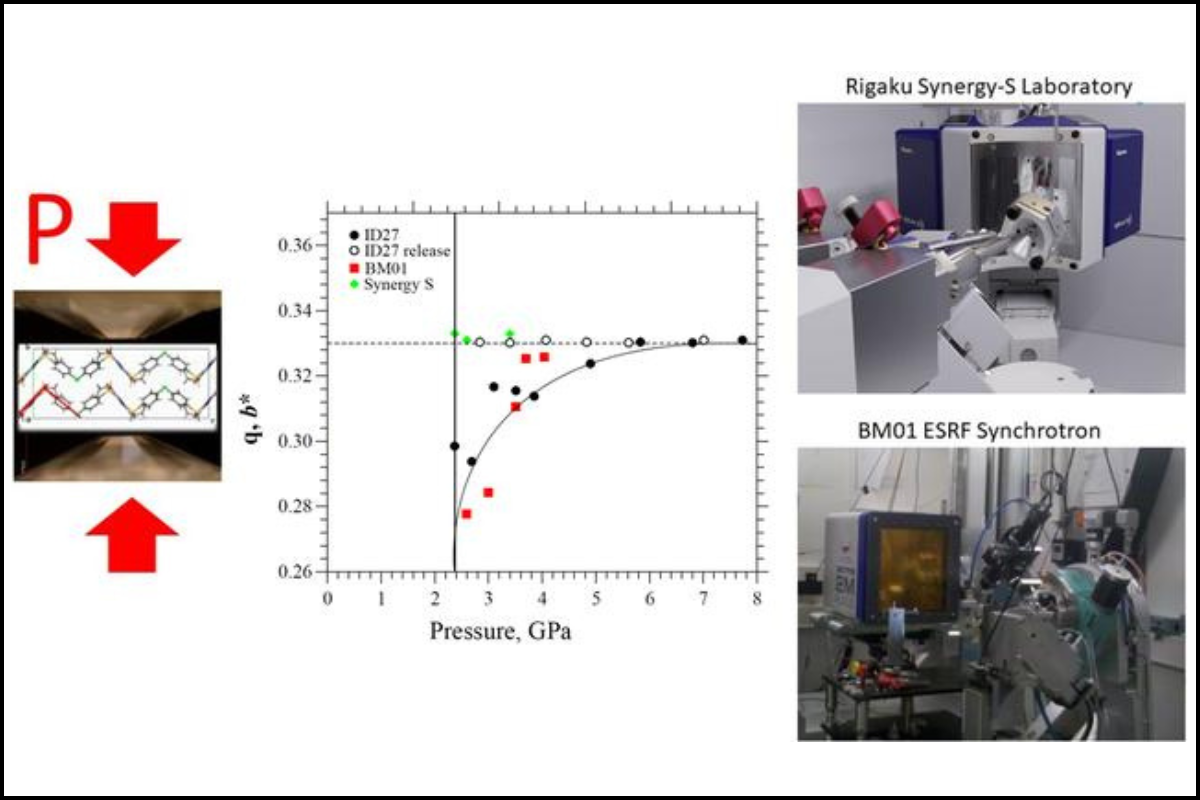
Upon compression of δ-chlorpropamide, direct transformation to a commensurate (q = 0.33) high-pressure phase is observed in laboratory single-crystal X-ray diffraction experiments, whereas an intermediate incommensurate (q < 0.33) phase is observed in synchrotron experiments owing to kinetic effects. [The structure and the pressure plot are reproduced from Bogdanov et al. (2026).]
High pressure is a powerful tool for probing the structure of crystalline solids, enabling changes in crystal volume with minimal impact on thermal motion and thereby altering interatomic interactions. It is particularly valuable for studying polymorphism in pharmaceutical compounds, where different crystal forms can affect drug performance. In this issue of IUCrJ, Bogdanov et al. present a detailed high-pressure study of δ-chlorpropamide, a diabetes drug known for its extensive polymorphism, using single-crystal X-ray diffraction across multiple laboratory and synchrotron setups.
Read the full commentary in IUCrJ.
Copyright © - Prior permission is not required to reproduce short quotations, tables and figures from this article, provided the original authors and source are cited.
The permanent URL for this article is https://www.iucr.org/news/newsletter/volume-34/number-2/kinetic-effects-yield-different-results-on-the-timescales-of-laboratory-and-synchrotron-high-pressure-experiments