




Meeting report (IUCr supported)
LACA–ABCr 2025 Meeting Report
Introduction and Objectives
The VII Meeting of the Latin American Crystallography Association (LACA) and the XXVII Meeting of the Brazilian Crystallography Association (ABCr), held jointly with the LACA-ABCr School, successfully took place at the Federal University of Ceará. The events fulfilled their main objective of promoting the integration of the Latin American scientific community, presenting advances in the diverse areas of crystallography and structural sciences, and fostering the training of new researchers.
Maintaining the internationalization strategy initiated in previous editions, the event adopted English as its official language, consolidating itself as a global forum and facilitating interaction between scientists from different continents. Furthermore, the organization was guided by a strict commitment to gender equity and diversity, reflected in the balanced composition of the committees, the selection of invited speakers, and the distribution of financial aid, ensuring an inclusive and representative environment.
The financial support received, notably the key grants from the International Union of Crystallography (IUCr), was fundamental to guarantee the scientific quality of the events and, mainly, to enable the participation of students and young researchers, aligning with the principles of inclusion and fostering the new generation of scientists.
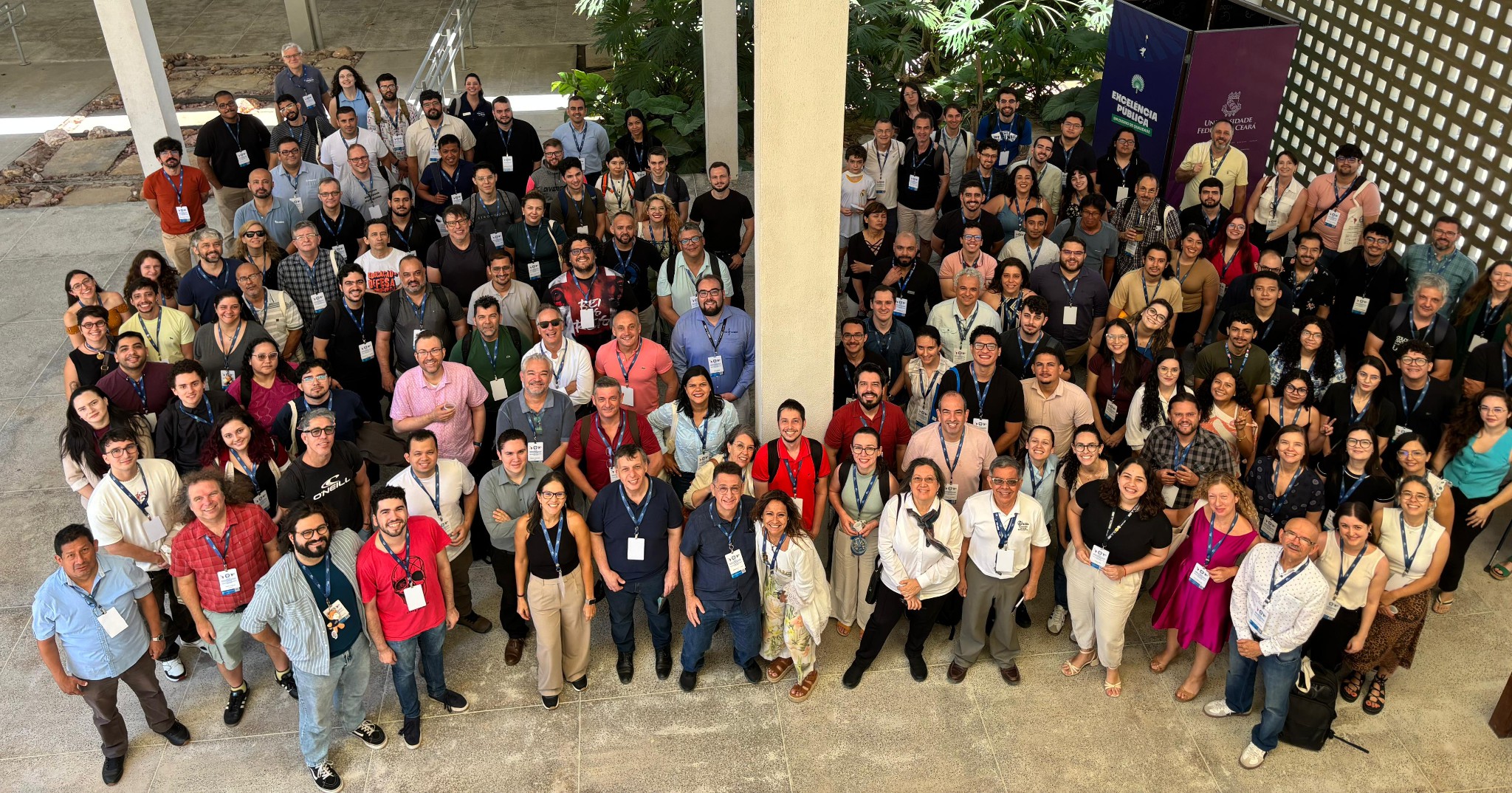
Participants of the VII Meeting of the Latin American Crystallography Association (LACA), XXVII Meeting of the Brazilian Crystallography Association (ABCr), and LACA-ABCr School in Fortaleza, CE, October 2025.
Participation and Reach
The joint event consolidated itself as the main crystallography forum in Latin America in 2025, presenting the following numbers:
- Total Participants: 240 registered.
- International Reach: 20 countries represented.
- Brazilian Participation: 150 participants (63% of the total).
- Female participation: 109 (37%)
- Latin American Participation: The event featured representatives from 10 Latin American countries (including Brazil), totaling 195 registered participants and representing 81% of the total audience, which reinforces the regional integration character of the meeting.
Scientific and Technical Program
The scientific program of the joint event was dense and high-level, structured to cover the frontiers of crystallography and, at the same time, promote interaction between different subareas. The activities were divided between the two main events (LACA-ABCr School and LACA-ABCr Meeting) and the joint poster and exhibition sessions.
The main event, held from October 14 to 17, continued the tradition of scientific excellence of the associations. The program was composed of:
- 73 Oral Presentations: Distributed among Plenary Lectures, Keynotes, and selected oral contributions.
- 10 Thematic Microsymposia: Covering a vast spectrum of research, including Structural Biology (applied to Drug Discovery and Integrative), Quantum Crystallography, Drugs and Natural Products, Materials Science (Functional, Inorganic, and Soft Matter), Organometallic Compounds and MOFs, and Advanced Techniques (Neutrons and Synchrotron).
Poster Sessions and Exhibition Area
The exhibition area was the heart of the congress's interaction, functioning in an integrated manner throughout the period.
- Poster Sessions: A total of 120 works were presented in poster format, with dedicated sessions that occurred simultaneously with coffee breaks to maximize discussion.
- Commercial and Institutional Exhibition: The event had the participation of 11 booths from the main companies in the scientific instrumentation and software sector. Additionally, there were institutional booths from the International Union of Crystallography (IUCr), the American Crystallographic Association (ACA), and the International Centre for Diffraction Data (ICDD).
- Recognition Awards: To encourage the scientific excellence of young researchers, awards were granted to the best poster presentations, sponsored by our institutional partners: ICDD Award, CCDC Award, PDB Award, and the LACA–ABCr/IUCr Award. This format follows the success of previous events, such as the VI LACA in Montevideo.
Training Activities
A fundamental pillar of the LACA-ABCr 2025 event was the commitment to the training of high-level human resources, materialized through two intensive satellite Schools held before the main events. These activities were designed to provide theoretical and practical training in frontier techniques, delivered by renowned international and regional specialists.
LACA-ABCr School (October 13-14)
This school served two central communities of crystallography through parallel courses:
- Structural Determination of Small Molecules: Focused on advanced resolution and refinement methods for the chemical crystallography, materials science, and pharmaceuticals community, including the practical use of databases like the CSD.
- X-ray Fragment Screening: Directed at the structural biology community, addressing modern techniques essential for the process of discovering new drugs.
The two intensive satellite schools attracted the participation of 60 students, with 30% of them being women. Furthermore, the commitment to gender equity was also reflected among the faculty, as 75% of the school's speakers were women.
The realization of these schools was a success, capacitating dozens of postgraduate students and young researchers from across Latin America. This initiative not only raised the technical level of the participants but also fulfilled the associations' mission of disseminating knowledge and ensuring the training of the next generation of crystallographers in the region.
Execution of Financial Support
Financial support from funding agencies, institutional sponsors, and commercial partners was critical to the success of LACA-ABCr 2025. Fund management was strategically focused on maximizing the event's scientific and educational impact, with a special emphasis on fostering the participation of young researchers.
Funding Sources
Resources were secured through a combination of:
- Institutional Sponsorships: Including IUCr, ICDD, CCDC, ACA, and ISIS.
- Funding Agencies: CAPES, CNPq, and FUNCAP.
- Commercial Sponsorships: From sector companies like Bruker, Rigaku, and Dectris.
The International Union of Crystallography (IUCr) provided key support through grants for the LACA-ABCr School (US$ 2,500), a Visiting Professor Grant (US$ 2,200), and a grant for the LACA-ABCr Meeting (US$ 5,000). These funds were utilized to support the School faculties, specifically Professors Florencia di Salvo (Argentina) and Vojtech Jancik (Mexico), and to reinforce the bursaries program.
Support for Young Researchers and Inclusivity
In line with the associations' core objective to cultivate the next generation of scientists, financial aid was directed toward enabling the presence of students and post-doctoral researchers.
- Bursaries: A total of 49 bursaries were granted to young researchers from eight Latin American countries (43% Brazilian). This support was crucial for promoting geographical and gender diversity, with 43% of the aid granted to women. All bursary recipients committed to participating in one of the training courses. From the 49 granted bursaries, 37 were able to attend the school and main meeting (38% women).
- Logistical Support: A partnership with the Federal University of Ceará (UFC) provided access to the University Restaurant (RU), benefiting more than 60 undergraduate and postgraduate students by covering their meals and ensuring full participation without additional costs.
The effective execution of these resources was fundamental to achieving the event’s goals of inclusion and human resource training, granting dozens of students access to cutting-edge scientific content and vital networking opportunities that would have otherwise been inaccessible.
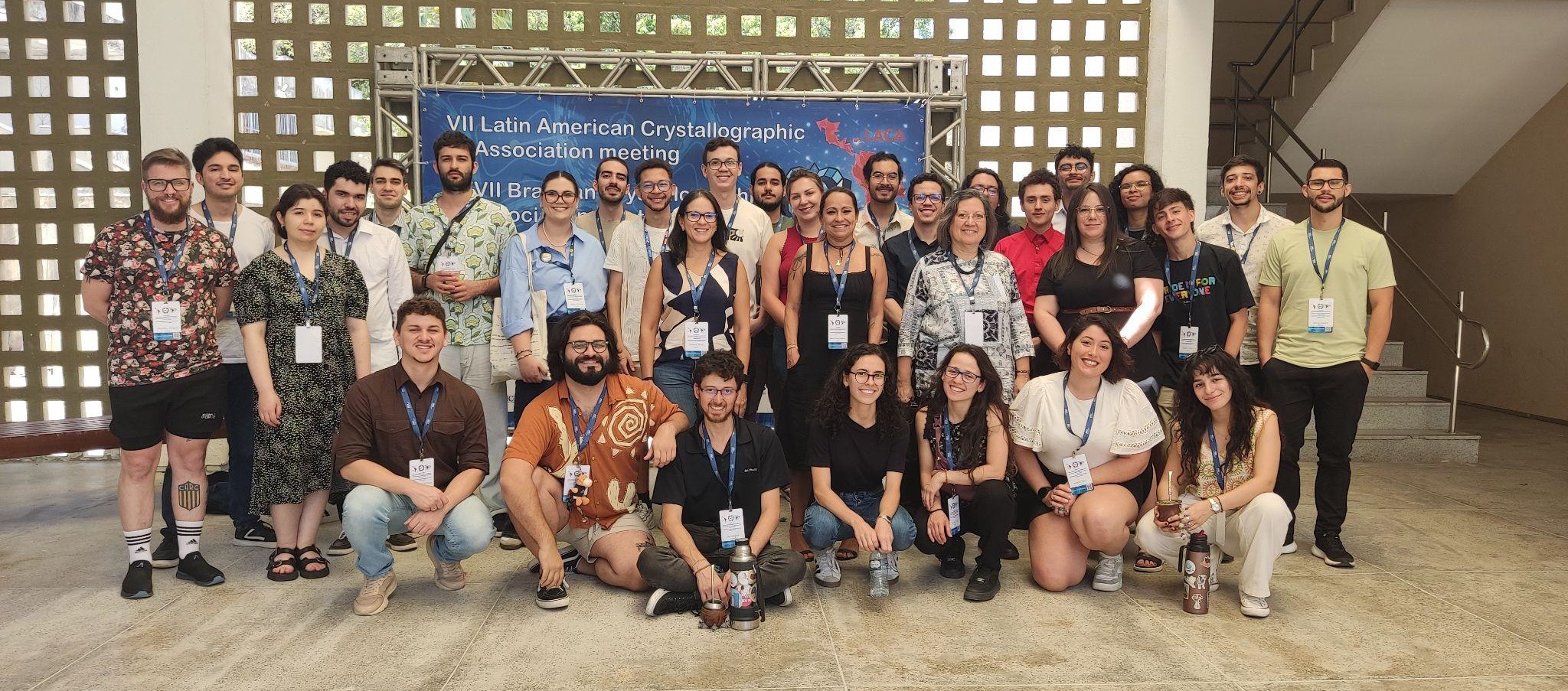
Young researchers who received bursaries to attend the LACA-ABCr 2025 meeting and school.
Conclusion
The VII LACA Meeting, the XXVII ABCr Meeting, and the LACA-ABCr School consolidated themselves as a landmark of absolute success for the Latin American crystallographic community. The central objectives of scientific integration, fostering the training of new researchers, and technological exchange were fully achieved.
The event proceeded in an organized manner, without unforeseen circumstances, standing out for the notable engagement and constant presence of participants in all technical sessions. The high quality of the scientific discussions and the intense interaction during the poster sessions and social activities indicate that new and lasting collaborations were established. The congress, therefore, concludes with a positive legacy, reinforcing the vitality of the community and boosting the future of structural sciences in Latin America.
Copyright © - Prior permission is not required to reproduce short quotations, tables and figures from this article, provided the original authors and source are cited.
The permanent URL for this article is https://www.iucr.org/news/newsletter/volume-34/number-2/latin-american-meetings