




Obituary
Paul Barnes (1942–2025)
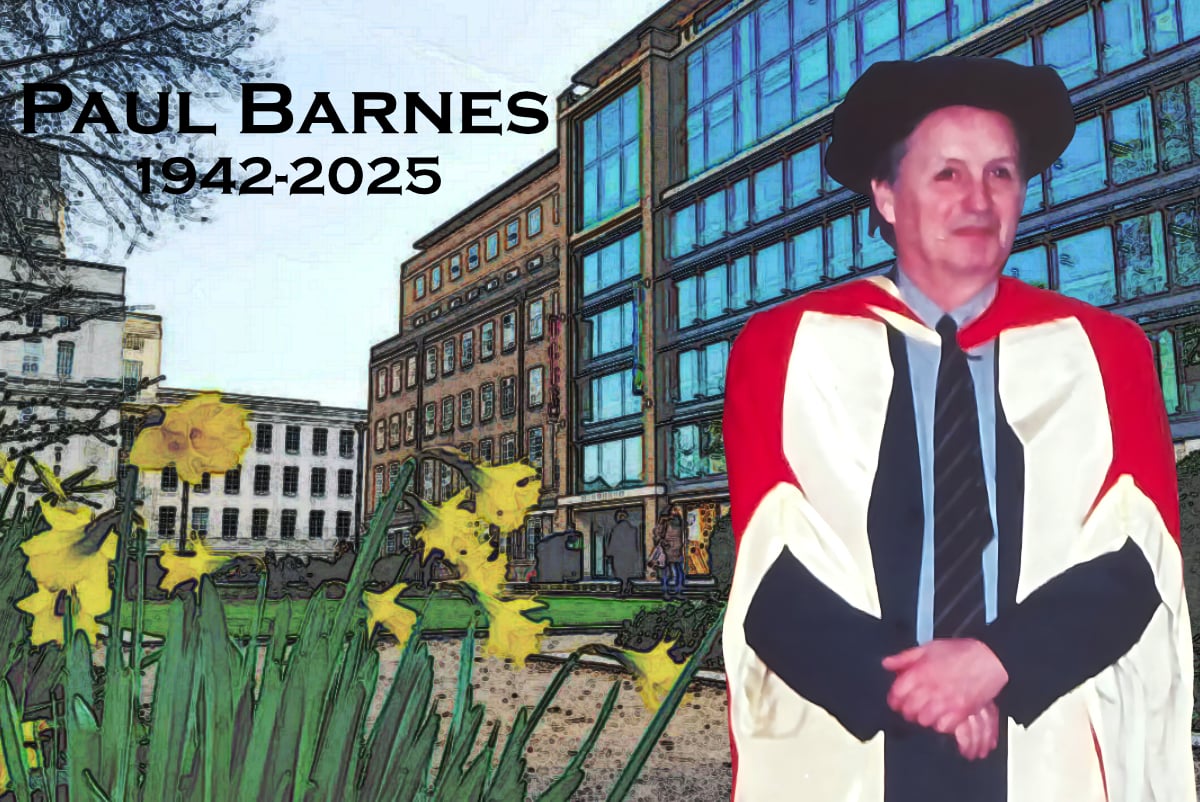
Paul Barnes was a child of World War II and the Welsh valleys, growing up near Swansea in South Wales. Raised with a Christian upbringing, his faith remained a cornerstone of his life. As a child, he was fortunate to receive a Hornby Dublo 3-rail locomotive, an expensive gift in the post-war years, particularly given the metal restrictions imposed on toy manufacturers such as Meccano as a result of the 1950s Korean War. This toy was a gift that Paul treasured throughout his life, and which sparked a lifelong interest in trains and model railways. At school, Paul developed a love for both science and music, but when it came time to decide on a university course, he chose physics. In later years, Paul admitted to many that this was a difficult choice, as his passion for music was very strong, and, like his enduring interest in railways, he maintained a lifelong love of music, particularly classical music. At his funeral, in addition to hymns, musical pieces by both Chopin and Debussy were played live in the chapel, as well as at the graveside; the musical duets were for piano and violin, two of Paul’s favourite instruments.
Paul’s academic journey took him from the Welsh valleys to the University of Bristol, where he earned a BSc in Physics. From there, he moved to the Cavendish Laboratory at the University of Cambridge to pursue a PhD in the Physics and Chemistry of Solids, under the guidance of Professors F. P. Bowden and D. Tabor. His research in surface physics focused on plastic flow and deformation in ice, a subject likely influenced by Bowden’s own enthusiasm for skiing. Paul’s academic career quickly gained momentum, with two papers published in Nature on his research. As was typical in those years, Paul learnt mechanical workshop skills that he put to good use elsewhere, for example, in building a spit on which to roast a pig. Apparently, the only way of getting a whole pig back to the student house was to strap it upright in the front seat of a car, something that caused a stare from many a passerby. His workshop skills were put to use at a much later date when we needed a part urgently for an ESRF experiment, and Paul volunteered to turn it himself on one of the workshop lathes.
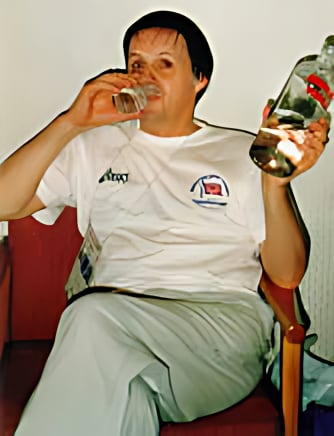
From his UCL/Birkbeck Homepage “an untypical picture of me in 1995; I am almost teetotal, but found a rare excuse here to celebrate!”
Next, Paul took a research position in the liquids group in the new Department of Crystallography at Birkbeck College, led by Professor J. D. Bernal. Visiting Bernal on his deathbed at home clearly had a profound effect on Paul, as he would often recount the visit in later years. A few years later, Paul was to secure a lectureship in the department. At the same time, he took on the leadership of the “Industrial Materials Group,” an area of crystallography championed by Bernal that focused on problems of industrial interest, such as cements. Paul continued in this role until his retirement. He was awarded a DSc from the University of London and was promoted to a personal chair in Applied Crystallography in 1994. Paul was a staunch supporter of the British Crystallographic Association (BCA) and, particularly, the Industrial Group of the BCA, and he had strong ties with many of its members.
During the 1980s and 1990s, Paul became a major user of synchrotron and neutron-scattering facilities for studying industrial problems. Although not trained as a chemist, Paul was most comfortable working with inorganic materials such as zeolites, zirconias, and cements. Paul was happy to ask for very large samples of the latter, and the excess did not go to waste, as it enabled him to construct his garage! Paul was less comfortable working on organic materials such as pharmaceuticals; this work was left in the domain of his PhD student Stephen Tarling (often working with Mike Glazer), and later on, myself working with Martin Vickers.
Paul’s close relationship with the Daresbury Synchrotron Radiation Source (SRS) made him a natural choice for the role of Industrial Liaison Officer. One of Paul’s key contributions was to in-situ diffraction studies. Early on, he recognised the potential of hard X-rays for this purpose, and in collaboration with Bob Cernik at SRS, Paul developed a more efficient setup. The new configuration, installed at station 16.4, enabled simultaneous energy-dispersive diffraction (EDD) measurements at three different Bragg angles, allowing the study of materials across a broad range of d-spacings. Paul also helped pioneer the concept of diffraction tomographic imaging, which evolved from basic 2-D scanning to monitor spatially components in solid samples like oil-well rock cores. Today, this technique, now done in angle-dispersive mode, is a key tool in materials research.
As the UK’s sole Department of Crystallography shifted its focus solely to biological research at the end of the 20th century, Paul negotiated with Richard Catlow for the entire Industrial Materials Group to move “next door” to the Department of Chemistry at University College London (UCL). However, Paul remained a “Birkbeck man” throughout his academic career and was elected as an Honorary Fellow of Birkbeck College in 2007. As an applied crystallographer, Paul collaborated with many prominent academics at UCL, including Richard Catlow, Gopinathan Sankar, Paul McMillan, Andy Beale, and many others, particularly in research involving major scientific facilities.
Beyond his scientific contributions, Paul had many other talents. He served as a governor and College Dean at Birkbeck, where he was known for his unwavering fairness in addressing issues and grievances from staff and students. A keen sportsman, Paul was a gymnast in his youth and continued playing squash well into old age, often playing with Graeme Hogarth from UCL Chemistry. Paul would take the opportunity to play it when travelling to international conferences, a notable occasion being a game against John Helliwell at the IUCr XVI Congress in Beijing in 1993. I was told by Paul that this attracted a large number of spectators. His athletic prowess also led him to become an international gymnastics judge, officiating at several World and Commonwealth Championships, culminating in his role as one of the judges at the 1984 Los Angeles Olympics.
Paul was also an accomplished pianist and composer. In 2017, he arranged for a public premiere of his composition “Layers of Life” by the Billroth String Quartet. The piece, consisting of four movements representing distinct musical periods—Baroque, Classical, Romantic, and Modern—served as a reflection of Paul’s own life. The movements, titled “The Physical (From the Beginning),” “The Emotional (Youth and Nostalgia),” “Maturity (Accomplishment),” and “Celebration (Fulfilment),” captured the essence of his personal and professional journey through life. As an event ticket holder, I had the impression that the audience was deeply captivated by the recital, as was I.
On a personal note, Paul was a devoted father to his only daughter, Rebecca. After his wife, Desirée, passed away, he took Rebecca with him to scientific conferences worldwide. Thus, Rebecca attended many European crystallography meetings with Paul, as well as IUCr Congresses. However, despite experiencing worldwide travel, Paul always maintained a fondness for the Welsh Coast. In particular, Rhossili Bay at the end of the Gower peninsula, Swansea, was one of the few places in South Wales that he really enjoyed visiting.
Paul lived with Parkinson’s disease for many years, diagnosed around the time the research group moved to UCL. Although the disease affected his physical movements in general, his mind remained sharp and inquisitive until the very end. This said, on the occasion of his 80th birthday party, Paul was able to play the piano to perfection but struggled to hold a microphone when talking about events in his life, so clearly the music changed him in some way. When Martin Vickers and I visited Paul in December 2025, Paul was still asking scientific questions despite being physically frail. However, somewhat sadly, he passed away shortly after Christmas 2025, following a brief bronchial illness. It was striking at his funeral to see people gathered from so many walks of Paul’s life — academics, musicians, as well as family, friends and neighbours. The fact that some travelled from as far away as Australia to attend it is a testament of the impact that Paul had on the lives of others.
Paul took a charitable view of people. As a mentor, I recall Paul saying, “You never know it, but one day the person you are commenting on now may be reviewing your grant in later years”. It was Paul’s own way of saying: take a Christian approach to life. So by way of epitaph, Paul was a good friend and collaborator to many, a fine scientist, and a very decent chap. He will be deeply missed.
A personal perspective written by Jeremy K. CockcroftCopyright © - Prior permission is not required to reproduce short quotations, tables and figures from this article, provided the original authors and source are cited.
The permanent URL for this article is https://www.iucr.org/news/newsletter/volume-34/number-2/paul-barnes-19422025