




Meeting report (IUCr supported)
Structural Biology at the Foot of the Andes
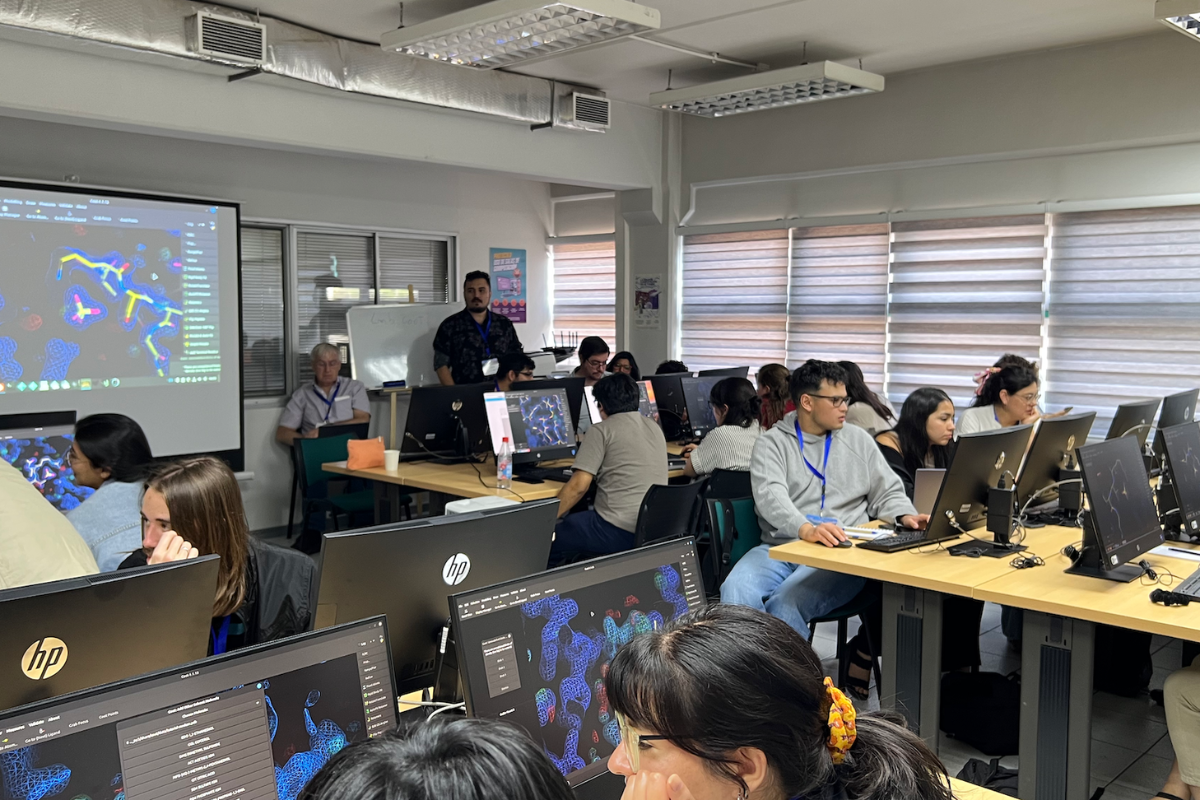
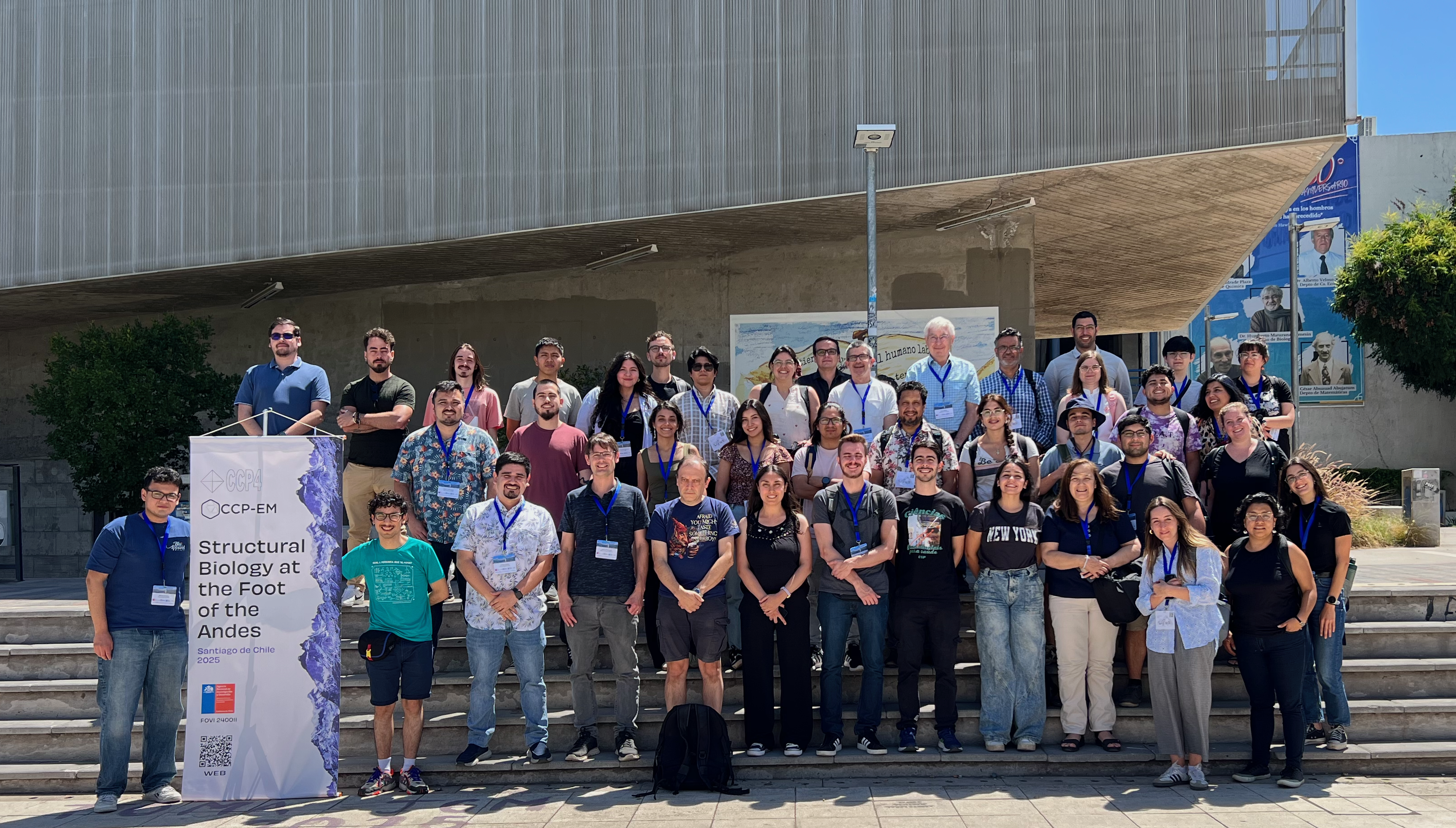
From 10 to 20 November 2025, the Faculty of Sciences from the Universidad de Chile, became the setting for an intensive and transformative training experience in structural biology. The CCP4/CCP-EM School Santiago, Chile: Structural Biology at the Foot of the Andes brought together expert tutors and early-career researchers from across Latin America and beyond, for ten days of lectures, tutorials, problem-solving sessions and hands-on practice in macromolecular crystallography and cryo-electron microscopy (cryo-EM).
The school was coordinated by Dr. Victor Castro and Dr. Victoria Guixé from the Universidad de Chile, together with Dr. James Parkhurst from the Rosalind Franklin Institute (UK). It was funded through the International Networking Program of the National Research and Development Agency (ANID), Chile (grant FOVI240011), and the Collaborative Computational Project No. 4 (CCP4), with additional support from the International Union of Crystallography (IUCr), the Facultad de Ciencias of the Universidad de Chile, the Universidad de Concepción, CCP-EM, Global Phasing Limited, Dectris, Onyxtech, Fermelo and Genexpress.
This marked the first time a joint CCP4/CCP-EM school was organized in Chile. The most recent editions held in Latin America took place in 2021 at the Institut Pasteur in Montevideo, Uruguay. Before that, up to 2018, the school was organized on a yearly basis, alternating between the Institut Pasteur de Montevideo and the Physics Institute in São Carlos at the University of São Paulo. In this context, the school stands as a milestone in reactivating the organization of these events, helping to renew their momentum and further promote the development of structural biology across Latin America. Importantly, the Chilean edition introduced a joint CCP4/CCP-EM format, whereas previous editions were exclusively CCP4 schools: for the first time, the programme incorporated a full week dedicated to cryo-EM, reflecting Chile’s growing commitment to building capacity in this technique. As Dr Castro has noted, the country is working to establish a medium-complexity centre for cryo-EM sample analysis. This school was a key component of that broader strategy to train the next generation of researchers who will operate these facilities and push the boundaries of structural biology in the region.
Bringing Together a Regional Community
The school received 65 applications, from which 30 participants were selected through a competitive review process. The cohort was remarkably diverse: 17 international students (57%) joined 13 Chilean participants (43%), together representing six countries: Argentina, Brazil, Peru, Colombia, Ecuador and Chile. Among the international students, the largest contingent came from Argentina (6), followed by Brazil (5), Peru (3), Colombia (2) and Ecuador (1). The Chilean participants were drawn mainly from Santiago (9), with additional students from Concepción (2), Talca (1) and Valdivia (1), reflecting the geographical spread of the country’s structural biology community.
The participant profile spanned several career stages: PhD students formed the largest group (12, 40%), closely followed by MSc students (11, 37%), with smaller numbers of academics (2), postdoctoral researchers (2), undergraduate students (2) and one research assistant. This distribution reflects the school’s aim of reaching researchers at formative stages of their careers, when intensive training in data processing and structure determination can have the most lasting impact on their scientific trajectory.
Gender balance was a central concern from the outset. Overall, 40% of the selected students were women (12 out of 30). Among the international participants specifically, the proportion was even higher: 53% women (9 out of 17). The Organizing Committee followed IUCr gender equity and diversity guidelines throughout the selection process, paying particular attention to equitable representation when evaluating applications and awarding IUCr travel grants.
Scientific Programme: From Crystals to Cryo-EM Maps
The school was structured as a two-week programme totalling 70.25 contact hours, combining lectures (35.25 h, of which 1 h corresponded to industry talks), hands-on tutorials (16 h), guided problem-solving sessions (16 h) and student presentations (2 h). This balance between theory and practice was deliberately designed so that participants could apply concepts immediately after learning them, working through real datasets under the supervision of experienced tutors.
The first week (10–15 November) was devoted to macromolecular X-ray crystallography. Day 1 introduced the foundational concepts of the field; Day 2 covered data collection, processing and phasing; Day 3 addressed data processing in depth and molecular replacement; Day 4 explored phasing in the AlphaFold era, a timely topic given the transformative impact of AI-predicted models on experimental structure determination; and Days 5 and 6 focused on refinement and model building using the CCP4 suite.
The second week (17–20 November) shifted to cryo-electron microscopy. The programme began with a general overview of cryo-EM on Day 8, followed by data processing workflows on Day 9, cryo-EM refinement on Day 10 and validation and deposition on Day 11. This week made extensive use of the CCP-EM software suite, and participants worked through single-particle analysis pipelines from raw micrographs to validated atomic models.
Experimental protein structure determination remains a cornerstone of modern biology. These methodologies allow researchers to understand, at atomic resolution, how the molecules that sustain life function, a knowledge that translates directly into advances in precision medicine, rational drug design, enzyme engineering and numerous biotechnological applications. Initiatives like this school strengthen regional capacities in these strategic areas and contribute directly to the scientific and technological growth of the country and the wider Latin American region.
An International Team of Tutors
A total of 25 tutors delivered the programme, drawn from seven countries. The largest contingent came from the United Kingdom (11, 44%), reflecting the strong involvement of the CCP4 and CCP-EM groups based at STFC, the MRC Laboratory of Molecular Biology, the Rosalind Franklin Institute, the University of Cambridge and the University of Liverpool. Chilean researchers contributed five tutors (20%), from the Universidad de Chile, the Universidad de Concepción and the Universidad Autónoma de Talca. Brazil was equally represented with five tutors (20%) from the University of São Paulo, the Universidade Estadual de Campinas and Sirius (LNLS-CNPEM). Argentina, Uruguay, the United States and Spain each contributed one tutor. Three tutors participated remotely: Eugene Krissinel and Rangana Warshamanage from the Research Complex at Harwell (UK) and Grzegorz Chojnowski from ALLOX (Spain).
Among the tutors, 28% were women (7 out of 25). The organizing committee is committed to improving this ratio in future editions, in line with IUCr policies on gender equity and diversity.
Ensuring Access: Travel Grants and Student Support
Access and inclusion were central priorities from the outset of the planning process. IUCr travel grants enabled the participation of international students who would otherwise not have been unable to attend. In particular, 64% (9) of the IUCr-funded awardees were international female students, contributing directly to the strengthening of female representation at the school.
The CCP4 and ANID FOVI240011 grant formed the backbone of the school’s funding, covering venue costs, logistics, tutor travel and accommodation, and overall coordination. This support was complemented by contributions from commercial sponsors (Global Phasing Limited, Dectris, Onyxtech, Fermelo, and Genexpress), enabling the delivery of a programme of this scale in a Latin American setting. To further promote access and participation, international students and selected Chilean students traveling from distant regions were provided with accommodation and breakfast, while lunch was offered to all students and tutors throughout the school.
Organization and Institutional Support
The academic organizing team brought together researchers from three Chilean universities: Dr. Victor Castro, Dr. Victoria Guixé, Dr. Pablo Villalobos and Dr. Antonio Galdámez from the Universidad de Chile; Dr. Amparo Uribe, Dr. José Martínez and Dr. Maximiliano Figueroa from the Universidad de Concepción; and Dr. Alejandra Herrera from the Universidad Autónoma de Talca. Dr. James Parkhurst from the Rosalind Franklin Institute (UK) co-coordinated the programme and served as the principal liaison with the CCP4 and CCP-EM communities. The course support team from the University played a key role in the school’s success. M.Sc. Ignacio Aravena managed operational coordination both prior to and during the event, while M.Sc. Isabel Asela and B.Sc. Leslie Hernández ensured the smooth running of daily logistics.
This interinstitutional collaboration, spanning Chilean and international partners, is itself a significant achievement. It reflects a growing network of structural biology researchers across Chile who are pooling resources and expertise to build training opportunities that no single institution could offer alone.
Looking Ahead
The CCP4/CCP-EM School Santiago 2025 represents more than an isolated training event. It is part of a broader effort to position Chile and Latin America as active participants in the global structural biology community. The consolidation of an international collaboration network through the FOVI project, and the continued training of young researchers through schools like this one are all pieces of a larger vision: a region where structural biologists can collect, process and interpret their own data at the highest international standards.
The organizing team is already exploring options for future editions that will deepen the cryo-EM component and expand collaborative ties with other Latin American institutions. We hope that many of the students who attended this school in Santiago will carry the knowledge and connections they gained back to their home laboratories, and that some of them will return in the future as tutors themselves, continuing the cycle of training and community building that lies at the heart of the CCP4 and CCP-EM missions.
Acknowledgements
The organizing committee gratefully acknowledges the financial support of ANID Chile through the International Networking Program (grant FOVI240011), the International Union of Crystallography (IUCr) for travel grants, and the Facultad de Ciencias of the Universidad de Chile and the Universidad de Concepción for institutional support. We thank CCP4, CCP-EM and Global Phasing Limited for their continued commitment to training initiatives worldwide, and our commercial sponsors Dectris, Onyxtech, Fermelo and Genexpress for their generous contributions. Finally, we are deeply grateful to every tutor who donated their time and expertise, and to every student whose enthusiasm and dedication made this school a success.
M.Sc. Ignacio Aravena Valenzuela, Universidad de Chile
Dr. Víctor Castro-Fernández, Universidad de Chile
Copyright © - Prior permission is not required to reproduce short quotations, tables and figures from this article, provided the original authors and source are cited.
The permanent URL for this article is https://www.iucr.org/news/newsletter/volume-34/number-2/structural-biology-at-the-foot-of-the-andes