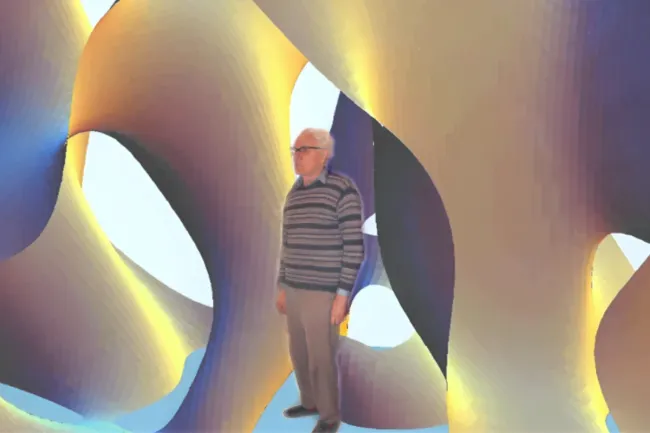
The Bernal Lecture given by John L. Finney at Birkbeck College, 23 September 2025
The quote in the figure below was a favourite of Alan’s and encapsulates much of his view of science and philosophy (alongside it is a photograph of Alan). Indeed, it would be possible to produce a lecture consisting largely of appropriate quotes from Alan. This I will try not to do; though to set the scene, I will start with some text he wrote in a draft of some autobiographical notes that Robert Mackay, Alan’s eldest son, has made available to me:
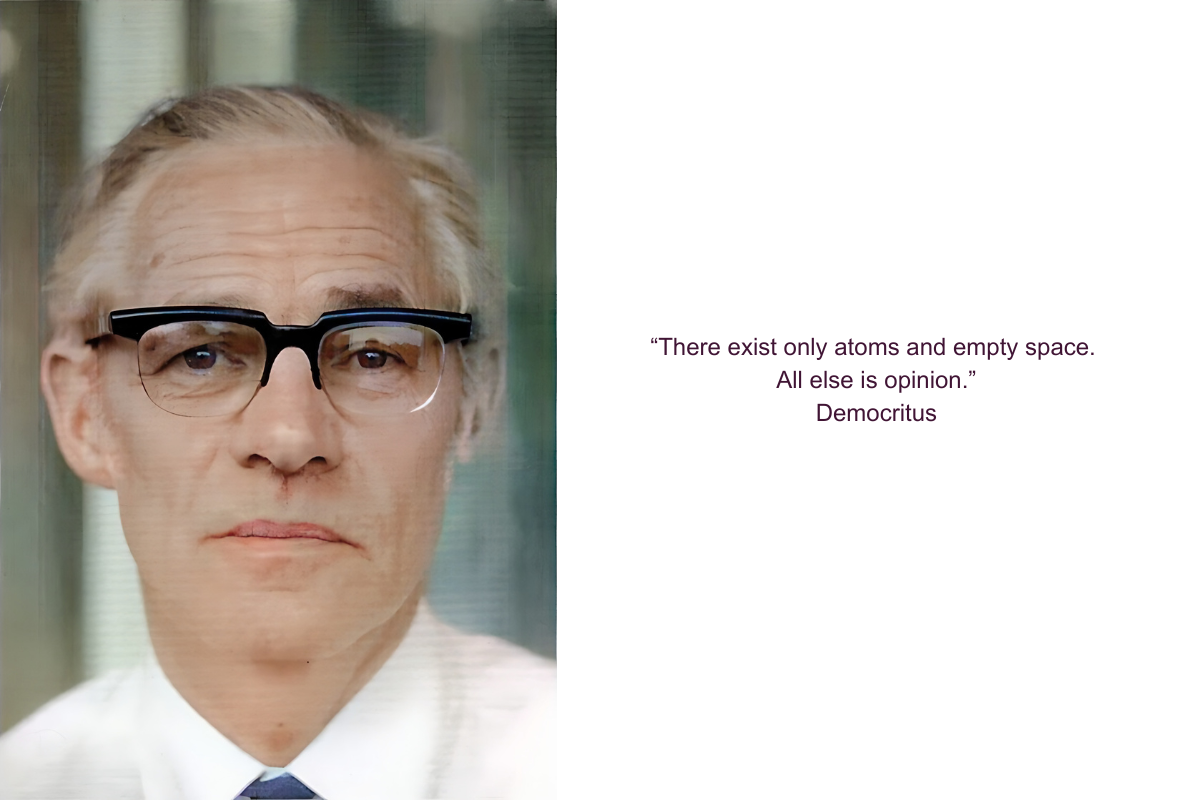
Image Credit: Istvan Hargittai.
“Expecting to be a research student in the [Cavendish] laboratory dealing with tribo-physics, I returned in 1947 from...student work on the Youth Railway in Bosnia in Yugoslavia…
I found that suddenly I had been switched to work in an industrial laboratory. No doubt the forces of state security had judged that I harboured dangerous thoughts, they were right and I still do.
These thoughts turned to crystallography, which might be regarded as a harmless science devoted to the shapes of crystals but, in fact, is one which continues to revolutionise our world.
Crystallographers have long had the habit of concerning themselves also with all kinds of other matters, political, economic, social, technical, ideological and have long formed a world-wide network.”
The Birkbeck Biomolecular Research laboratory in Torrington Square was opened on 1st July 1948 by Sir Lawrence Bragg (see image below)1. The research themes of the laboratory were carefully chosen by Bernal to carry out the revolution in molecular biology and materials science that X-ray diffraction promised.
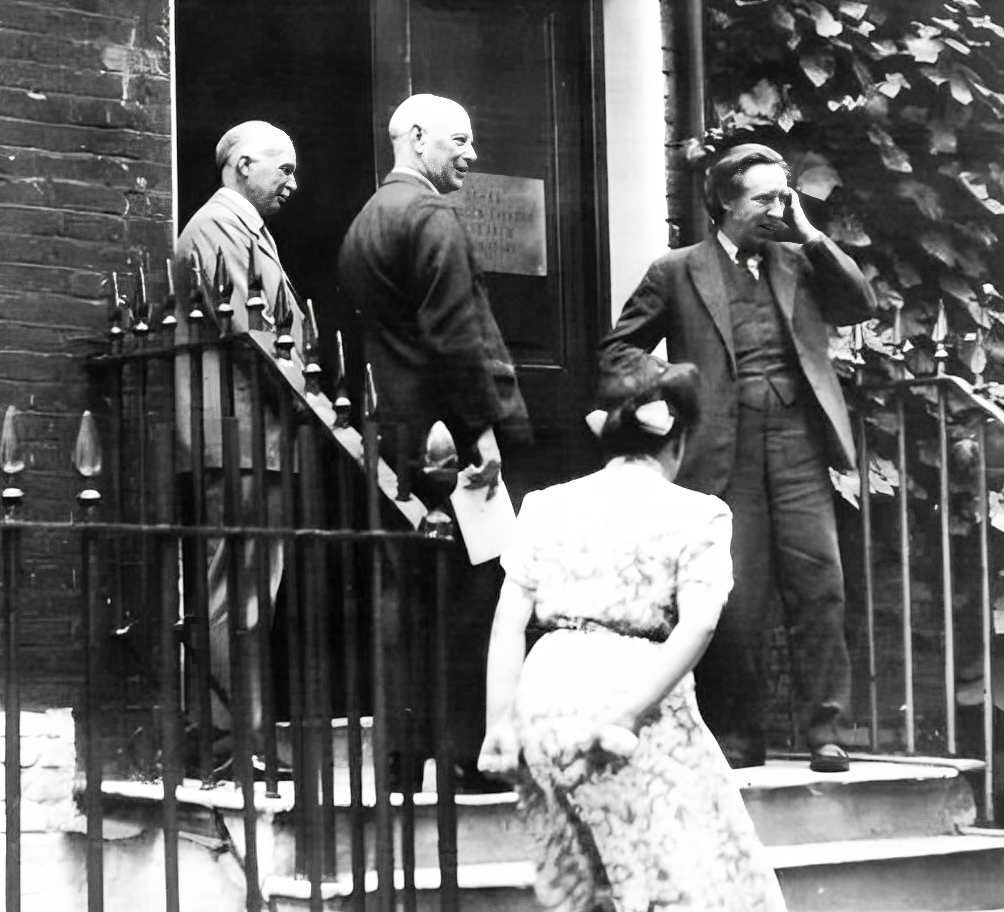
Image Credit: Rex Palmer.
Alan joined the laboratory in 1949 as a PhD student under Bernal, after taking a Birkbeck part-time first degree. He joined the materials team.
Alan’s crystallographic career
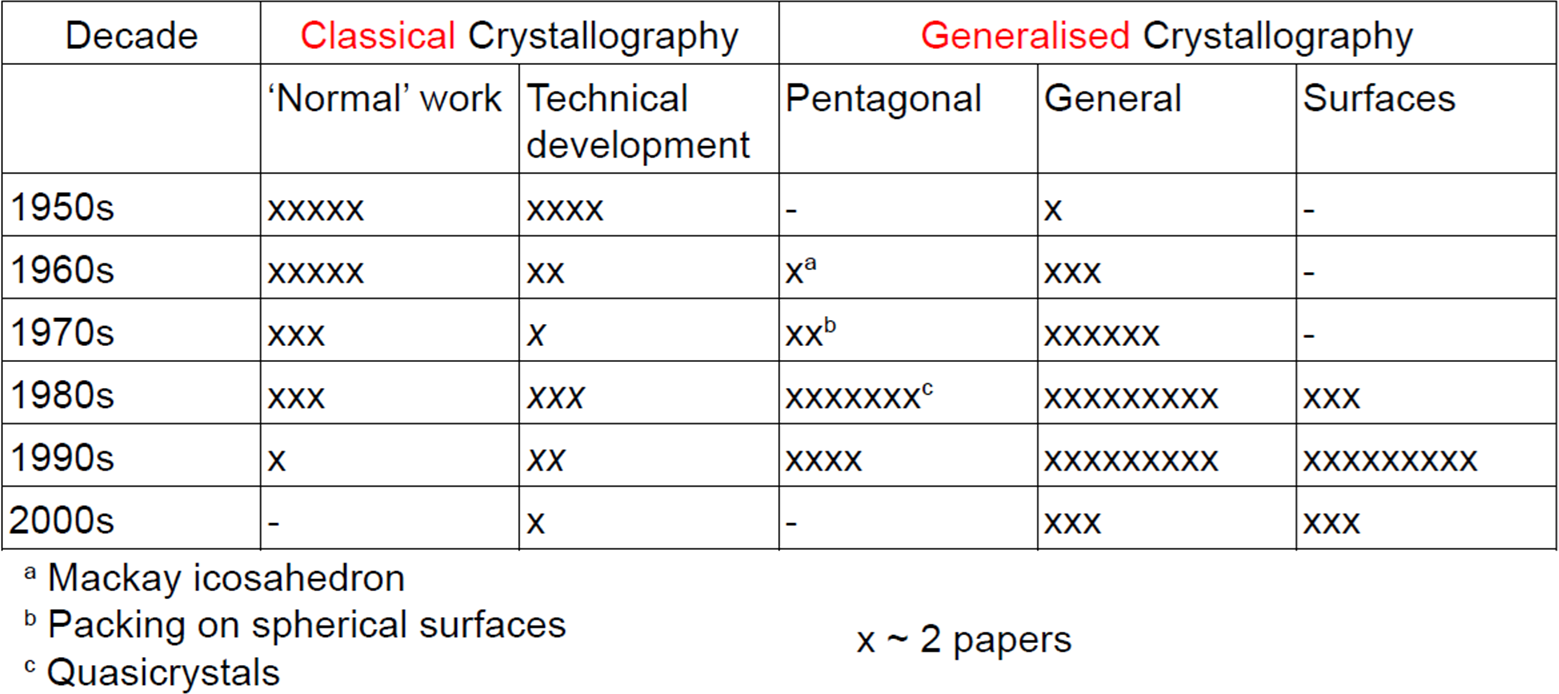
The table above attempts to classify Alan’s crystallographic work by decade, divided into five categories. It illustrates how his interests developed over time. For the first two decades or so, he focused on using – and developing – crystallographic techniques, while from the mid-1960s he moved his interests more in the direction of what Bernal and he termed ‘Generalised Crystallography’. His early work using classical crystallographic methods was slanted towards ‘real-world’ problems related to materials structure (this was, after all, in the immediate post-war period when the country was beginning to rebuild).
Examples include calcium phosphates (which were also the subject of his PhD thesis), a subject relevant to health and bones. Work on silicates had applications in cement, and that on the corrosion of iron-containing materials was highly relevant to rusting. Together with Bernal, he also explored structural transitions in the solid state, especially the phenomenon of topotaxy – those solid-state phase transitions in which the crystal orientations in the initial and final structures are correlated. A particularly detailed study was made of topotactic and non-topotactic structural transformations in the iron oxide/hydroxide system (Mackay, 1960b). He also made early use of electron microscopy and electron diffraction, and explored structures in solution – for example, in colloidal systems.
During this period, Alan made a number of instrumentation developments. These included a wire orientation camera (Mackay, 1953a), a retigraph (Mackay, 1960a) and a semi-micro manipulator for mounting crystals fitted to a microscope (Mackay, 1953b). He also took out a number of patents. As an interesting aside in the instrument context, when still at home in the 1940s, his father, who was setting himself up as a medical consultant, bought an early Siemens electrocardiograph, which the young Alan learned to mend.
His achievements were not limited to experimental work. He made early theoretical advances in X-ray data analysis and symmetry theory (for example, antisymmetry and colour groups – and their possible relevance to e.g. antiferromagnetism), and extended symmetry theory to four dimensions. See, for example, Mackay (1951), Mackay (1957) and Mackay & Pawley (1963).
The crystallographic straitjacket
As Alan’s ideas developed, he became increasingly concerned that classical crystallography was working within an intellectual straitjacket. In his view, the International Tables for Crystallography were inadequate for a number of reasons, such as the following (quotes of Alan’s from various sources, with my italics):
“International Tables have been a factor in inhibiting the growth of crystallography, because they allow only one kind of description.
The real lattice...induces the attitude that the crystal structure consists of molecular motifs hung in a framework of symmetry elements.
In fact the opposite is the case and the space group arises from the local interactions of the components.
They [International Tables] are...unsuitable for dealing with biological structures, but even for crystals, they are inadequate.
They cannot deal with dislocations, defects, twinning, or (systems) of almost continuously variable composition.
In general...the structure of the molecule is primary and the crystallisation is simply a means to this end”.
Calling himself a “non-conformist crystallographer” (Mackay, 1995a), he argued (Mackay, 2002) that “The emphasis on infinite periodicity...has somewhat distorted the development of crystallography”. Rather, he said, we should ask “Out to what range are identical points required to have identical surroundings to generate crystallinity?”. In arguing so, he was echoing the thoughts of Boris Nikolaevich Delone in his 1934 book on the Mathematical foundations of the structure analysis of crystals, whom he met in 1962. Alan asserted that “This approach is more suitable for a unified theory of crystals – hierarchic and amorphous, or statistically disordered crystals”.
Developing ideas along these lines, he wrote a key paper in 1962 that described a dense non-crystallographic packing of equal spheres (Mackay, 1962). Starting with an icosahedron of 12 spheres about a central sphere, he surrounded it with a second icosahedral shell that was twice the size of the first. This shell contained 42 spheres and lay over the first shell so that the spheres were in contact along a five-fold axis. Further layers can be added in the same fashion, the figure below showing a third layer, where on each triangular face the layers of spheres succeed each other in a cubic close-packing sequence.
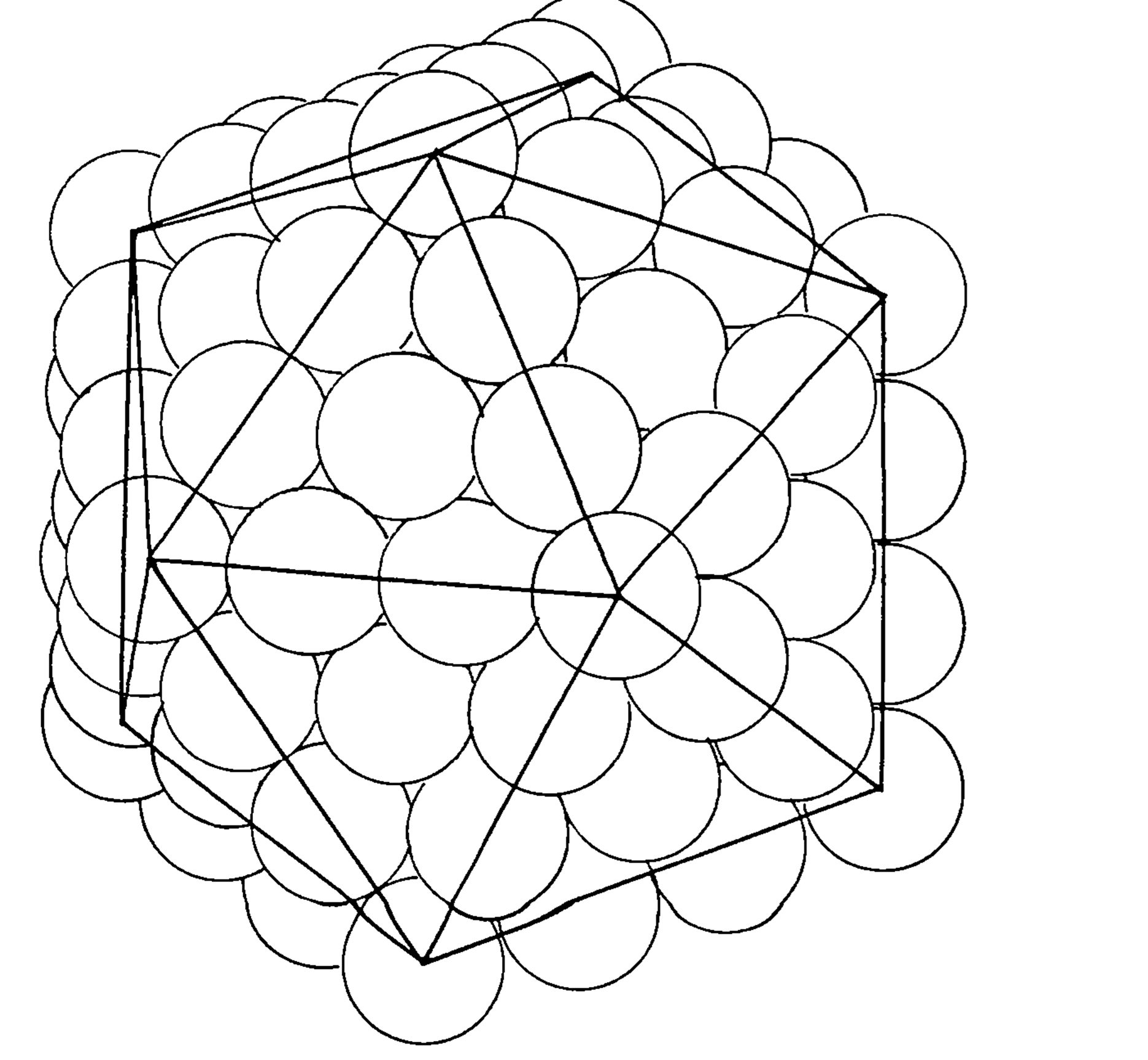
Image reproduced by permission from Mackay (1962).
This basic packed structure with inherent five-fold symmetry has been labelled by others as the Mackay Icosahedron. According to Kuo (2002), it has made a “tremendous impact on particle, cluster, intermetallics and quasicrystal researches” and that “with the advent of nanoscience and nanotechnology, the importance of this paper will become even more profound”. The concept has been extended to related local structures, variously labelled ‘Anti-Mackay’, ‘Double Mackay’, and ‘Pseudo-Mackay’, all of which have representative structures in real systems. Particularly colourful examples in a range of intermetallic crystal structures can be found in Akhmetshina & Blatov (2017).
Five-fold symmetry was, however, a symmetry that the pre-Mackay and pre-quasicrystal International Tables decried – after all, you can’t tessellate periodically either a plane or a volume with a figure with five-fold symmetry. However, Alan and others asked a slightly different – but still crystallographically relevant – question: if we cannot tile a surface periodically with a pentagon, can we tile it non-periodically? This had been, in fact, a long-standing problem, which was ‘solved’ by Robert Berger in his Harvard PhD thesis in 1964, who required 104 ‘dominoes’ to do so. Raphael Robinson reduced this to 24 in 1975 (see Gardner, 1977). Alan Mackay reduced it to 2. He published this in a lecture presented at the 10th Conference of the Yugoslav Centre of Crystallography in June 1975, with a paper subsequently published in a Yugoslav journal (Mackay, 1975). However, it is unclear how long before then that he developed the ‘recipe’, though he was clearly working on it in 1974.
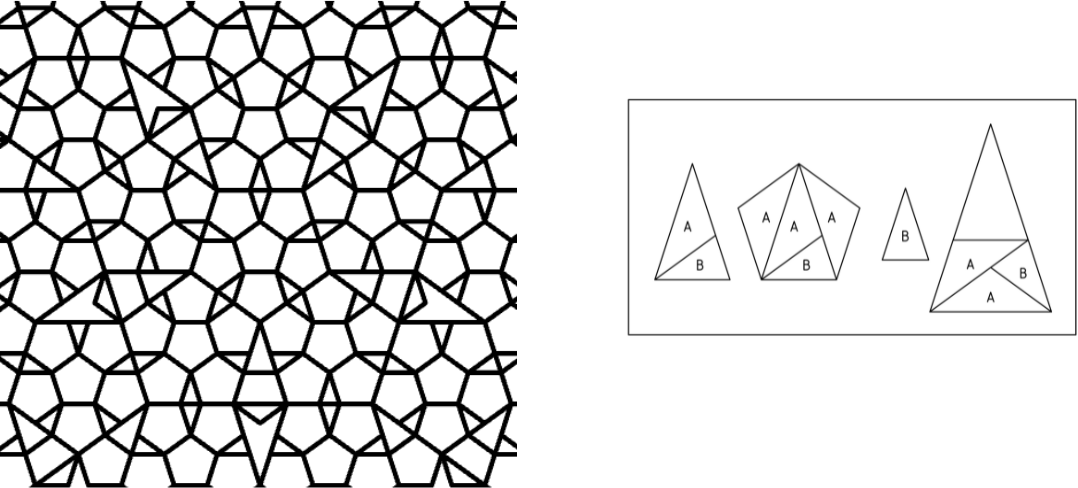
Image Credit: R. H. Mackay.
The left-hand figure above shows Mackay’s hierarchical packing of pentagons according to a recursive rule. The right-hand figure exemplifies the recursive rules for building pentagons and triangles from pieces of the two types of isosceles triangles A and B, and shows how the hierarchic pentagonal packing pattern can be decomposed into a packing of these two types of isosceles triangles. Hence, the two-dimensional plane can be filled using these two triangles, with the resulting pattern showing local centres with five-fold symmetry. Indeed, a major achievement!
Roger Penrose independently published his non-periodic plane-filling pattern of kites and darts the previous year (Penrose, 1974). However, the two solutions are in fact the same: as illustrated by the colouring in the figure below, Alan’s tiles are components of Penrose’s (dart red, kite blue).
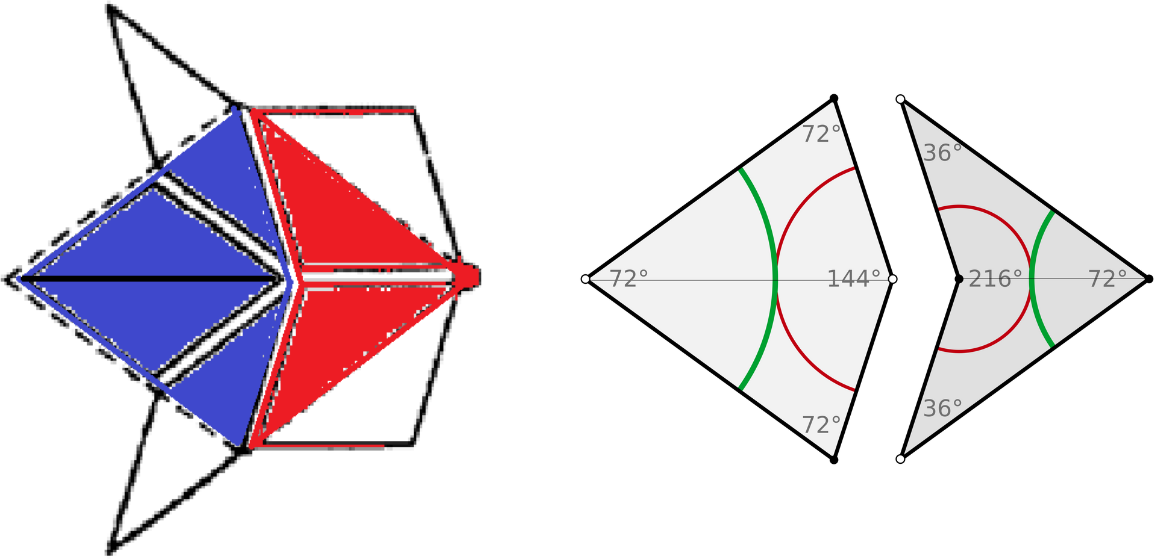
Image Credits. Left image: the author. Right image: by Geometry guy at English Wikipedia, CC BY-SA 3.0, https://commons.wikimedia.org/w/index.php?curid=30611873.
One wonders whether, had Alan published in a mainstream journal a little earlier, when he had solved the problem, he might have been credited with the first solution. He was, however, clearly the first in publishing a diffraction pattern of a two-dimensional non-periodic tiling (Mackay, 1982). ‘Non-crystallographic’ (ten-fold) symmetry is clearly visible in that pattern, and in the related carving shown below, which was kindly presented to the author by Alan’s eldest son, Robert Mackay2.
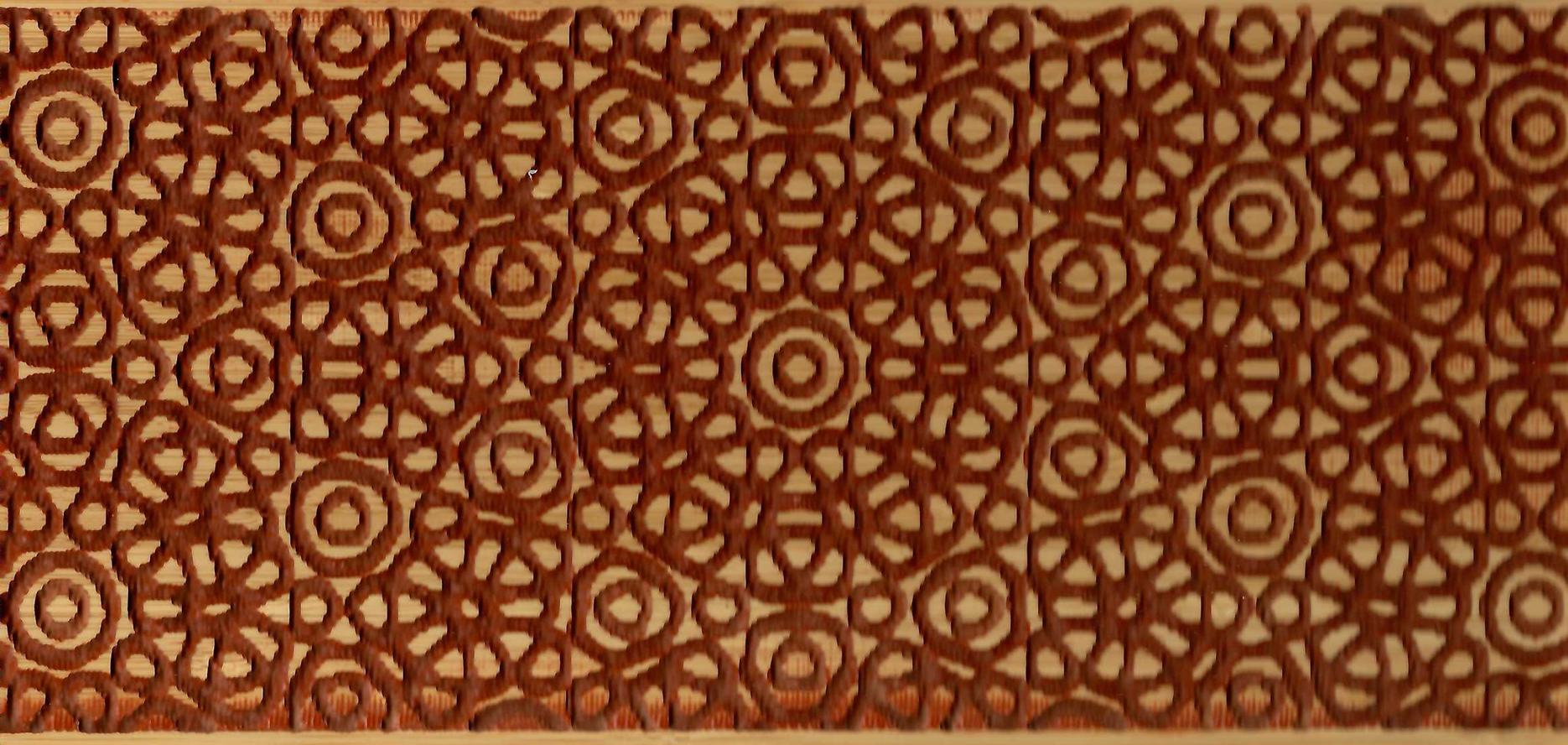
This is all very well for two dimensions, but can it also be done in three dimensions, and hence be potentially relevant to real materials? Alan demonstrated that it could indeed be done in a paper in Soviet Physics Crystallography celebrating the 60th birthday of Boris Vainshtein, which was published in 1981 (Mackay, 1981).
Typically, Alan chose the title of that ground-breaking paper, ‘De Nive Quinquagula’, to echo that of Johannes Kepler’s ‘De Nive Sexangula’ (Kepler, 1611), in which Kepler attributed the hexagonal symmetry of the snowflake to the close packing of spherical atoms. After an extensive discussion of the hierarchic packing of pentagons (‘the pentagonal snowflake’ – see Robert Mackay’s computer drawing – Figure 5 in that paper), towards the bottom of the penultimate page of the paper, Alan makes the following almost throw-away assertion: “The same type of construction can be made in three dimensions”. And he identifies the two basic quasi-unit-cells as acute and obtuse rhombohedra with identical faces and interaxial angles of 63.43º (arctan 2) and its supplement. He described the periodicity of the three-dimensional structure as being due to a ‘quasi-lattice’.
One might consider this to be fine theoretically, but could such structures actually be made? In this context, Alan’s 1981 paper concluded with the statement: “...the significance of the pattern for crystallography is that...it gives an example of a pattern of the type which might well be encountered but which might go unrecognised if unexpected”.
Indeed, one was encountered a year later in the preparation of an aluminium/manganese alloy – though its icosahedral character was not fully recognised for a further couple of years. That recognition brings us to the discovery of quasicrystals, for which Dan Shechtman was awarded the 2011 Chemistry Nobel Prize.
Why Alan was not included in the Nobel award has led to much discussion. It might be appropriate to compare the situation with that of the Higgs boson. Peter Higgs predicted its existence in 1964. It was discovered experimentally at CERN in 2012, with Higgs and Englert awarded the Physics Nobel the following year.
In the quasicrystal case, Alan Mackay predicted in 1981 the possible existence of a three-dimensional non-periodic ‘tiling’ with local five-fold symmetry, and introduced the term ‘quasi’ when he referred to a ‘quasi-lattice’. In 1982, an Al-Mn alloy, which showed a diffraction pattern with apparent five-fold symmetry, was made by Shechtman when visiting John Cahn’s NBS laboratory. Its diffraction pattern was published in 1984 (Shechtman et al., 1984). Shechtman alone was awarded the Chemistry Nobel Prize in 2011. Why should the Physics and Chemistry Nobel Committees have behaved differently with respect to prediction?
Alan, together with Steinhardt and Levine (who claimed the term ‘quasicrystal’ – though, as stated above, Alan had proposed the term in his 1981 paper), were awarded the Oliver Buckley prize in 2010 – a consolation prize perhaps? Roger Penrose also commented positively to Alan that he hoped that “there could be some consolation in seeing your clear predictions having become accepted as mainstream crystallography”.
Alan did, however, receive very significant recognition by his election to The Royal Society in 1988. It is appropriate to quote from his Royal Society citation:
- His contributions to non-Euclidean crystallography have furthered our understanding of quasicrystalline and icosahedral phases.
- He predicted the occurrence of five-fold symmetry and computed the details of the diffraction patterns to be expected from such structures several years before they were observed experimentally.
- He is a leading authority on the geometry and symmetry of crystals and has made pioneering contributions to periodic minimal surfaces, packing in curved manifolds, and incommensurate structures.
- He has elaborated the importance of the Penrose pattern for crystallography and demonstrated its Fourier transform optically.
- He has also made noteworthy use of quaternions in crystallographic calculations.
And also to quote a comment of Alan’s on his election: “This relieved pressures in the face of demands to assess academic productivity, but brought no material difference”.
Generalised Crystallography
Non-periodic structures such as quasi-crystals are only one example of what can be termed ‘Generalised Crystallography’. This concept was put forward originally by J. D. Bernal, and it was one area of structural science that Alan expanded his vision to explore. The following statements of Alan from various sources explain his view of Generalised Crystallography, and how it relates to the properties of matter:
“Crystallography is only incidentally concerned with crystals…”
“...[it] is rapidly becoming the science of structure at a particular level of organisation, being concerned with structures bigger than those represented by simple atoms…”
“The aim of generalised crystallography is to understand the properties of matter, inert and living, at our human scale, in terms of the arrangement and operation of atoms at a level which, until X-ray crystal analysis, remained unobservable”
"The science of structure...deals with form and function...particularly with the way in which large-scale form is the expression of local force."
The diagram below illustrates how Alan saw connections between apparently disparate areas of science – his concept-association network of topics connected to the generalisation of crystallography.
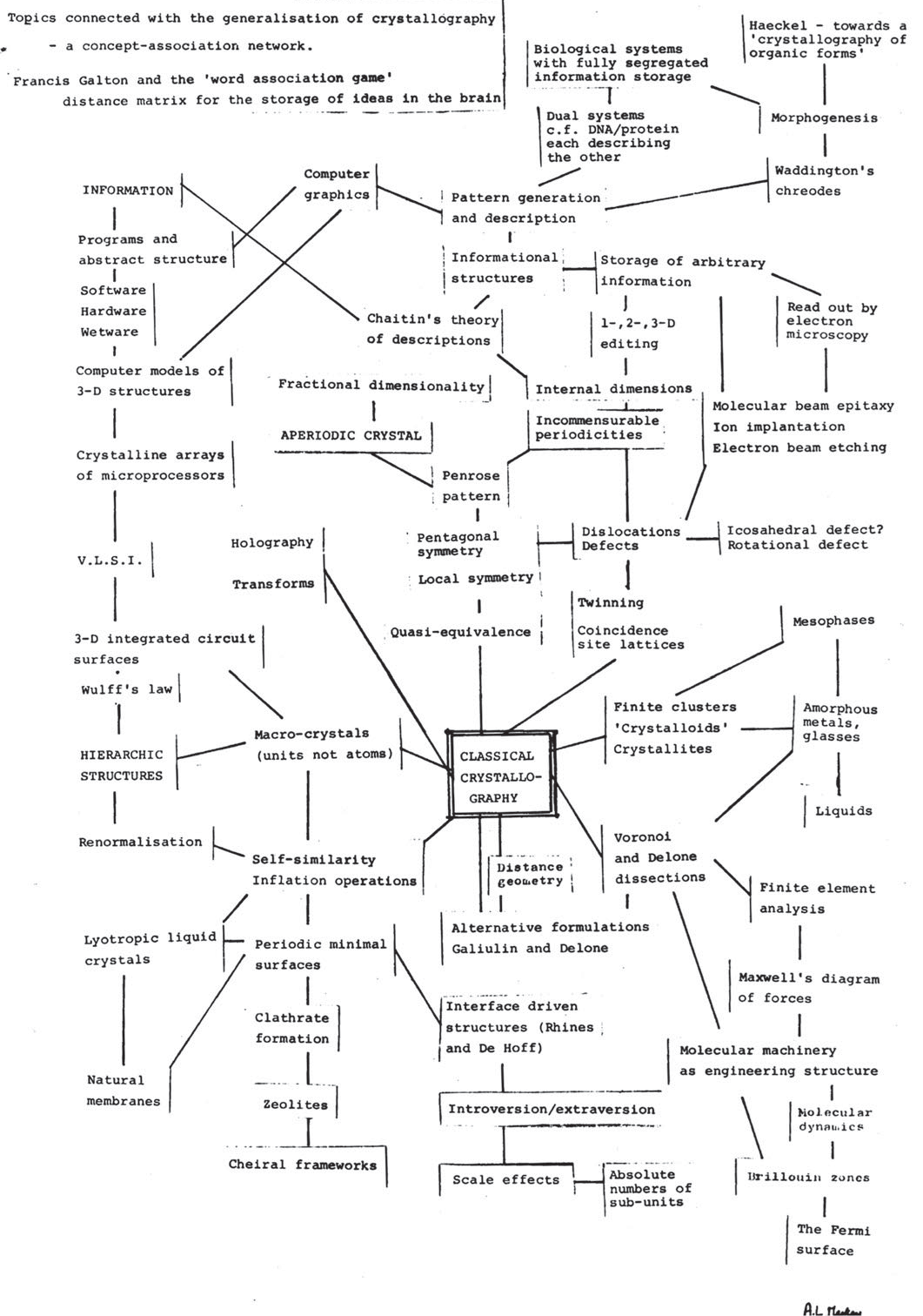
Image reproduced by permission of The Royal Society from Cartwright & Mackay (2012).
A key concept in generalised crystallography is that of hierarchy: in any large structure, we can distinguish smaller substructures in which the internal relations are stronger than the external relations binding the substructures together. An example given by Alan (Mackay, 1969) was atoms → amino acids → α-helix → fibril → muscle, while Bernal (Bernal & Carlisle, 1969) might suggest molecules → polymers → polymers of polymers. In general, structures exhibit new properties as they grow. The properties of interest are often at the level of the aggregate (e.g. fibres, membranes), and we want to understand how new properties emerge from the combination of simpler units.
Alan made a number of significant contributions to developing generalised crystallography. In addition to being an ambassador for Bernal’s ideas, he developed them further. Moreover, he argued for and developed alternative structural descriptors, with an emphasis on relating these to properties of the materials. Examples (Mackay, 1972, 1974; Mackay & Finney, 1973) include connectivity and adjacency matrices, Voronoi polyhedra, the average volume per atom, programs that generate a structure, and the relationship between structure and information. He also recognised that some descriptors – for example, of liquids – must be statistical.
Especially in his latter years, he began to explore non-planar two-dimensional surfaces. It is to this ‘flexicrystallography’ that we now turn.
Flexicrystallography
Here, atoms and molecules are seen to be embedded in flexible curved sheets rather than in the flat layers of classical crystallography. Alan argued (Mackay, 1993b) that looking at structures in this way (as periodic minimal surfaces) can help with the visualisation of structure at a level above that of single atoms. Examples he explored include biological structures such as lyotropic colloids, zeolites and curved graphite sheets (and this was before graphene and carbon nanotubes). He also asserted wider applications in structural engineering.
The figure below illustrates two particularly simple examples in structural science. On the left shows the zero equipotential surface in a caesium chloride unit cell while on the right shows the surface that separates the two non-connecting hydrogen-bonded water networks in ice VII.
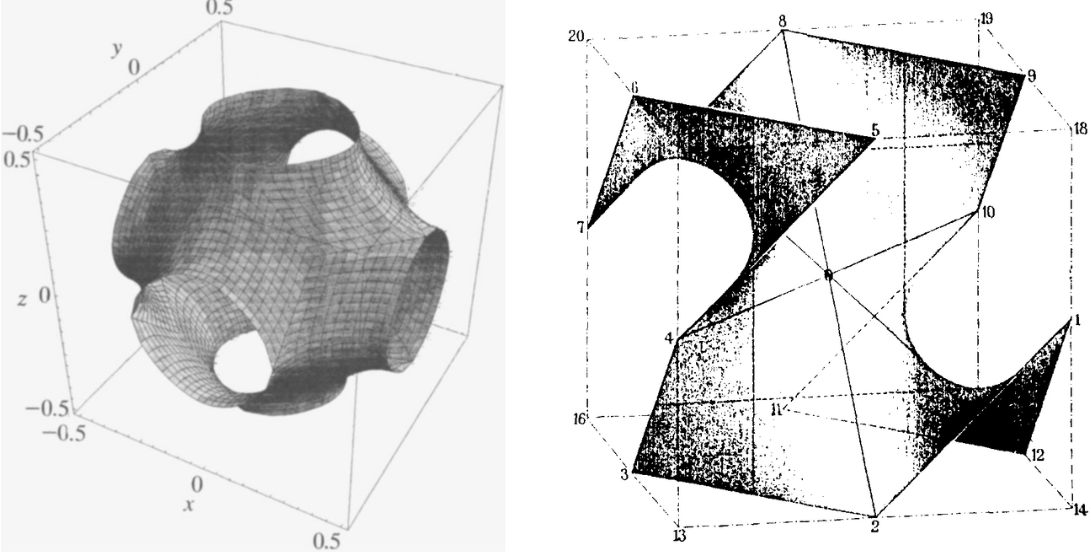
Image Credits. Left: reproduced by permission of The Royal Society from Mackay et al. (1993). Right: Schwartz (1890) original drawing of the F-surface.
The figure below is a small sample of the surfaces he generated. The image on the right is the cover of a Royal Society Philosophical Transactions Theme issue (Cartwright & Mackay, 2012) on the dialectics of structure and information jointly edited with Julyan Cartwright. A large number of further surfaces – many of them realised as sculptures – can be found at http://shotakahashi.com/.
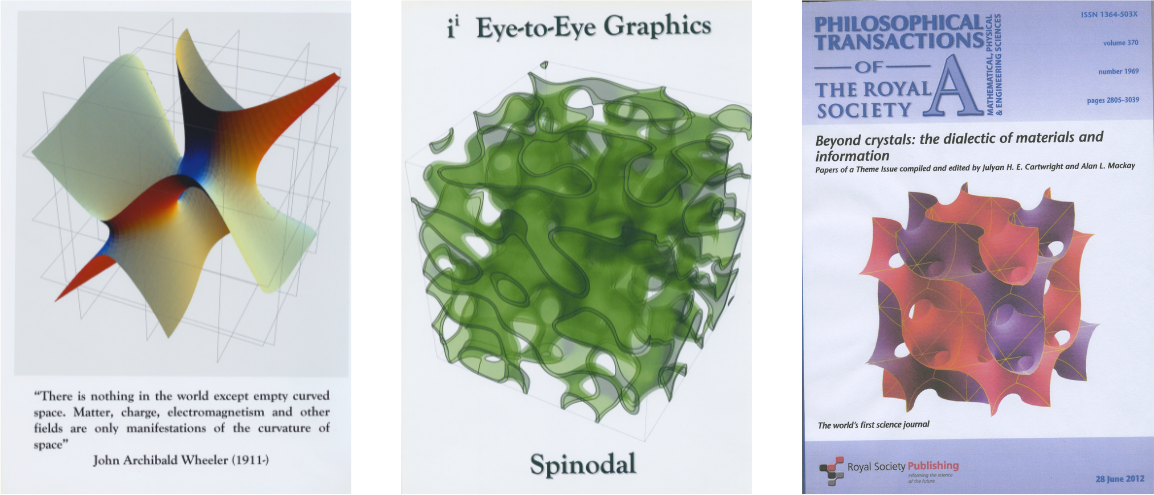
Image Credits: R. H. Mackay.
‘The well-known eclectic’
Alan’s interests were much broader than just science. He was once introduced by a colleague as ‘the well-known eclectic’, and so he “accepted the attribution” in choosing a title for the book he produced to “make available to my friends and relations, for the record, some of the unpublished papers, and the obscurely published papers, which clutter my shelves”. Having read through the nearly 400 pages of this fascinating collection (shown in the figure below), there are many gems that illustrate the breadth of his non-scientific as well as his strictly scientific ideas and interests.
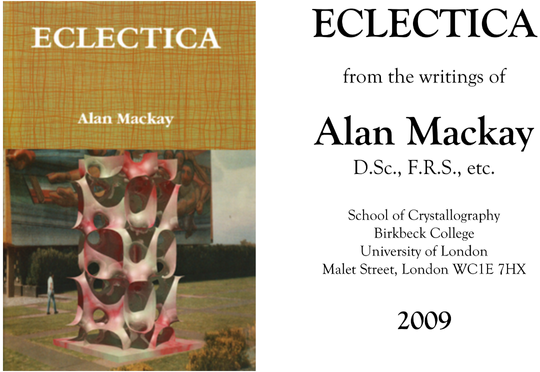
Image Credit: R. H. Mackay.
A taste of his breadth of interests is given by this list of titles of some of his non-crystallographic papers:
- On the type-fount of the Phaistos Disc
- Symmetric Celtic sycophancy
- How many characters did Lao Tzu know?
- Character-building
- Printing foreign text
- Optimisation of the Genetic Code
- How to organise a typist pool
- A metaphor for molecular evolution
- Dürer's technique
- The crystal abacus
- Copernican revolution declared
- Some are less equal
- From the 'dialectics of nature' to the inorganic gene
- The crystal ant heap
- Crystal souls
- Russian miniature cameras
- Mandala thinking
- Creativity and the physical basis of ideas
- The Shroud of Turin
- Science as entertainment
- Lucretius: atoms and opinions'
As an example, let’s consider briefly the first two papers (Mackay, 1965, 1994), which focused on the two historical objects shown below. On the left is the Phaistos Disc, a clay disc with text in an unknown language and script, discovered in 1908 in a Minoan palace on Crete. Comparing with symbol frequencies in Japanese Hiragana and English, Alan argued that the type fount of the disc consisted of 55 symbols (plus the dash), and also that the type was made by “the inscription of a set of symbols on clay with a stylus, followed by the drying and hardening of the clay by baking, and the casting of the pieces of type in bronze or clay from these matrices”. On the right is a detail of the Pictish stone number 26 in the Sculptured Stone Museum in Meigle, Scotland3, about which Alan commented, not only on the characteristic Pictish talent for symmetrical design but also on its “sharp social comment”! He also commented on its relationship to the Condorcet paradox of voting (see, for example, Niemi & Riker, 1976).
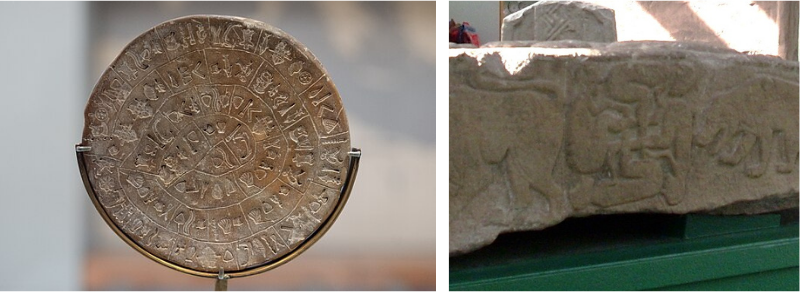
Image Credits. Left: Wikipedia Public Domain. Right: licensed under the Creative Commons Attribution-Share Alike 3.0 Unported license (Simon Burchall).
The breadth of his non-crystallographic interest and expertise is also illustrated by the list below of some of the non-crystallographic journals in which his papers have been published:
- Orientalia
- Statistical Methods in Linguistics
- Benchmark papers in Systematic and Evolutionary Biology
- Perception and Psychophysics
- Computers and Mathematics with Applications
- Practical Computing
- Amateur Photographer
- Chaos, Solitons, Fractals
- Imago Mundi
- Architectural Design
- Hyperspace (Tokyo)
- Annals of Botany
- Speculations in Science and Technology
- Interdisciplinary Science Reviews
- Journal of Mathematical Chemistry
- Hong Chi Chu Ban She (Beijing)
- Journal of the Royal Central Asian Society
- Organon (analytical philosophy)
- Science and Public Policy
- Science Policy News
- International Journal of Philosophy
- Philosophy and Social Action
- Social Studies in Science
- Euroscience News
- Science Progress
And he was a specialist in science in Asia, as illustrated by the titles of some of his papers relating to Russia and Asia:
- Kim Su-Hong and the Korean cartographic tradition
- Recent Soviet work in the field of crystallography
- Sources of Russian scientific information
- An outsider's view of science in Japan
- A background to science in Japan
- Scientific progress in Soviet Azerbaijan
- Science in Asia
- The state of science in the USSR
- The history of science in India
- Korea in the year 2000
- Japanese seven-place sine and tangent tables of 1856
- Science and technology in India
- Korean science opens its doors
- The rehabilitation of N[ikolai] I[vanovich] Bukharin
- Form and pattern in Azerbaijani civilisation
Alan, Science, and Society
Alan was deeply concerned about the relationship between Science and Society. His related work can perhaps be classified under five headings:
- What is Science?
- How does Science work? This is the subject of the Science of Science.
- The Science of Society – the application of Science to understand Society.
- Science in Society – the application of Science to guide the operation of Society.
- The Scientist in Society
Titles of some examples of his ‘Science and Society’ papers include:
- The scientist and the state
- Science policy and national salvation
- The laser effect in social physics
- The molecular basis of morality
- Intelligence as an applied science
- The nature of planning and the structure of thought
- The science critic
- Utopianism, scientific and socialist
- Bread and salt: science and politics
His deep concern with science and politics is evident in many of these papers. He had a science-based recipe for a successful future, identified in his view the forces that stood in the way of achieving it, and suggested how these might be countered.
How did Alan work?
It is unrealistic to delve here into the details of Alan’s views on Science and Society, but, considering the breadth of his published work, it’s perhaps instructive to look briefly at (a) how he himself worked and (b) ask what the characteristics of the Birkbeck laboratory were that made his work possible.
As to how Alan worked, he chose problems that interested him, irrespective of the need to get funds. He worked either alone or with people he resonated with; there was never a ‘Mackay Group’. In addition to UK colleagues, he found collaborators worldwide, helped by the fact that he spoke, read and wrote in many languages – German, Spanish, Russian (including translating papers), Serbo-Croat, Japanese, French and Chinese. He had papers published in even more languages – add Polish, Georgian, Romanian, Mexican and Hungarian to the above list.
He travelled widely – though he was strongly non-religious, he took to heart Daniel 12 verse 4: “Many shall run to and fro and knowledge shall be increased”. Significant periods of time were spent as a visiting researcher: Visiting Professor or Honorary Professor in Russia, China, Japan, South Korea, India, Hungary and Poland. He was made a Foreign Member of the Korean Academy of Science and Technology, an Honorary Member of the Materials Research Society of India and a Corresponding Member of the Mexican Academy of Sciences. Many of his scientific collaborations grew into long-lasting personal friendships.
Travelling worked both ways. Alan and his wife, Sheila, welcomed visitors to their home with open arms. Two pages of their visitors' book are shown below. In addition to picking out the signatures of the eminent Russian crystallographers Boris Vainshtein and Nikolai Belov, it’s worth noting the range of countries from which their visitors came. The comments of the visitors are often revealing – two Spanish visitors wrote: “This is the only place we know that joins science to goodness and friendship”. And noting that there were 114 pages in the book with around nine/ten entries per page – you can do the multiplication yourself to get an idea of the size of the Mackays’ Christmas card operation.
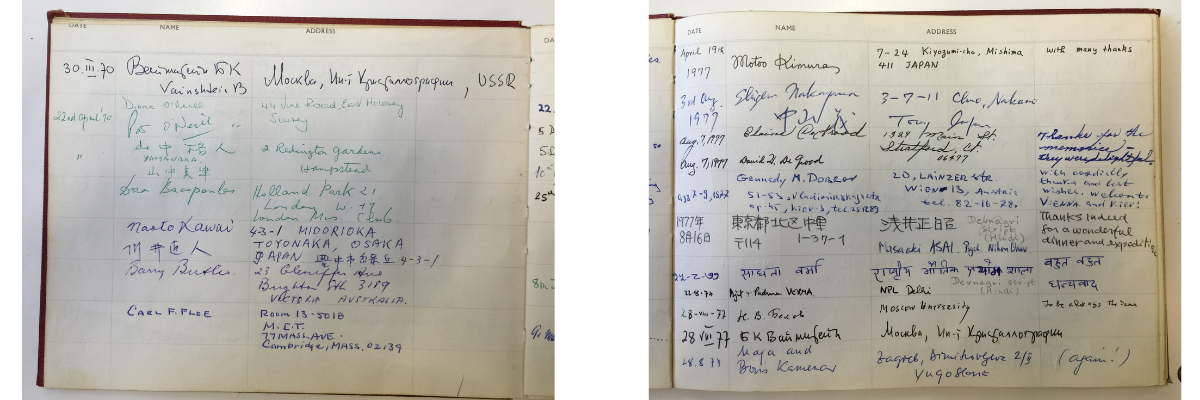
Image Credits: R. H. Mackay.
With respect to Alan’s working environment (shown in the figure below), how could this all be done in a department of crystallography? Was there something special about the laboratory? Alan’s view (Mackay, 1995b) was that the following characteristics were important:
- Organisation
- Commensality
- Dialogue with colleagues
- Wide range of research
- Everyone is interested in everything
- Social & political consciousness
- Science with relations to technology
- Uncompetitive (good for women)
- Visiting researchers
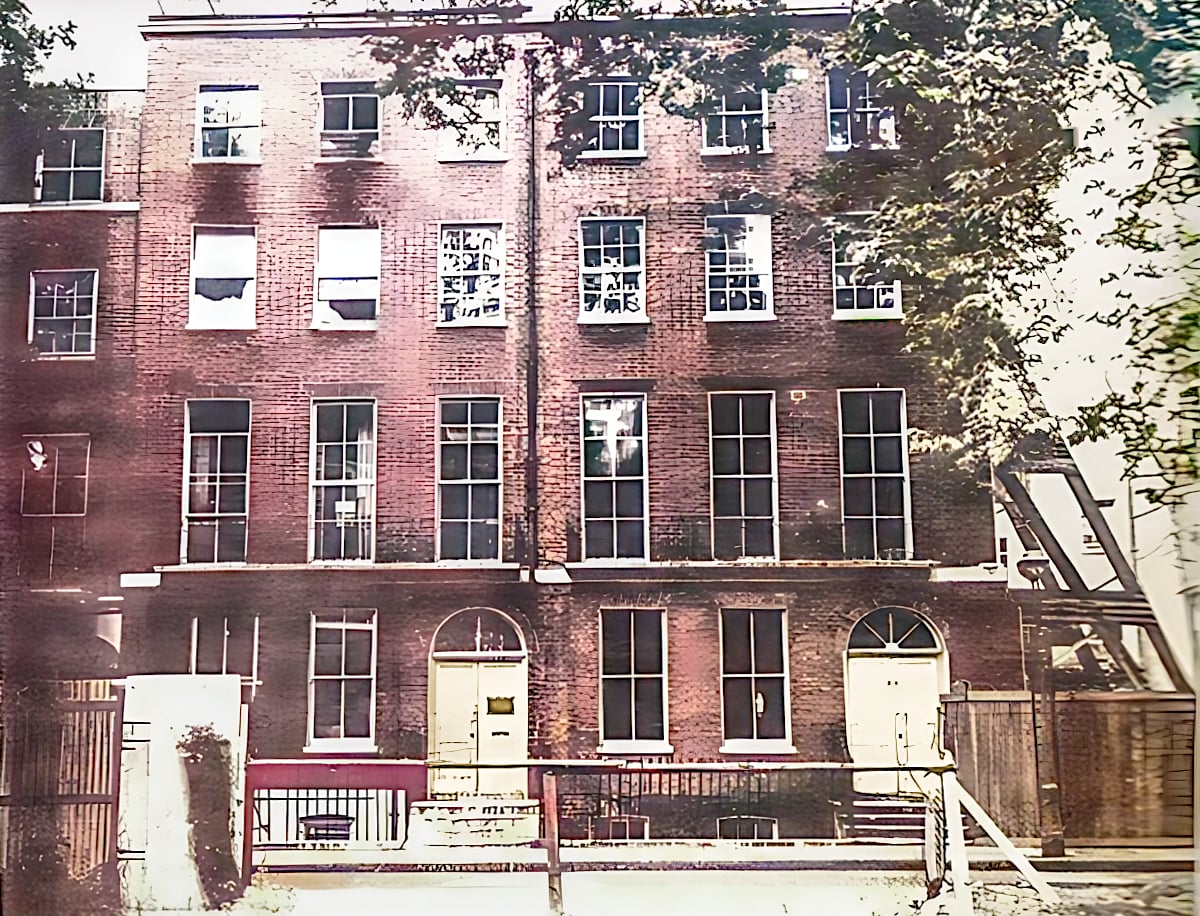
Image Credit: author’s personal collection.
With respect to organisation, Bernal was once asked if he ran his laboratory on communist lines. He replied no; he had advanced only as far as the stage of feudalism: “you plough the lord’s land for 50% of the time and for the other half you cultivate your own patch” (Mackay, 1995b). This suited Alan well. On commensality, Alan was convinced that “Eating together is one of the basic social institutions of science….If eating is mixed with talking, then nobody can talk all the time” (Mackay, 1996). Among a number of dining tables he was fond of quoting was the meeting between Ewald, Sommerfeld and Laue in the Café Lutz in Munich in 1912, where Laue proposed an experiment based on Ewald’s thesis to see whether crystals diffracted X-rays. “No doubt they pencilled diagrams on the marble-topped table – every café for scientists needs something to write on”. So was born X-ray crystallography.
Dialogue with colleagues shouldn’t only be with one’s scientific associates – Alan could be seen talking in the Senior Common Room with, for example, the historian Eric Hobsbawm, the sociologist Bernard Crick and the 19th century literature expert Barbara Hardy. Being in central London and close to the British Museum, the department was ideally placed to welcome visiting researchers, the list of whom is very long, including, for example, Linus Pauling and Buckminster Fuller. And as to the social and political consciousness in the department (Mackay, 1995b): “In Bernal’s heyday, people in the department did not hesitate to concern themselves with sociology, economics, politics, architecture, and many other topics.” “Paul Robeson sang in the computer room, and Picasso scribbled a large drawing on the wall.”4
We might perhaps ask if such a research laboratory could exist today.
Though science and politics continue, Alan commented that they were now “done in different ways. ‘Money’ is added to the dimensions of mass, length and time which form the framework of science.” However, he asserted (Mackay, 1995b) that “...small money guerrilla research can also continue in new forms in the interstices of ‘big science’, using the facilities of electronic mail, personal computing, data banks, etc.”. A comment that perhaps summarises the way in which he adapted to the changes that he saw during his scientific lifetime.
Though things may have moved on, they may remain in the memory. As Alan said (Mackay, 1995b): “The old lab. has long ago been demolished, but I could still find my way round it in the dark”.
Some concluding remarks
Alan Mackay’s influence on science is difficult to sum up in a few words. But we have now moved away from insisting on materials of interest being good ‘regular’ crystals. With the advances in electron microscopy, X-ray free electron lasers and atomic force microscopy, our need to hang molecules of interest on a lattice is becoming less necessary. And Crystallography has indeed now become the Science of Structure that Alan argued it should.
Alan was a Citizen in the Republic of Science, with some of his advances not properly recognised. He was also a Citizen of the World, concerned that Science should be making it a better place. He was a personal friend who helped me in many ways: that we wrote only two papers together in retrospect seems like a missed opportunity for me. And he had a great – and often mischievous – sense of humour.
Is there one word to characterise Alan? Some would say ‘polymath’ as they have often done to characterise Bernal. Alan (Mackay, 2007) preferred to call Bernal ‘polytropic’ (Homer: “of many strategies, versatile, wandering, ingenious”).
I prefer polytropic for Alan.
The last words – and the last image – should be Alan’s (Mackay, 2002):
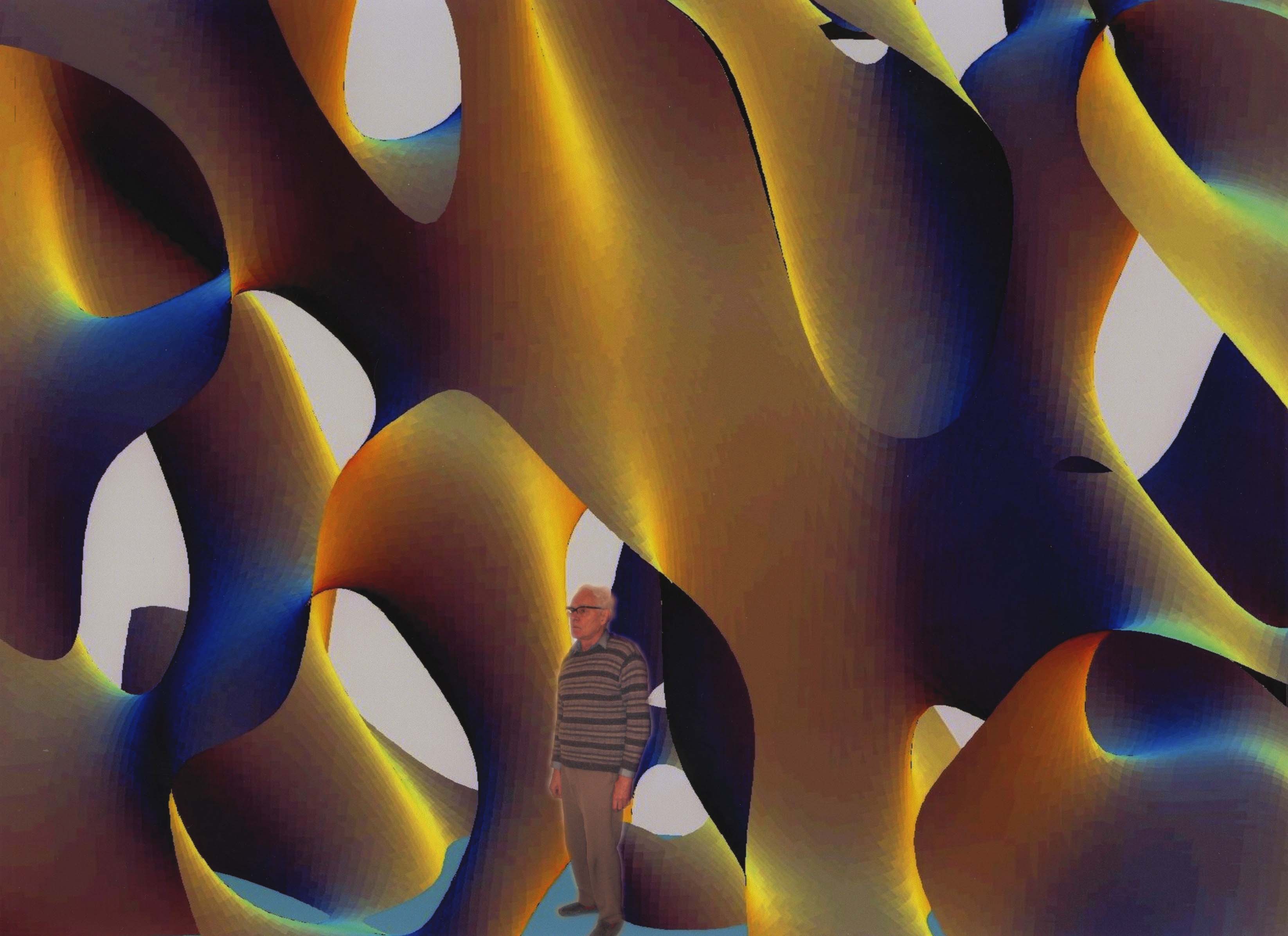
Image Credit: R. H. Mackay.
“...it is appropriate to acknowledge, as well as my immediate colleagues, especially those who have given me a congenial home at Birkbeck, the long-range influences of three of the great polymaths & encyclopedists who continue to affect us with their perceptions of science & civilisation. These are Titus Lucretius Carus, Denis Diderot, & John Desmond Bernal. Modern crystallography has taken place within the Republic of Science, the community of those who seek to acquire ‘reliable knowledge’ about the natural world by verifiable experimentation rather than by revelation & it has been a great privilege to have taken a small part in it.”
Acknowledgements
I am deeply indebted to the Mackay family, in particular to Robert H. Mackay, for giving me access to a great deal of material that is not publicly available. I also thank Birkbeck College and the Birkbeck/UCL Institute of Molecular Biology for the invitation to deliver the 2025 Bernal Lecture.
References
Akhmetshina, T. G. & Blatov, V. A. (2017). Struct. Chem. 28, 133–140.
Bernal, J. D. & Carlisle, C. H. (1969). Sov. Phys. Crystallogr. 13, 811–831.
Cartwright, J. H. E. & Mackay, A. L. (2012). Phil. Trans. R. Soc. A. 370, 2807–2822.
Gardner, M. (1977). Sci. Am. 236, 110–221.
Kepler, J. (1611). The six-cornered snowflake. Oxford University Press (1966).
Kuo, K. H. (2002). Struct. Chem. 13, 221–230.
Mackay, A. L. (1951). Acta Cryst. 4, 477–478.
Mackay, A. L. (1953a). J. Sci. Instrum. 30, 140.
Mackay, A. L. (1953b). J. Sci. Instrum. 30, 244–245.
Mackay, A. L. (1957). Acta Cryst. 10, 543–548.
Mackay, A. L. (1960a). Acta Cryst. 13, 240–245.
Mackay, A. L. (1962). Acta Cryst. 15, 916–918.
Mackay, A. L. & Pawley, G. S. (1963). Acta Cryst. 16, 11–19.
Mackay, A. L. (1965). Statistical Methods in Linguistics 4, 15-25.
Mackay, A. L. (1969). Chimia 23, 433–437.
Mackay, A. L. (1972). J. Microsc. 95, 217–227.
Mackay, A. L. & Finney, J. L. (1973). J. Appl. Cryst. 6, 284–289.
Mackay, A. L. (1974). Acta Cryst. A30, 440–447.
Mackay, A. L. (1975). Izvj. Jugosl. Centr. Krist. (Zagreb) 10, 15–36.
Mackay, A. L. (1981). Sov. Phys. Crystallogr. 26, 517–522. [Published in Russian: Mackay, A. L. (1981). Kristallografiya 26, 909–918.]
Mackay, A. L. (1982). Physica A 114, 609–613.
Mackay, A. L. (1993a). Nature 362, 489.
Mackay, A. L. (1993b). Proc. Roy. Soc. Lond. A 442, 47–59.
Mackay, A. L., Terrones, H. & Fowler, P. W. (1993). Phil. Trans. Roy. Soc. A 343, 113–127.
Mackay, A. L. (1994). Hyperspace (Tokyo) 3(2), 7-8.
Mackay, A. L. (1995b). The Chemical Intelligencer 1(1), 12–18.
Mackay, A. L. (1996). The Chemical Intelligencer 2(1), 52–53.
Mackay, A. L. (2002). Struct. Chem. 13, 215–220.
Mackay, A. L. (2007). J. Phys. Conf. Ser. 57, 1–16.
Niemi, R. G. & Riker, W. H. (1976). Sci. Am. 234, 21–27.
Penrose, R. (1974). Bull. Inst. Math. Appl. 10, 266–271.
Schwartz, H. A. (1890). Gesammelte mathematische abhandlung. Berlin: Springer.
Shechtman, D., Blech, I., Gratias, D. & Cahn, J. W. (1984). Phys. Rev. Lett. 53, 1951–1953.
1 Also shown in addition to Bernal (far right) are Gordon Cox and Anita Rimel (Bernal’s secretary).
2 I find it sad and depressing that the publisher of the paper in which Alan’s diffraction pattern was published was not prepared to allow its free use here in a paper dedicated to Alan’s memory. Alan himself had very strong views on ‘intellectual property’ – see, for example, Mackay (1987, 1993a).
3 https://www.historicenvironment.scot/visit-a-place/places/meigle-sculptured-stone-museum/
4 This is now housed in the Wellcome Collection, Euston Road, London.
29 October 2025
Copyright © - Prior permission is not required to reproduce short quotations, tables and figures from this article, provided the original authors and source are cited.